
Reviewed · CYCLING TOURS
The story of Vicenza: Guided Half-Day E-Bike sightseeing Tour
Vicenza’s great strength is that Palladio’s work is not locked away in one museum. It shapes the whole city. On this private e-bike tour, guide Manuel links palaces, churches, bridges, villas, and Renaissance personalities into one fast-moving story. You begin at Palazzo Valmarana Braga, ride out to Villa La Rotonda and Monte Berico, then return through the old center to Teatro Olimpico and the Basilica Palladiana.
I especially like the chance to reach places that are spread beyond the center without tiring yourself out, and I like the way the tour connects architecture with friendships, rivalries, religion, trade, and family fortunes. The bikes are easy enough for first-time e-bike riders, but you need to be at least 1.50 meters tall, and summer riders should bring water.
In This Review
- Key points at a glance
- Why an e-bike makes sense in Vicenza
- Starting at Palazzo Valmarana Braga
- Trissino, early Palladio, and the Roman past
- Villa La Rotonda, the tour’s great architectural pause
- Monte Berico gives you the best city view
- From Palazzo Chiericati to Teatro Olimpico
- Reformation, family drama, and the city’s green spaces
- Santa Corona and the heart of old Vicenza
- The palaces of ambition and risk
- Loggia Valmarana and the return to the starting point
- Is $159.63 a fair price?
- Who should book this ride?
- Should you book The Story of Vicenza?
- FAQ
- Where does the e-bike tour start?
- What time does the tour begin?
- How long does the tour last?
- Where does the tour end?
- Is the tour private?
- What language is offered?
- Is an e-bike included?
- Are attraction entrance fees included?
- How tall must children be to take part?
- Can the booking be canceled or changed?
Key points at a glance
- Palladio’s city in one ride: Follow the architect’s work from early palaces to his final masterpieces.
- Villa La Rotonda and Monte Berico: Get the tour’s most memorable views and its clearest sense of Palladian idealism.
- Guide Manuel’s storytelling: Expect a personal account of Palladio, his patrons, and the political and religious life around them.
- Mostly outdoor sightseeing: The tour gives you context and exterior views, but admission to individual sights is not included.
- A practical 2-hour-45-minute format: It suits a short stay or a first look before returning to explore key interiors.
- Private group experience: Your party rides together, with group discounts possible and English guiding available.
Why an e-bike makes sense in Vicenza
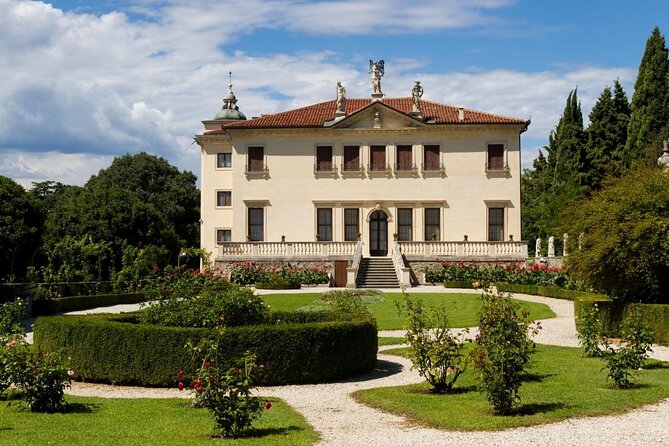
Vicenza’s historic center is compact enough to walk, but the full story reaches beyond it. Villa La Rotonda, Villa Valmarana ai Nani, and the Santuario della Madonna di Monte Berico sit outside the main cluster of Palladian palaces. An ordinary walking tour would need to skip them or spend much longer getting there.
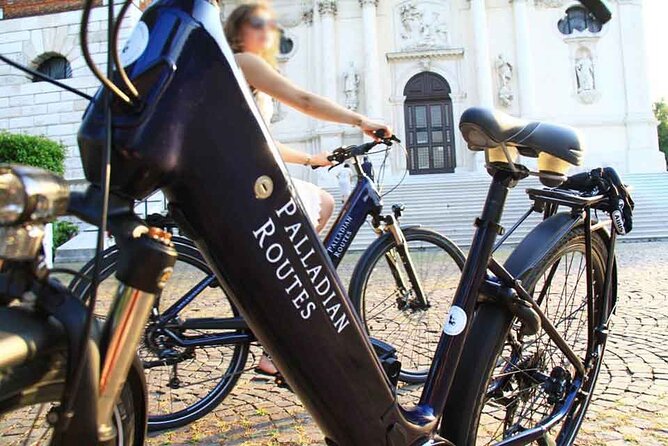
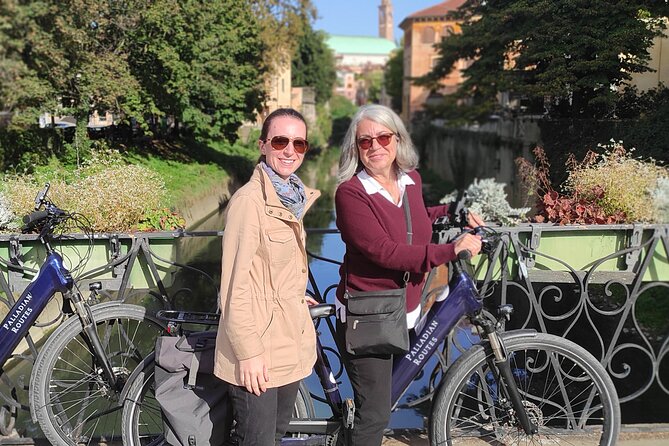
The e-bike solves that problem. You cover more ground while keeping the pace human. The supplied bicycle is described as a Palladian E-Bike, a fitting touch in a city shaped by one architect. Reviews of the experience point out that the bikes are modern and simple to operate, even for people who had never used an e-bike before.
You should still expect a moderate level of physical fitness. This is not a motorized sightseeing vehicle. You are riding for nearly three hours, getting on and off, and moving through city streets. The guide explains how the bike works before setting out, and the route has well-spaced stops, but this remains an active tour.
More bike days around Vicenza:
- Self Guided E-Bike Tour among the Palladian Villas of Vicenza
★ 5.0 · 44 reviews - Palladian E-Bike Rental in & around Vicenza
★ 5.0 · 16 reviews - Vicenza: discovering the city of Palladio by e-bike
★ 5.0 · 4 reviews
Starting at Palazzo Valmarana Braga
Meet at Palazzo Valmarana Braga on Corso Antonio Fogazzaro at 10:00 in the morning. This UNESCO-listed private palace is both a fitting beginning and the ending point. You collect your bike here, meet your Cicero Palladiano, and receive the opening chapter of Vicenza’s architectural story.
The first stop lasts about 15 minutes and includes admission to the starting point. After that, much of the tour works as an outdoor circuit. You are not being ushered through a long sequence of interiors. Instead, the guide places each building in its street, neighborhood, and historical setting.
That approach matters in Vicenza. Palladio was not an isolated genius producing pretty facades. His work depended on patrons, political connections, construction teams, and the city’s relationship with Venice. The tour begins with those connections.
Trissino, early Palladio, and the Roman past
On Corso Fogazzaro, you hear about Giangiorgio Trissino, Palladio’s mentor and an important 16th-century intellectual. His birthplace is tied to the opening chapter of Palladio’s career. Trissino recognized the talent of Andrea di Pietro della Gondola, introduced him to Vicenza’s leading families, and helped create the conditions for his new architectural identity.
The next short stop is Palazzo Civena, described as Palladio’s first private city palace and the first Renaissance palace in Vicenza. It gives you a chance to see how early his ideas began to take shape. The stop is brief, so you should think of it as a visual lesson rather than a full architectural study.
At Ponte Furo, the story widens. From the bridge, the guide explains how Palladio’s reputation grew and how his first clients became patrons and friends. You also learn about the Roman Theater, built in the first century BC and capable of holding 5,000 spectators. Its remains are not presented as a grand open ruin. They are tucked behind later buildings, which makes the stop a reminder that Vicenza has many historical layers under its modern streets.
Villa La Rotonda, the tour’s great architectural pause
The ride to Villa La Rotonda brings you to the most famous stop outside the city. The villa is a UNESCO World Heritage site and is often considered Palladio’s purest masterpiece. Its setting and symmetrical design reflect an ideal of balance, reason, and beauty.
The visit here lasts about 10 minutes, which is enough to understand why the building matters but not enough for a detailed interior examination. Admission to the attraction is not included, so this is primarily an exterior stop during the guided circuit. If La Rotonda is your main reason for coming to Vicenza, you should plan a separate visit that gives you more time.
Still, the short stop has real value. Palladio was given unusual freedom by his client, Paolo Almerico, and the result was more than a practical country house. The building was conceived as a place for serious conversation about philosophy, theology, politics, and classical culture. The guide’s job here is to help you see the idea behind the four-sided design, not just take a quick photo.
Nearby, Villa Valmarana ai Nani adds a later chapter. It belongs to the early 18th century and shows how Palladio’s influence continued after his death. The villa is also known for frescoes by Tiepolo, one of the leading painters of the period. Again, the tour stop is short and admission is separate, but the contrast is useful: Vicenza’s architectural story did not end with Palladio.
A few more Vicenza days to weigh up
- Verona e-bike tour: city center and panoramic views
★ 5.0 · 270 reviews - Small-group Amarone Wine e-Bike Tour from Verona
★ 5.0 · 144 reviews - From Verona: Amarone Wine E-Bike Tour with Tasting
★ 4.8 · 130 reviews - Verona: City E-Bike Tour with Lunch
★ 4.7 · 92 reviews
Monte Berico gives you the best city view
The Santuario della Madonna di Monte Berico provides the broad view that the palace streets cannot. From the terrace, you look across Vicenza toward the surrounding mountains and see how the Palladian center fits together from above.
This is one of the most useful stops for first-time visitors. After seeing individual buildings at street level, you can finally understand the city as a whole. The historic center appears as an organized pattern rather than a series of disconnected monuments.
The stop lasts about five minutes, so do not expect a long church visit. Its value is the view and the change of scale. It also gives you a natural break before the return to the center.
From Palazzo Chiericati to Teatro Olimpico
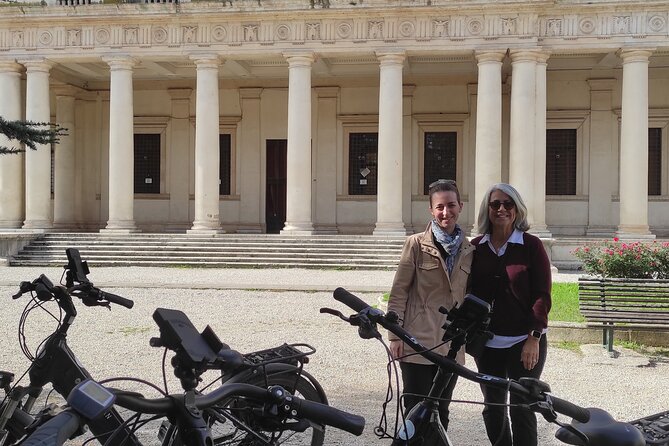
Back in Vicenza, Palazzo Chiericati introduces one of Palladio’s early supporters, Gerolamo Chiericati. The palace now houses the civic museum, with works associated with artists such as Tintoretto, Veronese, and Sansovino. The tour does not include the museum entrance, so note it for a later visit if Venetian art interests you.
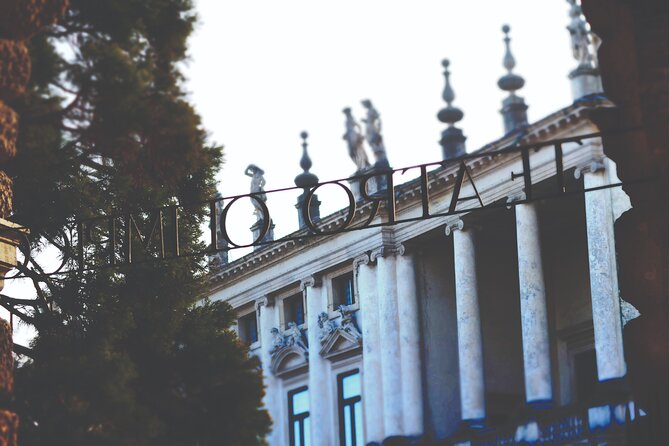
Teatro Olimpico is the dramatic high point of the route. Palladio designed it late in life for the Accademia Olimpica, helping create what is described as the first stable covered theater in the world. Its stage architecture and illusionistic setting are famous for making a confined space feel like an ideal ancient city.
The guided stop is only about five minutes and entrance is not included. That is the main limitation here. The theater deserves time inside, and the atmosphere is difficult to understand fully from the street. Treat the tour as an introduction, then return independently if the building catches your attention.
Reformation, family drama, and the city’s green spaces
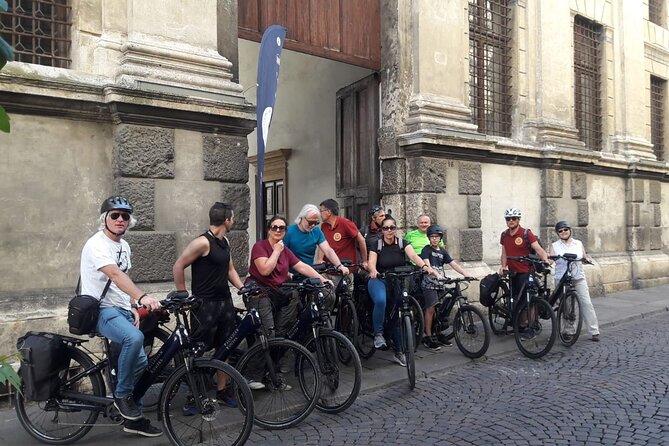
The route then crosses Ponte degli Angeli and passes Palazzo Angaran. This is where Manuel brings in the religious and political tensions of Renaissance Vicenza, including the city’s links to the Reformation and Calvinist thought. Palladio’s friendships with the Angarano family become part of the story.
At Chiesa di Santa Maria in Araceli, you hear about Bianca Nievo Angaran, a poet and intellectual whose life ended in a shocking turn. Her story adds a needed human edge to a tour that could otherwise become a parade of male architects and aristocratic clients.
Parco Querini offers a different view of the city. The park was once connected with the Capra family and later belonged to the Querini family. The guide explains its former mulberry plantation and the role of silk production in Vicenza’s trade with Europe. This is a good reminder that the city’s wealth came from commerce as well as grand building projects.
Contrà San Marco brings the story back to Palladio’s professional pressures. Palazzo Schio Vaccari Lioy Angaran was a project he had to set aside for years because of work in Venice. The stop shows how closely Vicenza’s fortunes were tied to the Serenissima.
Santa Corona and the heart of old Vicenza
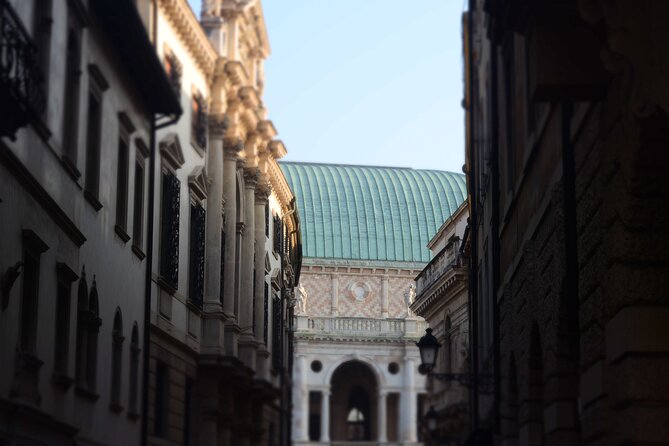
At Chiesa di Santa Corona, art and Palladio’s personal story meet. The church contains a Bellini altarpiece and the Naturalistic and Archaeological Museum, though neither entrance is part of the tour. It also became Palladio’s burial place, chosen by the Valmarana family, among his strongest local supporters.
From here, the route moves through Piazza della Biade, Piazza delle Erbe, and Piazza dei Signori. These short stops help you read the old city as a commercial and civic center. Piazza della Biade was once the official entrance from Venice, while Piazza delle Erbe offers a first view toward the Palladian Basilica.
The sequence works well because the guide builds anticipation before bringing you into Piazza dei Signori. You see the Basilica Palladiana and the Loggia del Capitanio together, two buildings that express Vicenza’s relationship with Venice. Palladio’s architecture here is not merely decorative. It speaks about civic pride, local power, and the presence of the Venetian state.
The Basilica Palladiana was Palladio’s major public commission in Vicenza. The city selected him from a field that included other major architects, and the project helped make his name. Palazzo Thiene follows, showing an earlier Palladio working with ideas linked to Giulio Romano and dreaming of a grand commission.
The palaces of ambition and risk
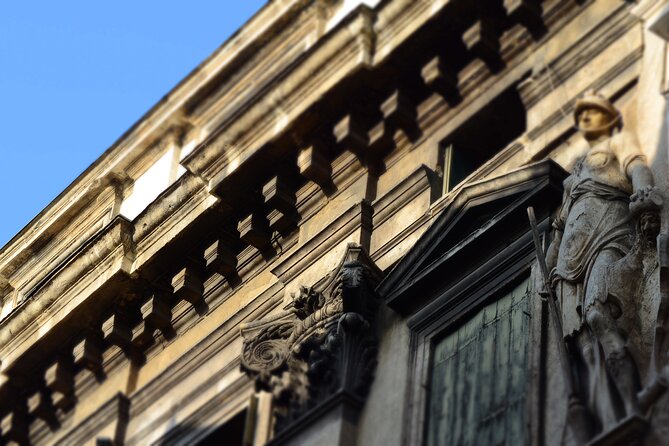
Palazzo Barbaran da Porto is especially important because it was the only major city palace Palladio saw completed. It now houses the Palladio Museum, making it one of the most useful places to return to after the tour. The building’s client, Montano Barbarano, was a musician with an interest in classical culture, the sort of patron whose tastes allowed Palladio to develop complex ideas.
Palazzo Iseppo Porto Festa reveals a more collaborative side of architecture. The design went through changes and revisions as the client and architect discussed the project over years. The palace also connects to accusations of heresy involving Iseppo, Adriano Thiene, and other Vicentine figures. Architecture here is tied to risk, family connections, and religious suspicion.
At Contrà Pedemuro San Biagio, you return to the beginning. Andrea di Pietro della Gondola started as an apprentice and stonemason in the Bottega dei Pedemuro. By this point, the tour has shown you the grand result of that working background. Palladio’s buildings were not abstract drawings. They depended on stone, brick, plaster, labor, and practical construction choices.
Villa Thiene, Valmarana continues that point. Palladio directed work on a project initially designed by Giulio Romano, and he showed skill in using terracotta instead of stone where possible. This is a useful stop for anyone interested in how Renaissance architecture was actually built.
Loggia Valmarana and the return to the starting point
The final route through the Salvi Gardens reaches Loggia Valmarana. Reflected in water and framed by trees, the loggia has the look of Palladian architecture even though its exact authorship is uncertain. Its style was already being copied during Palladio’s lifetime, which says something about the speed of his influence.
You finish at Palazzo Valmarana Braga, where the bikes are returned. The staff can offer advice for the rest of your stay, and the location makes it easy to continue exploring the center on foot.
The tour’s many stops may sound overwhelming, but most last only five minutes. That is both its charm and its limit. You get a sharp overview of Vicenza’s architecture and personalities, but you will need another day, or at least another few hours, for museums and interiors.
Is $159.63 a fair price?
At $159.63 per person, this is not a budget sightseeing ride. The price includes the Palladian e-bike and the guide, but not entry to individual attractions. Since the tour is private, the value improves when shared by a small group, and group discounts may be available.
You are paying for the guide’s narration and route design as much as for the bicycle. A standard rental would get you from one building to another, but it would not explain why Trissino mattered, how Palladio’s patrons shaped his career, or why the Basilica and Loggia del Capitanio speak to Venice in different ways.
The tour is also useful if your time is tight. A 2-hour-45-minute circuit gives you a working map of Vicenza before you choose which sites deserve a longer visit. If you already know Palladio well and want extended interior access, the price may feel less attractive.
Who should book this ride?
I would choose this for a first visit to Vicenza, especially if you want the city’s major Palladian sites in one organized outing. It suits couples, families with older children, and small private groups who prefer a personal pace over a large scheduled group.
Children must be at least 1.50 meters tall to enjoy the tour. Child seats are available only for children up to three years old. English is offered, and the tour runs at 10:00 in the morning.
Bring water in warm weather. The tour is outdoors, and even an assisted bicycle does not remove the need for sensible clothing and basic fitness. Bad weather can also affect the experience, since much of the appeal comes from moving through streets, gardens, bridges, and viewpoints.
Should you book The Story of Vicenza?
Book it if you want Palladio explained as a person, not just presented as a list of buildings. Manuel’s approach links architecture to patrons, family fortunes, religious conflict, silk production, and Venice. That turns a collection of handsome facades into a story you can follow.
Skip it if you want long interior visits or a slow museum tour. The short stops and separate admission costs mean this works best as a broad first look. For most first-time visitors with limited time, the e-bike format is a smart way to see both the city center and the outlying monuments without spending the whole morning walking.
FAQ
Where does the e-bike tour start?
The tour starts at Palazzo Valmarana Braga, Corso Antonio Fogazzaro 16, in Vicenza.
What time does the tour begin?
The stated start time is 10:00 am.
How long does the tour last?
The tour lasts approximately 2 hours and 45 minutes.
Where does the tour end?
The activity ends back at Palazzo Valmarana Braga, the starting point.
Is the tour private?
Yes. Only your group participates in the private tour.
What language is offered?
The tour is offered in English.
Is an e-bike included?
Yes. Your Palladian E-Bike is included in the tour price.
Are attraction entrance fees included?
Only the stated admission at Palazzo Valmarana Braga is included. Entrance to individual tourist attractions along the outdoor route is not included.
How tall must children be to take part?
Children must have a minimum height of 1.50 meters to enjoy the e-bike tour. Child seats are available only for children up to three years old.
Can the booking be canceled or changed?
No. The experience is non-refundable and cannot be changed for any reason.
More Half-Day in Vicenza
- Murano, Burano and Torcello Half-Day Sightseeing Tour
★ 3.5 · 7,928 reviews - Venice: Murano and Burano Half-Day Lagoon Trip
★ 4.1 · 3,083 reviews - From Venice: Murano and Burano Half-Day Island Tour by Boat
★ 4.6 · 2,489 reviews - Murano and Burano half-day trip from Punta Sabbioni Jesolo
★ 3.9 · 204 reviews
Just added around Vicenza
- Vicenza Small-Group Walking Tour: Top Sights & Hidden Gems★ 5.0 · 3 reviews
- Vicenza: Palladian Architecture Private Walking Tour★ 3.3 · 3 reviews
- Vicenza: discovering the city of Palladio by e-bike★ 5.0 · 4 reviews
- Vicenza City Sightseeing Walking Tour of Must-See Sites With a Local Guide★ 4.5 · 4 reviews
- Private pasta-making class at a Cesarina’s home with tasting in Vicenza★ 4.0 · 4 reviews
- Vicenza: Pasta & Tiramisu Cooking Class at a Local’s Home★ 5.0 · 5 reviews
- Vicenza and the Olympic Theatre★ 5.0 · 5 reviews
- Vicenza Small-Group Walking Tour: Top Sights & Hidden Gems★ 5.0 · 6 reviews
Cycling Tours, compared.
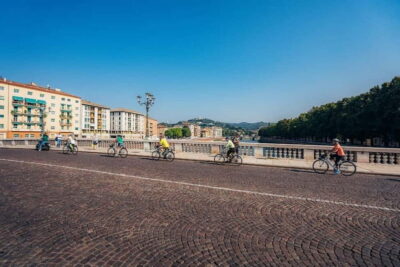
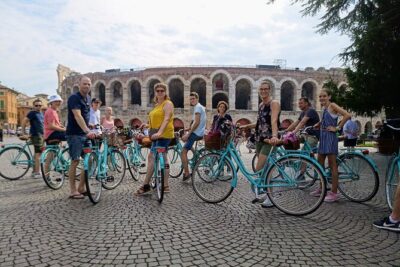
Verona e-bike tour: city center and panoramic views
Read our review →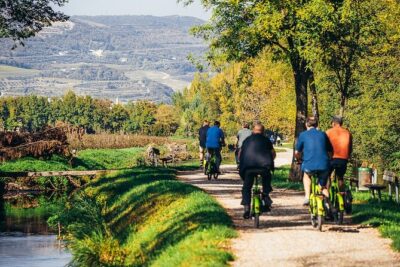
Small-group Amarone Wine e-Bike Tour from Verona
Read our review →
Self Guided E-Bike Tour among the Palladian Villas of Vicenza
Read our review →Browse the lists this tour appears in