
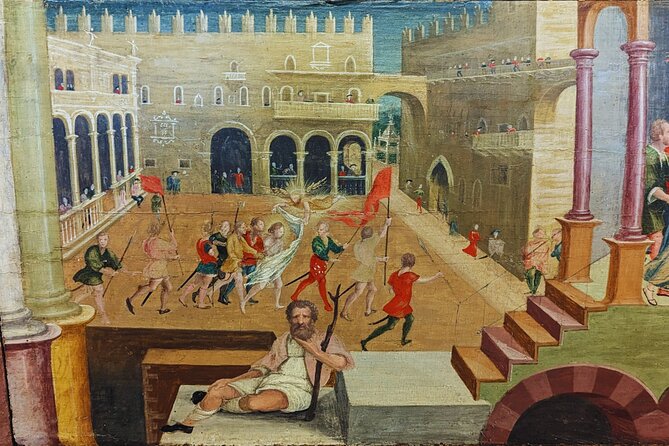
Reviewed · VERONA TOURS
Dante in Verona: From Inferno to Paradise
Dante’s Verona is not just Romeo-and-Juliet Verona. This 90-minute walk follows the poet’s medieval world from Piazza dei Signori to the quiet Romanesque Duomo, linking politics, exile, poetry, and the Divine Comedy along the way. You get a more thoughtful look at a city many visitors only see from the arena outward.
I like the way the route joins famous sights to smaller corners, especially Via Sottoriva and the old church connected with Dante’s family. I also like the human touch supplied by guides such as Leonardo, Giovanni, and Leo, who bring Dante’s story down to street level. The main drawback is its short length: serious Dante fans may want more time for literature, while the walk can feel brisk in summer heat.
In This Review
- Key points at a glance
- Why Dante’s Verona is worth an hour and a half
- Starting near Stradone San Fermo
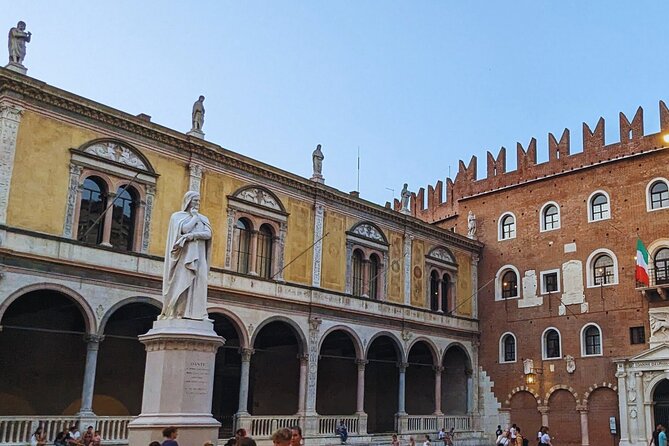
- Piazza dei Signori and the Dante statue
- Via Sottoriva and old Verona at street level
- The Arche Scaligere and Cangrande’s place in Dante’s story
- Piazza delle Erbe and the working city
- Medieval protection at the clock tower
- The church linked to Dante’s family
- Ending in the quiet of Verona’s Duomo
- Guides, group size, and the pace of the walk
- Is $42.05 a fair price?
- Who should book this Dante walking tour?
- Should you book Dante in Verona?
- FAQ
- How long does Dante in Verona last?
- What language is the tour offered in?
- Where does the tour start?
- Where does the tour end?
- What places are included on the route?
- How large is the group?
- Can I cancel for a full refund?
Key points at a glance
- A 90-minute literary walk: The tour fits Dante, Verona, and several major sights into a compact route.
- Piazza dei Signori as the starting point: Dante’s statue and the square’s political past give the story a clear center.
- Cangrande and the Scaliger tombs: The Gothic tombs connect Verona’s ruling family with Dante’s admiration for Cangrande I della Scala.
- A quieter side of the city: Via Sottoriva and the Duomo offer relief from Verona’s busiest sightseeing paths.
- Guides who shape the experience: Leonardo, Giovanni, and Leo are praised for storytelling, care, and clear explanations.
- A small-group feel: The group is limited to 15 people, with an English-speaking guide and mobile ticketing.
Why Dante’s Verona is worth an hour and a half
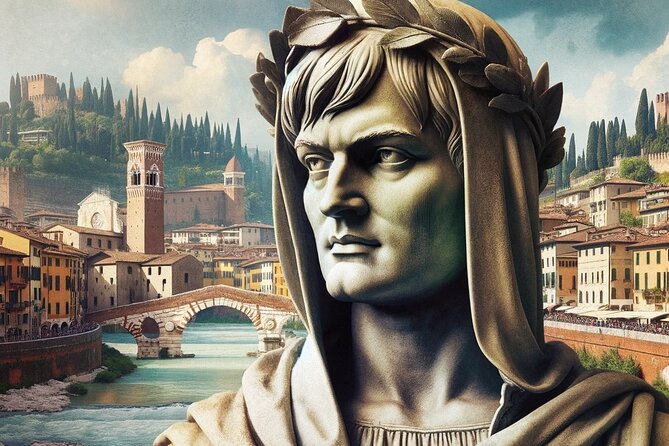
Dante Alighieri spent time in Verona after exile from Florence, and the city became part of the world around his later life and work. This tour uses that connection as a thread rather than treating Dante as a dry schoolroom subject.
That distinction matters. You do not need to arrive as a Dante expert. The route is designed to explain why the poet mattered in medieval Italy, how Verona’s rulers fit into his story, and how places around town connect to the Divine Comedy.
I like this approach because Verona becomes more than a collection of handsome buildings. Piazza dei Signori becomes a political stage. The Arche Scaligere become a statement of power and a reminder of Dante’s relationship with Cangrande. The Duomo becomes the calm final stop in a route described through the movement from Inferno to Paradise.
The tour is offered in English and lasts about 90 minutes. That makes it easy to fit before dinner, after a larger city tour, or between visits to Verona’s main sights. The group size is capped at 15, which should make it easier to hear the guide and ask a question without turning the walk into a private tour.
A few more Verona days to weigh up
- Verona: Hop-on Hop-off Tour 24 or 48-Hour Ticket
★ 4.4 · 2,010 reviews - Verona: History and Hidden Gems Guided Walking Tour
★ 5.0 · 1,379 reviews - Verona: Priority Access Arena Guided Tour
★ 4.6 · 1,152 reviews
Starting near Stradone San Fermo
The meeting point is at Stradone San Fermo, 3, in central Verona. The route ends at Cattedrale di Santa Maria Matricolare, also called the Duomo of Verona, on Piazza Vescovado.
This is a point-to-point walk, not a loop. You should allow enough time to reach the starting address and remember that the final stop is elsewhere. Since the route stays in the historic center and is near public transportation, it is practical for most sightseeing plans.
The walk includes several stops of about 10 to 15 minutes each. The rest of the time is spent moving through the old streets and listening as the guide connects each place to Dante and medieval Verona.
A mobile ticket keeps arrival simple. Confirmation is provided at booking, and the activity allows service animals. Most people can take part, but you should still expect a standing and walking tour rather than a seated lecture.
Piazza dei Signori and the Dante statue
Piazza dei Signori is the tour’s main historical anchor. Dante’s statue occupies the square, giving the guide an obvious place to begin explaining the poet’s life in Verona.
The square also served as a cultural and political center. That setting helps you understand why Dante’s time in Verona cannot be separated from the city’s ruling families, alliances, and power struggles. His work grew out of a world where politics was personal, exile was real, and a ruler’s protection could determine where a writer lived.
The square has several connections to the themes of the Divine Comedy, so the discussion here is not limited to dates and biography. You can expect the guide to use the buildings and public space to explain how Dante’s surroundings may have shaped his outlook.
This is also a useful first stop for people who know little about Dante. A statue alone can feel like a quick photo opportunity, but the guide gives it a reason to matter. If you already know the Divine Comedy well, you may find the stop most useful for its Verona setting and political context.
The scheduled time here is about 15 minutes. That is enough for a focused introduction, though not enough for a full literary lecture. I would listen for the links between Dante, Verona’s rulers, and the work itself, then save detailed questions for the walk between stops.
Via Sottoriva and old Verona at street level
Via Sottoriva offers a change of pace. It is one of Verona’s oldest and best-preserved streets, with views toward the Torricelle hills.
This part of the tour is valuable because it shifts attention away from monuments. You get a sense of the old city as a place where people moved, traded, worked, and lived. The street provides a physical setting for the medieval world that the guide has been describing.
The route also brings out Dante’s habit of walking around town. That simple detail helps make him feel less like a marble statue and more like a person taking in the streets around him. The connection is not presented as a claim that every view directly inspired a line of poetry. Instead, it gives you a way to picture his time in Verona.
The stop lasts about 15 minutes. The Torricelle views are a pleasant bonus, but the route information does not promise a long viewpoint visit. Treat them as part of the setting, not as the main attraction.
A different sort of day out around Verona:
- Verona: Juliet’s House Fast-Track Entry Ticket & Audio Guide
★ 4.2 · 1,121 reviews - Verona: Small Group Guided Walking Tour with Arena Tickets
★ 4.9 · 848 reviews - Verona: Arena di Verona Opera Ticket
★ 4.6 · 721 reviews - Verona: Pasta and Tiramisu Cooking Class with Fine Wine
★ 4.8 · 633 reviews
The Arche Scaligere and Cangrande’s place in Dante’s story
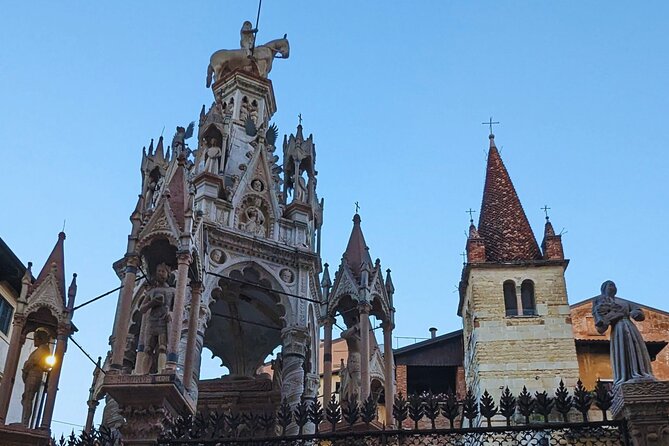
The Arche Scaligere are among Verona’s most striking medieval monuments. These elaborate Gothic tombs honor members of the della Scala family, Verona’s ruling dynasty.
The key connection here is Cangrande I della Scala. Dante admired Cangrande and referred to him in the Divine Comedy, making the tombs a meeting point for architecture, politics, and literature. The guide uses the monument to show how Dante’s work was tied to the people who held power around him.
This is one of the tour’s strongest stops because the building itself tells part of the story. The Gothic forms signal status and ambition, while the discussion adds the personal and political link to Dante. You are not simply looking at a cemetery monument. You are seeing how a ruler wanted to be remembered and why that ruler mattered to one of Italy’s major poets.
The visit is planned for about 15 minutes. That is enough to understand the connection and examine the exterior, but you should not expect an extended architectural study. If your main interest is Gothic detail, you may want to return independently for a slower look.
For me, this stop also explains why Dante in Verona is more than a literary walk. The poet’s story is inseparable from patronage and political protection. His relationship with Cangrande gives the tour a firm historical center.
Piazza delle Erbe and the working city
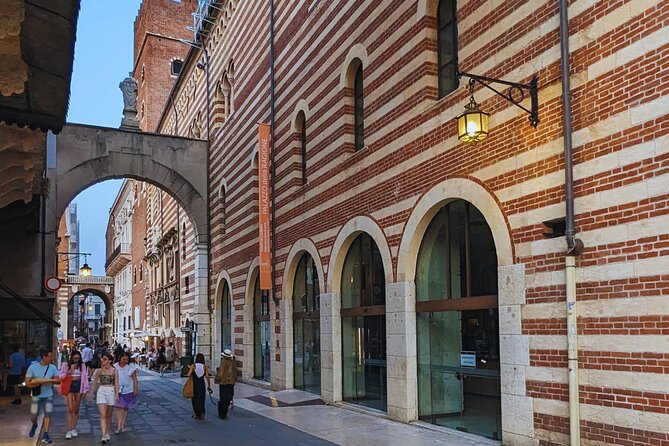
Dante loved walking through Verona, and Piazza delle Erbe offers a glimpse of the city’s daily activity during his era. The square was once a lively market area, filled with trade and movement.
The tour uses Piazza delle Erbe to bring ordinary life into the story. Dante’s Verona was not only churches, tombs, and noble towers. It was also a place of merchants, tradespeople, and public exchange.
This context is important because it gives the city texture without turning the walk into a list of grand monuments. You can picture the square as a place where news traveled, goods changed hands, and different parts of society crossed paths.
The supplied route does not give a fixed stop length for Piazza delle Erbe, so the guide may use it as part of the walking section rather than as a long formal visit. Keep your attention on the explanation, since the square itself can draw your eye in many directions.
Medieval protection at the clock tower

One of the shorter stops concerns a tower that now resembles a clock tower. Its earlier purpose was more defensive: it helped protect a noble family from rivals.
That detail adds useful tension to the tour. Medieval Verona was not a peaceful backdrop for poetry. Noble families needed protection, towers had practical roles, and public buildings could reflect competition as much as civic pride.
The stop is brief, but it supports the larger story of power that begins in Piazza dei Signori and continues at the Arche Scaligere. It also reminds you that the historic center is full of layers. A structure that looks familiar today may have served a very different purpose centuries ago.
Because the exact tower is not identified in the tour details, you should rely on the guide’s explanation rather than expect a separate monument visit. The value here is the historical perspective, not a long photo stop.
The church linked to Dante’s family
The route includes a church where Dante used to spend time after it was built. It now contains a chapel built by his family, the Alighieri.
This is one of the more personal moments on the walk. Public squares and tombs show Dante’s connection to Verona’s rulers, while the chapel points toward family memory and private devotion.
The church also gives the tour a chance to move beyond Dante as a political exile or literary figure. You see how his family name remained part of Verona’s built environment. The details provided do not identify the church by name, so you should let the guide establish the exact setting and explain the chapel’s connection.
The stop may appeal most to visitors who enjoy small pieces of biography. It is not necessarily the grandest building on the route, but it adds a human scale to the larger story.
Ending in the quiet of Verona’s Duomo
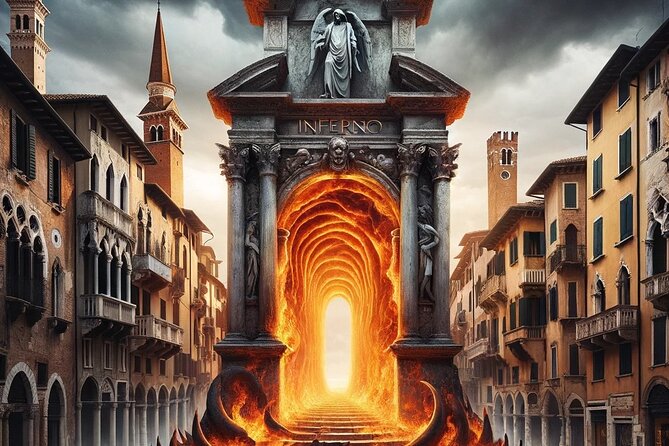
The tour finishes at the Cattedrale di Santa Maria Matricolare, Verona’s Duomo, on Piazza Vescovado. This Romanesque church represents the peaceful end of the route, the Paradise side of the Inferno to Paradise theme.
The Duomo is described as an off-the-beaten-track place, which makes it a fitting finish. After the political energy of Piazza dei Signori, the imposing tombs, and the working streets, the cathedral gives the walk a quieter final note.
The scheduled time here is about 10 minutes. That is enough for an introduction to the church and its role in the tour, but not a full examination of every feature. If the cathedral catches your interest, you may want to plan a separate visit so you are not rushed by the end of the experience.
Finishing here also makes the route feel purposeful. It does not simply return you to the starting point. Instead, you end at a place that reflects the tour’s final theme and leaves you in a quieter part of the historic center.
Guides, group size, and the pace of the walk
The guides named in the available information include Leonardo, Giovanni, and Leo. Their strengths are clear: storytelling, enthusiasm, subject knowledge, and care for the group.
Giovanni is especially associated with weaving Dante’s life together with the Divine Comedy. Leonardo is described as both entertaining and well informed, while Leo is praised for looking after the group during very hot weather. Those details matter because this tour depends heavily on delivery. The buildings provide the setting, but the guide provides the connections.
The maximum group size is 15. That is not the same as a private walk, but it is small enough to keep the experience more personal than a large city group. You should be able to hear the commentary more easily and ask questions when the guide pauses.
The pace is likely to feel brisk rather than strenuous. The route lasts about an hour and a half, includes several short stops, and takes place on city streets. Wear comfortable shoes and consider the heat if you visit in summer. One person specifically praised Leo for taking good care of the group in scorching conditions, so weather is a practical factor worth respecting.
Is $42.05 a fair price?
At $42.05 per person, this is not the cheapest way to walk around central Verona. You can pass many of these streets without paying anything, and admission to the listed stops is free.
The value comes from interpretation. You are paying for a guide to explain why Dante, Cangrande, Verona’s noble families, the markets, and the churches belong in one story. If you would otherwise wander past the Arche Scaligere or Piazza dei Signori without understanding their connection to the poet, the fee can be worthwhile.
The price makes the most sense for three types of visitors:
- You already enjoy Dante and want to connect the Divine Comedy to a real city.
- You are new to Dante and want a clear introduction without reading a long historical account first.
- You want a short guided walk that shows a quieter, more literary side of Verona.
The value is weaker if you only want the city’s headline sights, need a fast photo tour, or expect entry into every building. Admission is listed as free, and the focus is on the guide’s explanations and the route between places.
Who should book this Dante walking tour?
I would choose this tour if you like history, literature, or the way a city’s streets reveal its past. It is also a good fit for first-time visitors who want an organized introduction to central Verona without giving up much of the day.
You do not need to have read the Divine Comedy. The guide’s storytelling should give you enough context to follow the main ideas. Still, anyone who has read Dante will get more from the references to Cangrande and the Inferno to Paradise structure.
Families and mixed-interest groups may also find it useful because the walk is short and the story moves through visible places. The experience may be less satisfying for someone seeking a long academic lecture or a detailed church and architecture tour.
Slow Travel Italia allows free cancellation up to 24 hours before the start time for a full refund. Changes or cancellations inside that 24-hour window are not accepted for a refund, and cut-off times follow Verona’s local time.
Should you book Dante in Verona?
Book it if you want Verona explained through one strong story rather than a string of unrelated sights. The combination of Dante’s statue, the old streets, the Scaliger tombs, Cangrande, and the Duomo gives the walk a clear shape and a useful sense of place.
Skip it if your schedule is already packed with major attractions or if you want substantial time inside each monument. At 90 minutes, this is a focused introduction, not a full-day study of Dante.
For the best fit, arrive ready to listen, wear comfortable shoes, and keep an open mind if you know little about the poet. Guides such as Giovanni, Leonardo, and Leo appear to make the difference, turning a short city walk into a readable story about exile, power, faith, and medieval Verona.
FAQ
How long does Dante in Verona last?
The experience lasts approximately 1 hour and 30 minutes.
What language is the tour offered in?
The tour is offered in English.
Where does the tour start?
It starts at Stradone S. Fermo, 3, 37121 Verona, Italy.
Where does the tour end?
It ends at Cattedrale di Santa Maria Matricolare, Piazza Vescovado, Verona.
What places are included on the route?
The route includes Piazza dei Signori, Via Sottoriva, the Arche Scaligere, the Duomo of Verona, Piazza delle Erbe, a church connected with Dante and the Alighieri family, and a former defensive tower that now resembles a clock tower.
How large is the group?
The activity has a maximum of 15 participants.
Can I cancel for a full refund?
Yes. You can cancel at least 24 hours before the experience start time for a full refund. Cancellations or changes made less than 24 hours before the start time are not accepted for a refund.
Just added around Verona
- The city of Romeo and Juliet: A self-guided audio tour through Verona★ 4.5 · 28 reviews
- 3-Hour Walking Tour with Guide Discovering Verona★ 4.5 · 29 reviews
- Walking Tour in Verona: 9+ Landmarks with Live Guide★ 4.5 · 29 reviews
- Truffle hunting and lunch experience in a restaurant★ 5.0 · 30 reviews
- Truffle Hunting with Wine Tasting★ 5.0 · 31 reviews
- Bardolino: Garda Lake Pasta Cooking Class at the Agritourism★ 5.0 · 32 reviews
- Food and Wine Tasting in Valpolicella★ 5.0 · 32 reviews
- Verona Panoramic E-Bike tour with Lunch★ 5.0 · 32 reviews
Verona Tours, compared.
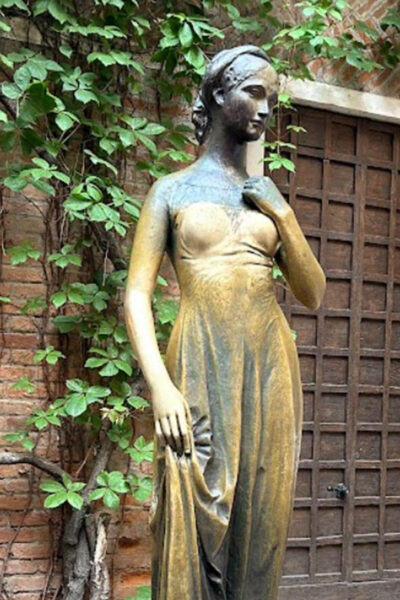
Juliet’s House Fast-Track Entry Ticket & Audio Guide
Read our review →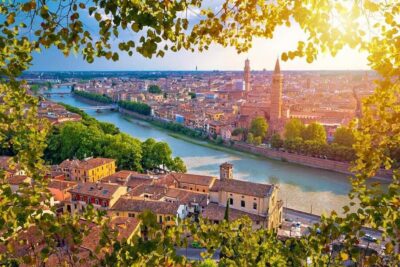
Small Group Guided Walking Tour with Arena Tickets
Read our review →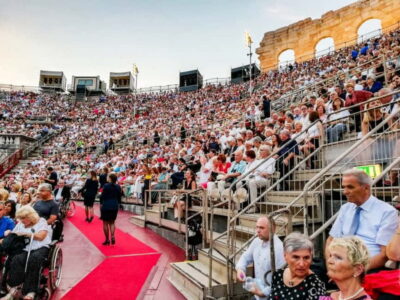
Pasta and Tiramisu Cooking Class with Fine Wine
Read our review →
Browse the lists this tour appears in