
Reviewed · WALKING TOURS
Verona Highlights Walking Tour in Small-group
Verona’s great trick is how much history fits into a compact old center. In about two hours, this walking tour links a Roman arena, a medieval castle, Gothic tombs, Shakespeare’s Juliet, and handsome public squares without making you sprint from one sight to the next. The Arena di Verona is the star, but the smaller stops often explain the city better.
I like the relaxed walking pace and the chance to ask questions as you go. I also like the local guide approach: guides such as Frank, Isabella, Maria, and Priscilla are praised for clear English, humor, and personal stories. The main limitation is that admission to the Arena and Juliet’s House is not included, so this is primarily an outdoor orientation tour.
In This Review
- Key points at a glance
- Why this two-hour walk works well in Verona
- Castelvecchio and the restored Scaligero Bridge
- Roman Verona at the Arch of Gavi
- Piazza delle Erbe and the old civic center
- Piazza dei Signori and Dante’s Verona
- The Scaliger tombs and medieval power
- Romeo’s house and what Verona can actually show you
- Juliet’s House and the short courtyard stop
- The Arena di Verona and its long second life
- What the guides add to the walk
- Price, pace, and what you receive for $42.33
- Practical details before you book
- Who should book this Verona walk
- Should you book it?
- FAQ
- How long does the Verona Highlights Walking Tour last?
- Where does the tour begin and end?
- Is the tour offered in English?
- What is included in the tour price?
- Are entrance tickets included?
- How large is the group?
- Does the tour operate in bad weather?
- Can I visit Juliet’s Balcony with this tour?
Key points at a glance
- See Verona’s Roman arena in context: Learn how the first-century amphitheater worked and how it still hosts opera and concerts.
- Walk with a small group: The maximum is 16 people, with the tour guaranteed when at least two participants book.
- Cover the old center efficiently: Castelvecchio, the Scaligero Bridge, Piazza Bra, Piazza delle Erbe, Piazza dei Signori, and the Scaliger tombs all fit into the route.
- Get more than postcard facts: Guides explain Roman, medieval, Venetian, and modern layers of Verona’s past.
- Plan for extra tickets: The tour does not include entry to the Arena, Juliet’s House, or other paid sights.
- Use it as your first Verona walk: The tour begins and ends at Piazza Bra, making it easy to continue sightseeing afterward.
Why this two-hour walk works well in Verona
Verona is easy to admire and surprisingly easy to misunderstand. You can walk from a Roman gate to a medieval palace in minutes, but without context, the old stones can blur together. This tour gives you a basic map of the city and a timeline that runs from ancient Rome through the Scaliger dynasty and into modern opera culture.
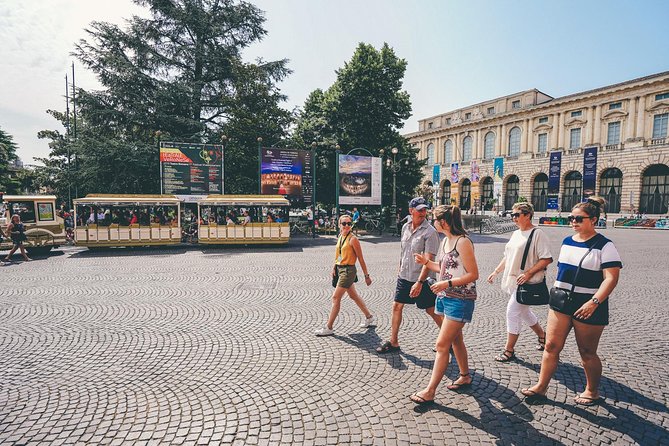
The meeting point is Piazza Bra, Verona’s largest square. It is lined with cafés, restaurants, and attractive buildings, and it puts you beside the Arena from the start. The tour also finishes here, which is useful if you want to stay for lunch, return to the amphitheater, or continue toward the railway station and other parts of the center.
The group can include up to 16 people. That is small enough for a guide to keep an eye on the group and answer questions, though it is not the same as a private tour. The experience is offered in English and runs for about two hours.
I would use this walk early in a Verona visit. It helps you decide which places deserve a second look, especially the Arena, Castelvecchio Museum, and Juliet’s House. Several people have also used the tour as a quick introduction when they had only limited time in town.
More Walking Tours in Verona
- Verona: History and Hidden Gems Guided Walking Tour
★ 5.0 · 1,379 reviews - Verona: Small Group Guided Walking Tour with Arena Tickets
★ 4.9 · 848 reviews - Verona walking tour:food, wine, legends, lunch/dinner & cable car
★ 5.0 · 386 reviews
Castelvecchio and the restored Scaligero Bridge
One of the strongest early sights is Castelvecchio, the medieval fortress built by the ruling Scaliger family. You see the castle as part of Verona’s defensive story, rather than simply as an attractive old building. The tour does not include a full visit inside the museum, so anyone interested in medieval art should return later with a separate admission ticket.
Attached to the castle is the Scaligero Bridge, which crosses the Adige River. The bridge was almost destroyed during wartime bombing and was later rebuilt to match the original design. That restoration gives the site an extra layer of meaning: you are looking at both a medieval structure and a careful modern reconstruction.
This is a good place to pay attention to the guide’s explanation instead of rushing for photographs. The bridge connects the castle to the left bank of the Adige, and the relationship between fortress and crossing makes more sense when you see them together.
Roman Verona at the Arch of Gavi
The Arch of Gavi is a small but important Roman remnant. It was built in the first century AD by the architect Vitruvius to honor the Gavia family, a prominent Verona clan. It originally stood outside the city on the Via Postumia, an ancient Roman road.
The arch was demolished under Napoleon in 1805 and reconstructed in its current location in 1931. That story is a useful reminder that old European monuments have not always remained untouched. Some were altered, dismantled, moved, or rebuilt long before modern preservation became standard practice.
The stop is brief, but it helps you spot Roman Verona beyond the famous amphitheater. You may also hear about traces of the original Roman walls and other remains tucked into later buildings. One particularly unusual example described on the walk is a section of Roman ruins visible inside a Benetton store. That kind of detail gives the city a pleasantly layered feel.
Piazza delle Erbe and the old civic center
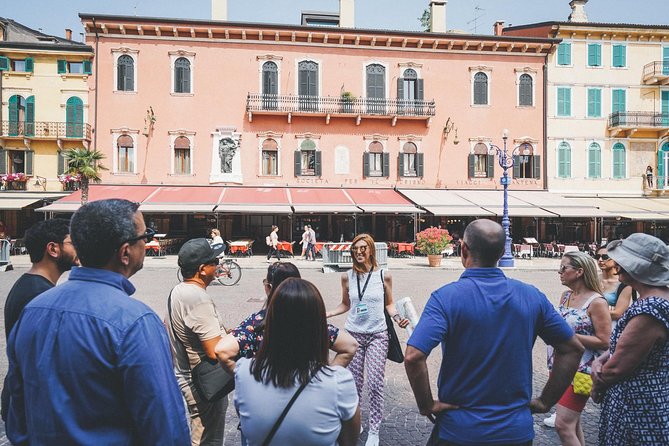
Piazza delle Erbe occupies the site of Verona’s Roman forum. Today it is a lively square surrounded by historic buildings, painted façades, monuments, and a central fountain from the Scaliger period.
The square is one of the places where a guide adds real value. On your own, you may notice the color and decoration first. With an explanation, you can begin to read the square as a record of changing rulers and civic power. Roman foundations, medieval government, Venetian influence, and later decoration all appear within a short walk.
The stop is listed at about five minutes, so do not expect a long pause for every building. If the square interests you, mark it for a return visit. You may want time to study the frescoed façades, take photographs, or sit at one of the cafés.
A different sort of day out around Verona:
- Verona: Hop-on Hop-off Tour 24 or 48-Hour Ticket
★ 4.4 · 2,010 reviews - Verona: Priority Access Arena Guided Tour
★ 4.6 · 1,152 reviews - Verona: Juliet’s House Fast-Track Entry Ticket & Audio Guide
★ 4.2 · 1,121 reviews - Verona: Arena di Verona Opera Ticket
★ 4.6 · 721 reviews
Piazza dei Signori and Dante’s Verona
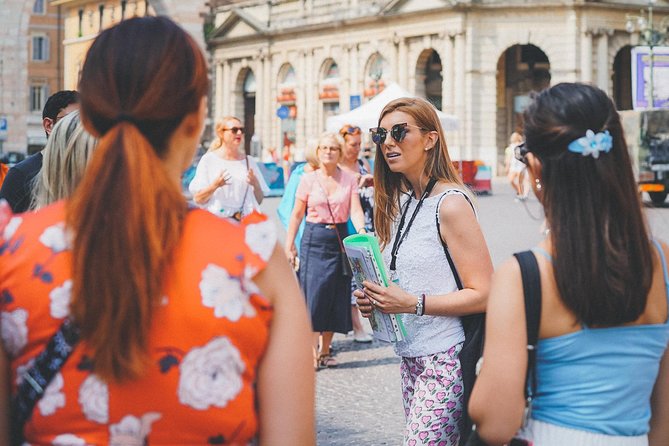
A short turn from Piazza delle Erbe brings you to Piazza dei Signori, once the center of political power in Verona. The square is more formal and enclosed than Piazza delle Erbe, with palaces that reflect the city’s governing past.
A statue of Dante Alighieri has dominated the square since 1865, giving it the informal name Piazza Dante. The connection is fitting because Verona appears in Dante’s work, and the city’s medieval atmosphere helps explain why the poet’s presence feels natural here.
This is also a useful place to ask questions about Verona beyond its famous romantic legend. The tour focuses mainly on history, buildings, and local stories, but the guides are available for questions as you walk. One guide, Frank, is praised for mixing historical explanation with lighter facts and practical suggestions for food and places to visit afterward.
The Scaliger tombs and medieval power
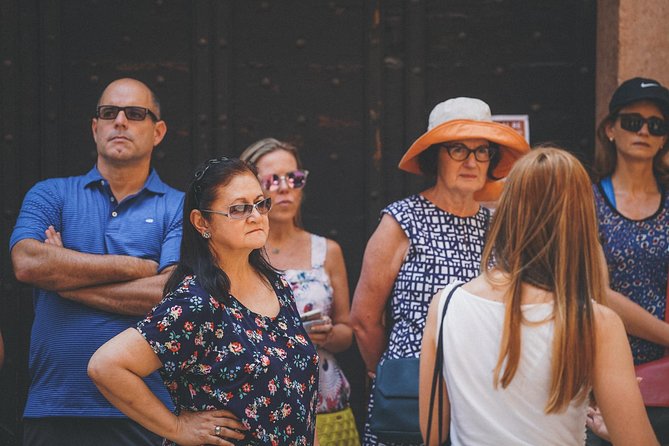
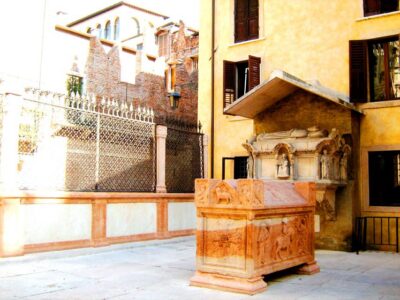
The Arche Scaligere are the elaborate outdoor tombs of Verona’s ruling Scaliger family. Their Gothic arches and carved sarcophagi are easy to miss if you are simply following a map, but they are among the city’s most distinctive medieval sights.
The tour points out the monuments associated with Cangrande I, Mastino II, and Cansignorio. The stop lasts about five minutes and does not include admission. Even from outside, you can see how the tombs were designed not merely as graves but as public statements of family power.
This is one of the better examples of the tour’s time span. Within the same morning, you move from Roman engineering to medieval dynastic display. The guide’s job is to connect those separate periods so Verona feels like one continuing city, not a collection of unrelated monuments.
Romeo’s house and what Verona can actually show you
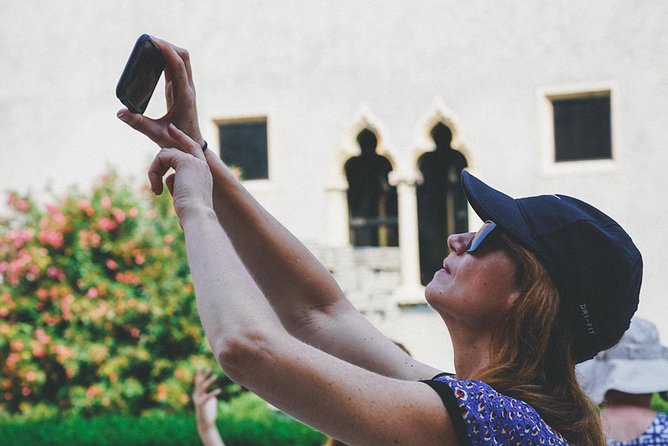
Romeo’s House is a medieval palace linked by legend and literary tradition to the Montecchi family, the supposed family of Shakespeare’s Romeo. The building is private and occupied, so you can only view it from the outside.
That limitation matters. This stop is about location and storytelling, not an interior visit. The tour presents Verona’s romantic traditions while leaving room for a little skepticism. Juliet’s House, too, is closely tied to later tourism and popular imagination, so it is best enjoyed as part history, part literary legend, and part modern cultural phenomenon.
The guide can help separate documented medieval Verona from the story created around Romeo and Juliet. That balance is more useful than treating every detail of the tale as historical fact.
Juliet’s House and the short courtyard stop
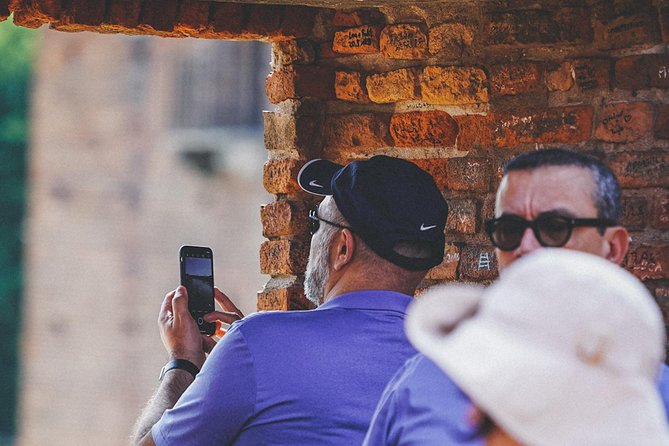
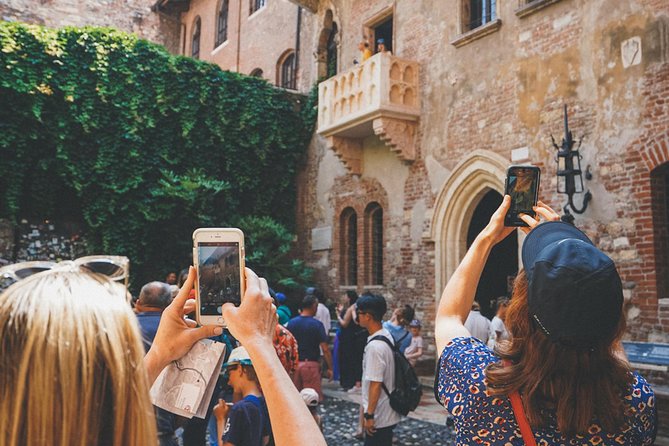
Casa di Giulietta is one of Verona’s most recognizable sights. The tour takes you into the courtyard associated with the Capuleti family, where Juliet is said to have lived.
The standard stop lasts about five minutes, and admission is not included. The itinerary describes the courtyard visit rather than promising a full museum experience or guaranteed balcony access. If you want to go inside, check the current ticket rules and allow extra time beyond the walking tour.
There is a particularly interesting modern twist to the site. The famous balcony setting was created as part of the 1930s presentation of the house, using an Egyptian sarcophagus in the construction. That does not make the stop worthless. It makes it a good example of how Verona turned literary tradition into a physical attraction.
From December 6, 2025, through January 6, 2026, access to Juliet’s Balcony requires a separately purchased ticket because of high visitor numbers. The tour provider can give information about buying it but will not purchase the ticket for you. Plan ahead if the balcony is important to your visit.
The Arena di Verona and its long second life
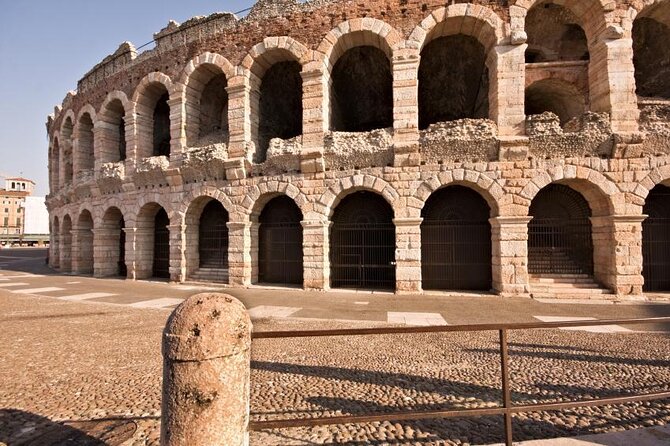
The Arena is the tour’s major landmark. Built by the Romans in the first century AD, during the Augustan period, it predates Rome’s Colosseum by roughly 30 years. Its surviving inner tiers remain imposing even though much of the outer ring was lost or removed over time.
The amphitheater could hold as many as 30,000 people in ancient times. Today, it is still used for large performances, including international concerts and the Verona Arena Festival, the city’s celebrated summer opera season. The modern opera setup is often described as accommodating about 13,000 people.
The scheduled stop is about 10 minutes, and entry is not included. That is enough time to see the exterior, take photographs, and hear the basic story. It is not enough for a proper look inside, especially if you want to study the stonework or imagine the scale of a performance.
I see this as a strength and a limitation. The tour gives you the background you need, while keeping the price lower than a combined sightseeing and admission package. But if the Arena is a main reason for your visit, you should budget for a separate ticket or consider a separate Arena tour. One particularly useful option described by a participant was joining an Arena visit with the same guide immediately afterward, though that is a separate experience.
What the guides add to the walk
The guide can make or break a compact city tour, and the strongest pattern here is the emphasis on personality and storytelling. Frank is repeatedly described as funny, friendly, and good at turning historical facts into memorable stories. Isabella is praised for clear explanations, energy, and a mix of cultural background and humor.
Priscilla brings a local connection to the city and is described as fluent in English, charming, and attentive to an older family member. Maria is praised for keeping a rainy tour interesting. These details matter if you want more than a set speech delivered at each monument.
The tour also appears to suit questions and mixed groups. Guides have been noted for checking that everyone understands, including people who briefly fall behind in crowded streets, and helping older participants. Still, the walk can move at a fairly brisk pace. If you need frequent rests or have reduced mobility, contact the provider before booking, since some parts are not easy for every participant.
Price, pace, and what you receive for $42.33
At $42.33 per person, this is not the cheapest way to walk around Verona, since you can visit many squares and exterior sights without paying anything. The value comes from the guide’s explanations, the efficient route, and the chance to cover a lot of ground in a short stay.
You receive a local English-speaking guide, but not hotel pickup, transportation, or entry tickets. That makes the tour a better fit for someone who wants orientation and context than for someone seeking a fully packaged sightseeing day.
The 97 percent recommendation rate and 4.8 rating from 494 reviews suggest a strong record, with the most praised elements being the guides, the easygoing tone, and the amount of history covered in two hours. The one useful criticism is that the tour can favor a broad overview over detailed discussion of present-day Verona, its university, population, or business life. If you want museum-level depth at every stop, you may find the coverage light.
Practical details before you book
The tour starts and ends at Piazza Bra in central Verona. It runs in rain or shine, so bring suitable clothing and shoes. The route includes city streets, crowded areas, and historic sites that may not be easy for people with reduced mobility.
Minors must be accompanied by an adult, and service animals are allowed. The tour is near public transportation, and most people can take part, but the walking pace may require you to keep moving rather than linger at every stop.
Confirmation is issued at booking. You can cancel up to 24 hours before the local start time for a full refund. Cancellations or changes made later are not refunded or accepted, and the provider may offer another date or a full refund if the minimum of two participants is not reached.
Who should book this Verona walk
I would choose this tour if you are visiting Verona for the first time, have only a morning or afternoon, or want a clear introduction before exploring independently. It works especially well for families and mixed-age groups because the guide can connect architecture, legends, and Roman history without requiring specialist knowledge.
It is also a good choice if you want to see the main center without spending the whole day inside museums. The route gives you a useful overview, then leaves you free to return to the Arena, Castelvecchio, or Juliet’s House with a better sense of what you are seeing.
I would hesitate if you want included admission, a private guide, or long stops inside each monument. This is a brisk orientation walk, not a full archaeological tour. And if you have mobility concerns, ask for route details before committing.
Should you book it?
Book this tour if you want a friendly, efficient first look at Verona and value a guide who can connect Roman ruins, medieval rulers, local legends, and opera tradition. The small group and two-hour format give you structure without taking over your day.
Skip it if you already know Verona well or plan to spend your time inside the Arena and museums. For most first-time visitors, though, $42.33 is a fair price for getting your bearings and learning why the city’s famous sights matter.
FAQ
How long does the Verona Highlights Walking Tour last?
The tour lasts approximately two hours.
Where does the tour begin and end?
It begins and ends at Piazza Bra in central Verona.
Is the tour offered in English?
Yes. The experience is offered in English.
What is included in the tour price?
A local tour guide is included.
Are entrance tickets included?
No. Admission to the Arena di Verona, Casa di Giulietta, and the Arche Scaligere is not included. Piazza Bra, Piazza delle Erbe, and Piazza dei Signori are listed as free stops.
How large is the group?
The tour has a maximum of 16 participants.
Does the tour operate in bad weather?
Yes. The tour runs rain or shine, although the provider does not guarantee a full refund for severe storms, unexpected extreme events, or other unforeseen circumstances.
Can I visit Juliet’s Balcony with this tour?
From December 6, 2025, through January 6, 2026, Juliet’s Balcony requires a separately purchased ticket because of high visitor numbers. The provider can offer information about buying the ticket but does not purchase it for you.
Just added around Verona
- Verona: Private 2-Hour Walking Tour★ 4.9 · 41 reviews
- Valpolicella Lunch or Dinner Wine & Food tasting with Amarone★ 5.0 · 43 reviews
- The 10 Tastings of Verona With Locals: Private Food Tour★ 4.5 · 45 reviews
- Arena di Verona Opera Ticket Package★ 4.0 · 46 reviews
- Unique Wine tasting in Verona, with Amarone docg★ 5.0 · 46 reviews
- Verona: the Arena at the Gladiators’ time★ 5.0 · 48 reviews
- Verona: Juliet’s House Fast-Track Entry Ticket & Audio Guide★ 3.5 · 52 reviews
- Valpolicella Wine Experience at Montresor winery★ 5.0 · 54 reviews
Walking Tours, compared.
Rialto Bridge & Offbeat Unusual Venice Walking Tour
Read our review →
Private 3 hrs Venice Tour: St Mark’s, Walking tour & Boat tour
Read our review →
Walking Guided Tour of the City Must-See Sites
Read our review →
Private Best of Venice Walking Tour with St Mark’s Basilica
Read our review →
Venice Sightseeing Small Group Walking Tour with a Local Guide
Read our review →Browse the lists this tour appears in