
Reviewed · WALKING TOURS
3 Hour Walking tour of Verona and Arena
Verona reveals its story in layers, and this three-hour walking tour moves neatly from medieval fortress to Roman amphitheater. You’ll cross the brick Castelvecchio Bridge, pass ancient gates, see the city’s grandest squares, and finish inside the Arena. It’s a useful way to get your bearings without spending a full day on foot.
I like the mostly level route, which makes the distance manageable, and I like the balance of famous sights with less obvious pieces of Verona’s past, such as the private Roman Arch of the Gavi. Guides Frank and Maddy are praised for clear, engaging explanations that do not bury you in dates.
The main drawback is value. At $171.52 per person, this is a costly group walk for three hours, especially since nearly every stop is viewed from outside and the Arena visit is scheduled for only 20 minutes. Check exactly what matters to you before booking.
In This Review
- Key points to know before booking
- What this Verona walking tour is really designed to do
- Castelvecchio and the Scaliger Bridge
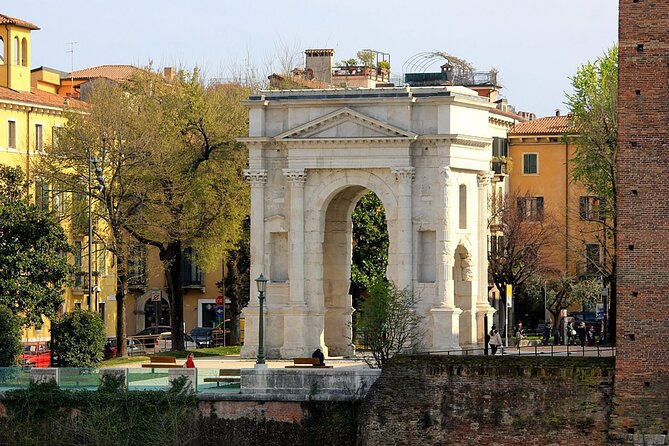
- Roman Verona at the Arch of the Gavi
- Porta Borsari and the old city boundary
- Piazza delle Erbe, Verona’s everyday center
- Torre dei Lamberti and Piazza dei Signori
- Finishing at the Arena di Verona
- How the guiding style affects the experience
- Is $171.52 a fair price?
- Timing, weather, and what to bring
- Should you book this Verona tour?
- FAQ
- How long is the Verona walking tour?
- What time does the tour begin?
- Where does the tour start?
- Where does the tour end?
- Is Arena admission included?
- How large is the tour group?
Key points to know before booking
- Eight central Verona stops: The route links Castelvecchio, the Scaliger Bridge, Roman gates, medieval squares, and the Arena.
- A mostly level walk: One review specifically found the three-hour route manageable on foot, with little demanding uphill walking.
- Arena museum admission included: The ticket is included, but the planned Arena stop lasts about 20 minutes.
- Small shared group: The maximum is 16 people, a useful size for hearing the guide without joining a huge crowd.
- English-speaking licensed guide: Frank and Maddy received especially warm praise for clear, friendly presentation.
- Weather matters: The tour operates in all conditions, so carry water, sun protection, and an umbrella.
What this Verona walking tour is really designed to do
This is a city-orientation tour rather than a slow museum day. In three hours, you move through Verona’s main historic center and see how Roman, medieval, and Scaliger-era buildings fit together. The guide supplies the connections, which is often more useful than collecting isolated photographs.
The walk begins at Via Teatro Ristori 7 at 10:00 a.m. and ends back at the meeting point. Since transport to the start is not included, you need to make your own way there. The tour is shared and capped at 16 people, so it should feel more personal than a large coach group, while still keeping the price and pace of a group outing.
The schedule gives roughly 20 to 25 minutes at each stop. That is enough time for an explanation, photographs, and a look around, but not enough for a detailed visit to every site. Think of this as a guided introduction to Verona, with the Arena museum as the one included admission.
More Walking Tours in Verona
- Verona: History and Hidden Gems Guided Walking Tour
★ 5.0 · 1,379 reviews - Verona: Small Group Guided Walking Tour with Arena Tickets
★ 4.9 · 848 reviews - Verona Highlights Walking Tour in Small-group
★ 5.0 · 493 reviews
Castelvecchio and the Scaliger Bridge
The first stop is Museo di Castelvecchio, housed in the fortress originally known as the Castle of San Martino in Aquaro. The building was the chief military monument of the Scaliger rulers, the medieval dynasty that shaped much of Verona.
You have about 25 minutes here. The stop is valuable even if you do not enter the museum because the fortress gives the tour an immediate sense of Verona’s medieval power. Its heavy defensive character is a sharp contrast to the elegant squares later in the walk.
The museum admission itself is not included as a separate part of this tour. The itinerary lists the stop as free admission, so expect the guide to interpret the exterior and setting rather than lead a full museum visit. If you want to study the art collection inside Castelvecchio, you will need to arrange that separately.
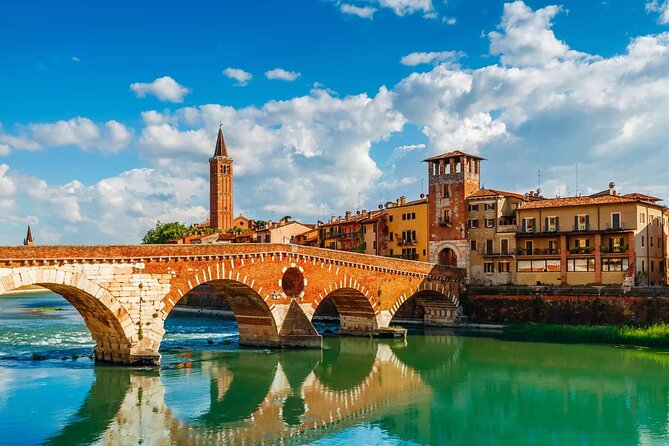
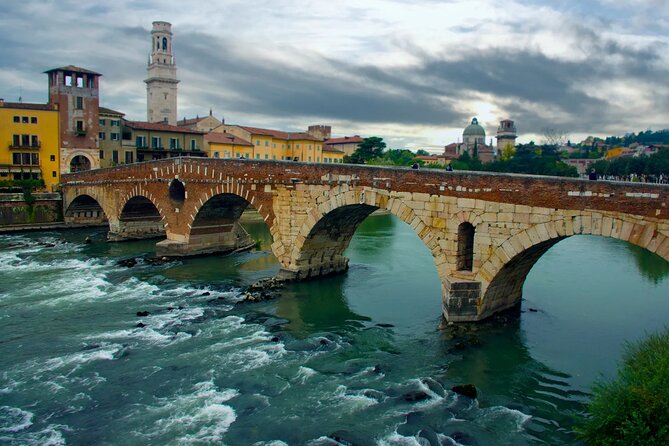
Next comes Ponte Scaligero, also called the Castelvecchio Bridge. This military bridge crosses the Adige River and was built as part of the fortress system. Its purpose was not simply to provide a pretty crossing. It gave the ruling family a protected route out of the fortress.
You get another 25 minutes here, which allows time to look at the bridge’s brickwork and position along the river. This is one of the tour’s more rewarding stops because the bridge makes medieval engineering easy to understand. You are not just looking at an old structure; you are seeing how defense, transport, and political control worked together.
Wear shoes you can walk in comfortably. The route is described as mostly level, but a three-hour walk still means steady time on your feet. Water is a smart addition, particularly on a warm morning.
Roman Verona at the Arch of the Gavi
The Arch of the Gavi shifts the story back to Roman Verona. Built around the middle of the first century, it honored the Gavia family and once stood along the ancient Via Postumia, just outside the walls of the Roman city.
This is an unusual monument because it was a private honorary arch, rather than a structure created only for an emperor or the state. You have about 25 minutes to hear that context and see how the arch relates to Verona’s former road system.
I like this stop because it adds a human detail to the Roman story. Verona was not only a strategic city of walls and roads. Families also used public monuments to mark their status and memory. The guide’s explanation is especially useful here because the arch can be easy to pass without understanding what makes it unusual.
The itinerary does not include an admission charge at the Arch of the Gavi. This is an outdoor viewing stop, so the focus is on the structure and its place in the old city.
Porta Borsari and the old city boundary
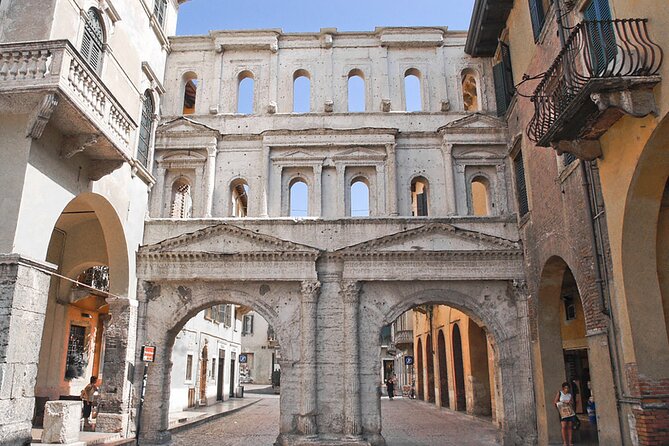
Porta Borsari is another reminder that modern Verona sits on top of a Roman plan. In antiquity it was called Porta Iovia, a name connected with a nearby temple dedicated to Jupiter Lustralis. It was one of the gates through the Roman walls.
You have 25 minutes here. That may sound generous for a gate, but it gives the guide time to explain how the entrance controlled movement into the city and how later Verona grew around Roman foundations.
The gate is particularly useful for understanding scale. Roman Verona was not just a collection of ruins scattered around the center. It had walls, entrances, roads, and an organized civic core. Once you have seen Porta Borsari, later stops in the old center make more sense.
This is another free, outdoor stop. The tour does not promise a separate visit to Roman wall remains or an extended archaeological walk, so keep your expectations focused on interpretation rather than excavation sites.
A different sort of day out around Verona:
- Verona: Hop-on Hop-off Tour 24 or 48-Hour Ticket
★ 4.4 · 2,010 reviews - Verona: Priority Access Arena Guided Tour
★ 4.6 · 1,152 reviews - Verona: Juliet’s House Fast-Track Entry Ticket & Audio Guide
★ 4.2 · 1,121 reviews - Verona: Arena di Verona Opera Ticket
★ 4.6 · 721 reviews
Piazza delle Erbe, Verona’s everyday center
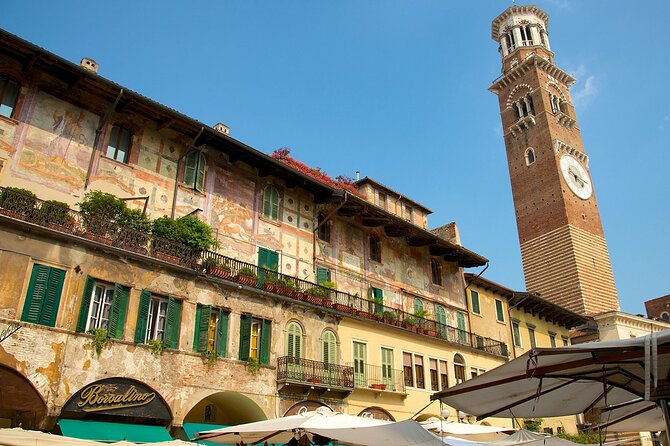
Piazza delle Erbe is the oldest square in Verona and occupies the area of the Roman Forum. In Roman times, this was the city’s political and economic center. Medieval buildings later replaced the Roman structures, but the civic role of the site continued.
The tour allows about 20 minutes here. That is enough to take in the square, listen to the guide, and understand why this is one of Verona’s key public spaces. I would pay attention to the way the square’s buildings show different periods rather than treating it as one single historic scene.
The square is also a practical point in the walk. After the fortress, bridge, and Roman gates, Piazza delle Erbe brings you into the social heart of the center. Its importance is not only architectural. It has long been a place where Verona gathers, trades, and presents itself.
A short visit means you will not have much free time for shopping, food, or a relaxed drink. Food and drinks are not included, so plan those separately. The tour’s aim here is explanation, not a market stop or café break.
Torre dei Lamberti and Piazza dei Signori
The Lamberti Tower rises near Piazza delle Erbe and represents Verona’s medieval civic ambition. You have around 20 minutes at the tower. The schedule does not state that a ticket to the tower or a climb is included, so do not assume you will go to the top.
One review referred to a cable car and an impressive view from above. That experience is not listed in the stated itinerary or inclusions, so I would not book this tour expecting a cable-car ride. If the view matters to you, confirm the plan with the provider before paying, particularly since the published route describes a walking tour with Arena museum entry.
Piazza dei Signori follows, with another 20-minute stop. Also called Piazza Dante, this square grew in the Middle Ages around the palaces of the Scaliger rulers. Arches and loggias connect the surrounding monumental buildings, giving the square a more formal, political character than Piazza delle Erbe.
This is where the tour’s medieval story becomes clearer. Castelvecchio showed military power. Piazza dei Signori shows government and representation. The two spaces belong to the same broad period, but they express different sides of rule.
The square sits next to Piazza delle Erbe, so you are not covering a great distance between them. That helps keep the route manageable and leaves more time for the guide’s explanation. A good guide can turn this short section into a useful lesson in how public spaces reflected rank and authority.
Finishing at the Arena di Verona
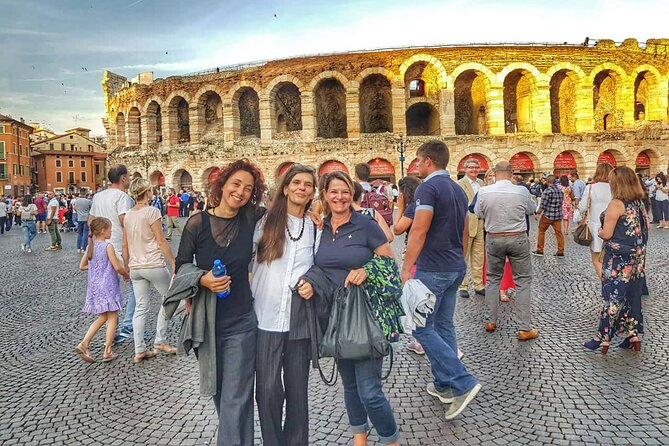
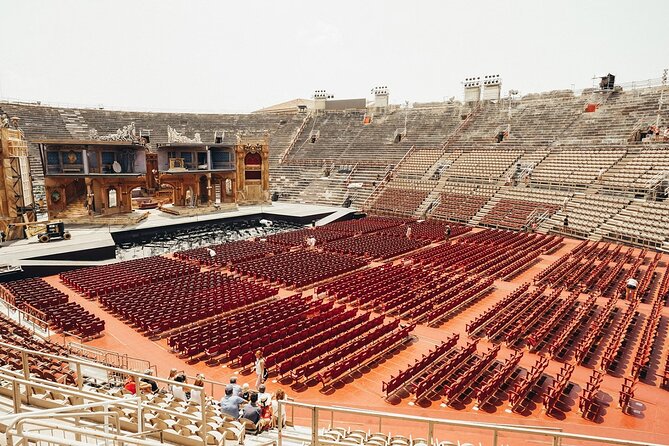
The final stop is the Arena of Verona, the city’s famous Roman amphitheater. It is one of Verona’s defining sights, alongside the city’s connection with Romeo and Juliet. The tour includes an entrance ticket to the Arena museum, and about 20 minutes is allocated here.
That inclusion improves the tour’s value, but the short timing is important. You will not have the freedom of a long, unhurried museum visit. Instead, expect a focused introduction to the Arena and its place in Verona’s Roman past.
The Arena is a strong ending because it brings together several themes from the walk: Roman planning, public spectacle, civic identity, and the way ancient buildings continue to shape modern city life. After seeing Roman gates and the old forum area, the amphitheater feels like the natural final chapter.
If entering the Arena is your main reason for booking, check the exact access arrangements before departure. The information provided confirms Arena museum admission, not a separate concert, performance, or extended visit. The tour ends back at the original meeting point, so you can continue exploring afterward if you have more time.
How the guiding style affects the experience
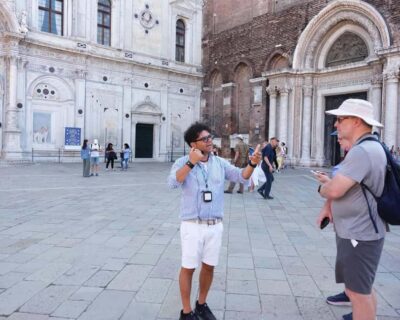
The guide will make or break a fast city walk. The strongest feedback points to Frank and Maddy. Frank is described as giving useful information without overloading the group with history. That is the right approach for a three-hour route with eight stops.
Maddy is praised for being interactive, kind, and clearly enthusiastic about Verona’s past. That matters because the itinerary includes several monuments that need explanation. A Roman gate or medieval square does not always explain itself. A guide who asks questions, points out details, and connects one era to the next can make the walk feel much more alive.
Isabella is also named in one piece of feedback, though that comment raises a concern about value rather than her personal manner. The overall rating is 4.3 from six reviews, with four five-star ratings and one one-star rating. That is a small sample, so I would treat the praise as a helpful signal, not a guarantee that every departure will feel identical.
The group limit of 16 is a plus. It is still a shared tour, not a private walk, but a group of this size is easier to manage at busy squares and easier for you to hear than a much larger gathering.
Is $171.52 a fair price?
At $171.52 per person, this tour sits in the expensive range for a three-hour walking experience. The price pays for a licensed English-speaking guide, a structured route through eight major stops, and the Arena museum ticket. It does not include transport to the meeting point, food, or drinks.
The value depends on what you want from Verona. If you have only a morning and want one person to connect the city’s Roman and medieval sights, the organized route may save you planning time. You also receive context that can be hard to assemble on your own in a short visit.
The price is harder to justify if you prefer a slow pace, want to enter several monuments, or are happy to read about the city independently. Most stops are outdoor viewing points, and several last only 20 or 25 minutes. The one negative assessment specifically questioned paying a high price for a result that could be obtained more cheaply.
My practical advice is to book this for the guide and the structure, not simply for admission tickets. If you need a broad introduction and value clear storytelling, the price may work. If you mainly want access to the Arena, compare the cost of visiting it separately and walking around Verona at your own pace.
Timing, weather, and what to bring
The starting time is 10:00 a.m. Tours continue in all weather. Verona’s center may feel very different on a hot sunny morning than on a cool, wet one, and the tour does not shift indoors simply because conditions are unpleasant.
Bring mineral water, sunscreen, a hat, and an umbrella. Comfortable shoes are essential. In colder weather, dress warmly. If the route includes a church interior during warmer months, carry a cape or other covering for bare shoulders.
The supplier advises against booking another tour with a close schedule on the same day. That is sensible. The tour lasts about three hours, but sightseeing times can stretch, meeting a group can take a few minutes, and you do not want to hurry away from the final stop.
Same-day or overnight bookings carry an extra risk. If there are no seats, you may be moved to the following day. If your Verona visit is tightly planned, reserve ahead rather than relying on a last-minute place.
You receive confirmation when booking. The tour is near public transportation, and the published information says most people can participate. No special accessibility details are provided, so anyone needing specific arrangements should check before reserving.
Should you book this Verona tour?
Book it if you want a single guided introduction to central Verona, prefer walking to riding between sights, and appreciate a guide who keeps history understandable. It suits a first visit, a short stay, or anyone who wants the city’s Roman and Scaliger chapters explained in one continuous route.
It is also a good fit if you want to see Castelvecchio, the Scaliger Bridge, Piazza delle Erbe, Piazza dei Signori, and the Arena without building the route yourself. The mostly level walk and group limit of 16 make the format practical.
Think twice if $171.52 feels high for a short tour with limited interior access. You will spend much of the time outside, and the Arena museum visit is brief. I would also clarify the cable-car reference before booking, since it is not part of the stated route or included features.
For the best experience, wear sensible shoes, bring water and sun or rain protection, and leave the rest of your day open enough that you are not watching the clock. If clear guiding matters more to you than a long museum visit, this can be a useful and well-paced way to meet Verona.
FAQ
How long is the Verona walking tour?
The tour lasts approximately three hours.
What time does the tour begin?
It begins at 10:00 a.m.
Where does the tour start?
The meeting point is Via Teatro Ristori 7, 37122 Verona VR, Italy.
Where does the tour end?
The activity ends back at the meeting point.
Is Arena admission included?
Yes. The Arena museum entrance ticket is included.
How large is the tour group?
This is a shared tour with a maximum of 16 people.
More 3-Hour Experiences in Verona
- Verona: 3-Hour Guided Walking Tour
★ 4.9 · 156 reviews - 3-Hour Walking Tour with Guide Discovering Verona
★ 4.5 · 29 reviews - 3 Hour Watercolor Private Experience in Verona
★ 5.0 · 8 reviews - 3 Hour Shared Walking and Aperitivo Tour of Verona
★ 5.0 · 3 reviews
Just added around Verona
- 3 Hour Shared Walking and Aperitivo Tour of Verona★ 5.0 · 3 reviews
- Verona: Blindfolded Wine Tasting★ 5.0 · 3 reviews
- Excursion in Verona.★ 4.5 · 3 reviews
- Verona Airport (VRN) Arrival Transfer (Airport to Verona Hotels or Address)★ 4.0 · 3 reviews
- Photo Shoot in Verona: Capture Your Love Story in Pictures★ 5.0 · 3 reviews
- Incredible Verona – Family Walking Tour★ 5.0 · 3 reviews
- From Verona: discover Lake Garda and Sirmione private tour★ 5.0 · 3 reviews
- Madonna di Campiglio and Dolomites Self-Guided Tour★ 5.0 · 3 reviews
Walking Tours, compared.
Rialto Bridge & Offbeat Unusual Venice Walking Tour
Read our review →
Private 3 hrs Venice Tour: St Mark’s, Walking tour & Boat tour
Read our review →
Walking Guided Tour of the City Must-See Sites
Read our review →
Private Best of Venice Walking Tour with St Mark’s Basilica
Read our review →
Venice Sightseeing Small Group Walking Tour with a Local Guide
Read our review →Browse the lists this tour appears in