
Reviewed · WALKING TOURS
Verona: Highlights Walking Tour with Arena Priority Access
Verona’s Roman Arena is the grand finale here, but the best part is the walk that leads you to it. In about three hours, you move from a medieval castle and Roman gateway to market squares, Gothic tombs, Juliet’s balcony, and finally the ancient amphitheater on Piazza Bra. I like the small maximum of 12 people, and I like that guides such as Frank, Isabella, Priscilla, and Andrea bring humor and personal feeling to the city’s story.
The main consideration is pace. You cover a lot of central Verona on foot, with plenty of outdoor stops and only a 30-minute break before the Arena visit. Some parts may be difficult for people with reduced mobility, and there is no hotel pickup, so you need to reach the meeting point yourself.
In This Review
- Key points to know before booking
- Why the Verona Arena is a fitting finale
- Starting at Teatro Ristori and reaching Castelvecchio
- Roman traces at the Gavi Arch and Porta Borsari
- Piazza delle Erbe and the center of daily life
- The Scaliger tombs and Verona’s ruling family
- Juliet’s House and the limits of the famous story
- A 30-minute pause in Piazza Bra
- What the small group changes
- Is $81 a fair price?
- Practical advice for a smoother walk
- Who should book this Verona walk?
- Should you book the Arena priority walking tour?
- FAQ
- Where does the tour begin?
- Where does the tour finish?
- How long does the experience last?
- Which languages are available?
- Is Arena entry included?
- Can I bring luggage, pets, or an unaccompanied minor?
Key points to know before booking
- The Arena comes last: You enter Verona’s 2,000-year-old amphitheater with a priority ticket after exploring the historic center.
- A compact city overview: Castelvecchio, Piazza delle Erbe, Juliet’s House, the Scaliger tombs, and several Roman and medieval landmarks fit into one route.
- Small groups matter: The maximum of 12 makes it easier to hear the guide and ask questions.
- Guides set the tone: Frank, Isabella, Priscilla, Maria, and Andrea have all been praised for humor, clear explanations, and enthusiasm for Verona.
- Plan for a walking tour: Wear comfortable shoes, leave large luggage behind, and expect the tour to run in rain or shine.
- Good first-day choice: The route gives you a useful map of central Verona and helps you decide where to return later.
Why the Verona Arena is a fitting finale
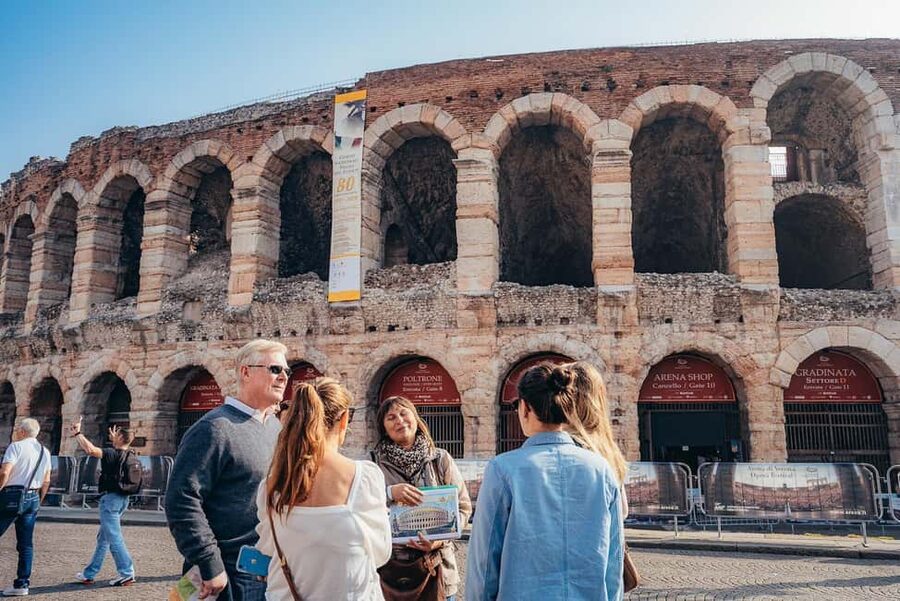
The tour saves its most famous sight for the end. That is a smart choice. After seeing Verona’s medieval streets and Roman traces, you arrive at Piazza Bra with enough context to understand why the Arena has remained the city’s great public stage for two millennia.
From the outside, the Arena is an enormous pink-and-white stone oval, though parts of its original outer ring were lost over time. Inside, you see the steep seating area and the open central floor where ancient spectacles took place. The guide explains the amphitheater’s gladiatorial past, but also brings the story forward to its present role as a venue for international festivals, music events, and opera.
That modern use is one of the Arena’s special qualities. This is not only an archaeological monument viewed from behind a barrier. It is still a working performance space. The scale becomes easier to appreciate when you consider how many people the structure was built to hold and how its broad stone tiers focus attention on the center.
The priority entry is useful at a popular sight such as this. It does not mean you have the Arena to yourself, and access arrangements can vary by day, but you avoid the standard ticket line included with ordinary entry. Your guide leads the Arena portion, which lasts about 45 minutes according to the planned schedule.
You should also know that the Arena visit comes after a 30-minute break in Piazza Bra. That pause gives you time to rest, find a drink, or use the facilities before the final visit. It also breaks up what would otherwise be a fairly demanding continuous walk.
More Walking Tours in Verona
- Verona: History and Hidden Gems Guided Walking Tour
★ 5.0 · 1,379 reviews - Verona: Small Group Guided Walking Tour with Arena Tickets
★ 4.9 · 848 reviews - Verona Highlights Walking Tour in Small-group
★ 5.0 · 493 reviews
Starting at Teatro Ristori and reaching Castelvecchio
The meeting point is in front of Teatro Ristori at Via Teatro Ristori, 3. Look for the guide holding a yellow sign marked Tour. This detail is worth taking seriously because Verona’s center has many similar-looking lanes and public spaces. Arrive with enough time to spot the sign rather than rushing in at the starting time.
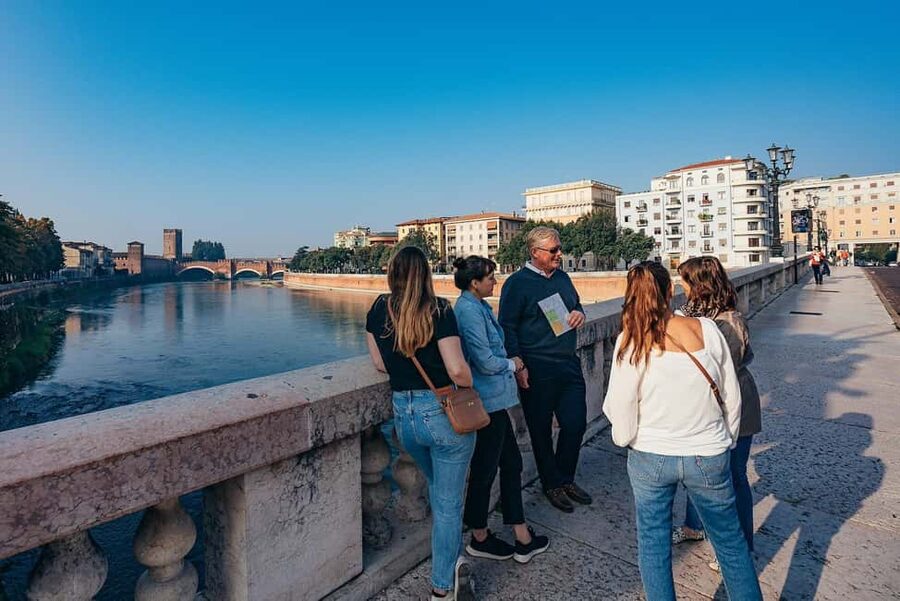
The first major stop is Castelvecchio, the medieval castle built by the Scaligeri family. The Scaligeri ruled Verona during the Middle Ages, and their influence appears repeatedly during this tour. Castelvecchio gives you an immediate sense of Verona as a fortified city, not simply a romantic setting attached to Shakespeare.
The nearby bridge, Castelvecchio Bridge, is part of the visit and photo stop. Its brick construction and defensive design make it one of the city’s most memorable medieval sights. Your guide helps you read the structure as a piece of military architecture, while also pointing out the way it connects the castle area with the city.
The castle and bridge are a strong opening because they offer visual variety right away. You are not spending the first hour staring at one façade while waiting for the tour to gather momentum. Instead, you begin with a large landmark, a crossing, and stories about the family that shaped much of medieval Verona.
Roman traces at the Gavi Arch and Porta Borsari
The route then shifts from medieval Verona to the Roman city. At the Arco dei Gavi, you see one of the city’s Roman markers and hear how Verona’s old roads and gateways shaped its growth.
Porta Borsari is another useful stop. This Roman gate once controlled entry into the city, and its surviving façade gives you a sense of the formal entrance visitors would have encountered in antiquity. It is not as complete or immediately dramatic as the Arena, so having a guide here adds real value. Without an explanation, you might pass it as an attractive wall with carved details.
I like this section because it connects the famous monuments to the less obvious ones. Verona’s Roman past is not confined to the Arena. It appears in fragments, gateways, street patterns, and building foundations scattered through the center. The guide’s comments help you notice those details instead of treating the city as a collection of unrelated photo stops.
Piazza delle Erbe and the center of daily life
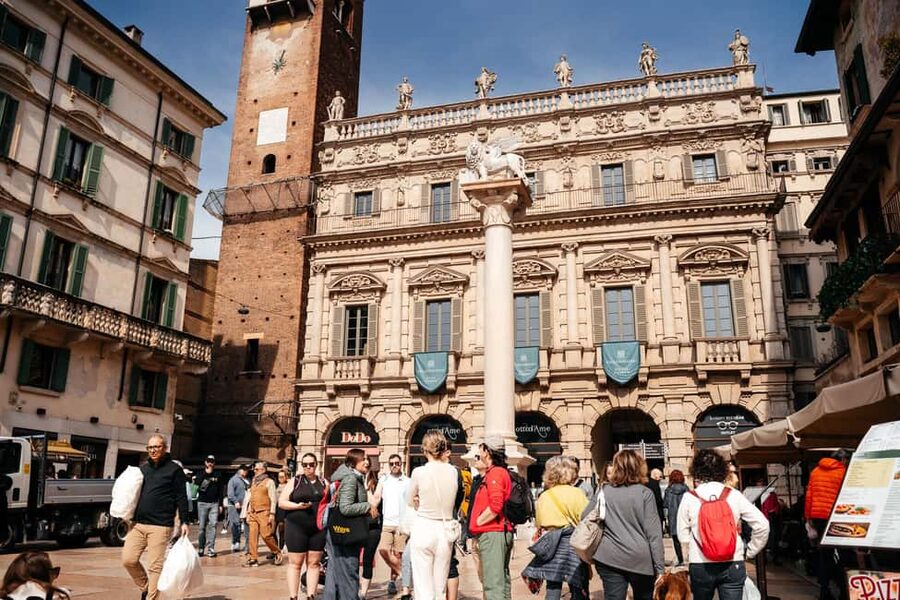
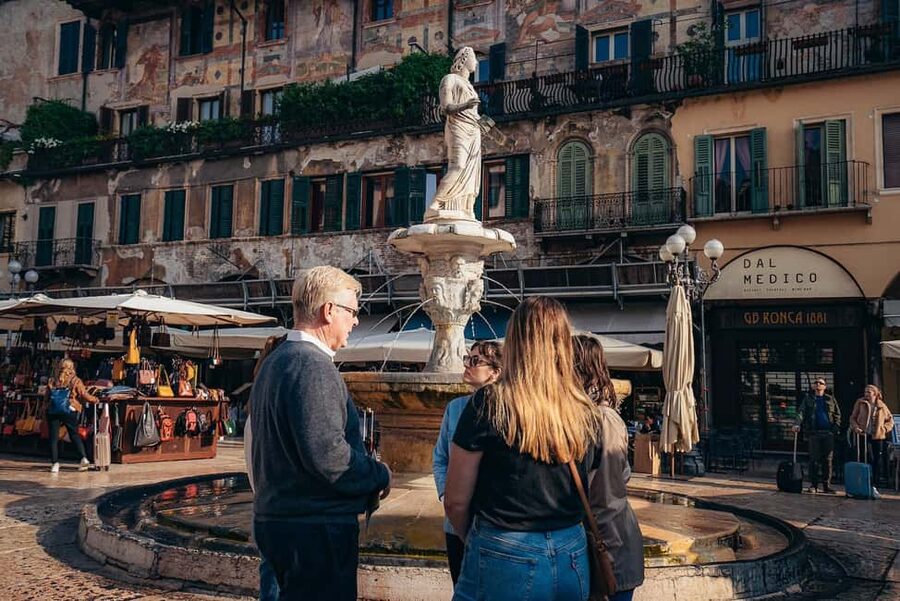
Piazza delle Erbe is one of Verona’s most atmospheric squares. The tour pauses for a photo and takes in the views as you move through the city. Its buildings, monuments, and market tradition create a very different mood from the stern stone of Castelvecchio.
This is also a good place to watch how Verona functions as a living city. The square is not just an old postcard backdrop. It has long been a center for trade and public activity, and the surrounding architecture shows layers from different periods.
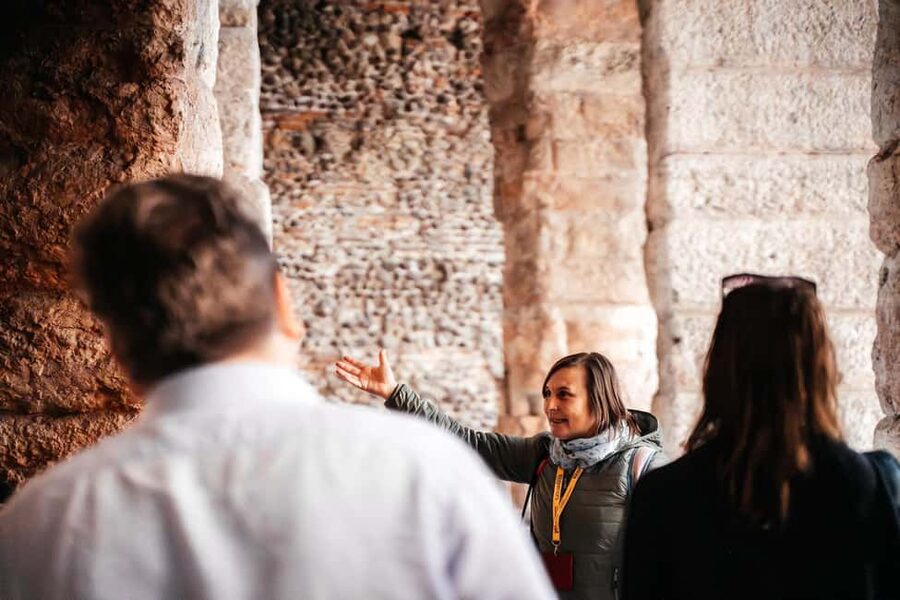
Your guide will likely point out small details that are easy to miss while you are focused on the square as a whole. Several guides have been praised for noticing details that independent visitors might walk past. That is one of the strongest reasons to book a guided walk in Verona: the value is often in the explanation, not merely in reaching the landmark.
The walk continues to Piazza dei Signori, another important civic space. Here the mood becomes more formal and political. The square is closely tied to Verona’s ruling families and public life, and your guide places the surrounding buildings within that story.
A different sort of day out around Verona:
- Verona: Hop-on Hop-off Tour 24 or 48-Hour Ticket
★ 4.4 · 2,010 reviews - Verona: Priority Access Arena Guided Tour
★ 4.6 · 1,152 reviews - Verona: Juliet’s House Fast-Track Entry Ticket & Audio Guide
★ 4.2 · 1,121 reviews - Verona: Arena di Verona Opera Ticket
★ 4.6 · 721 reviews
The Scaliger tombs and Verona’s ruling family
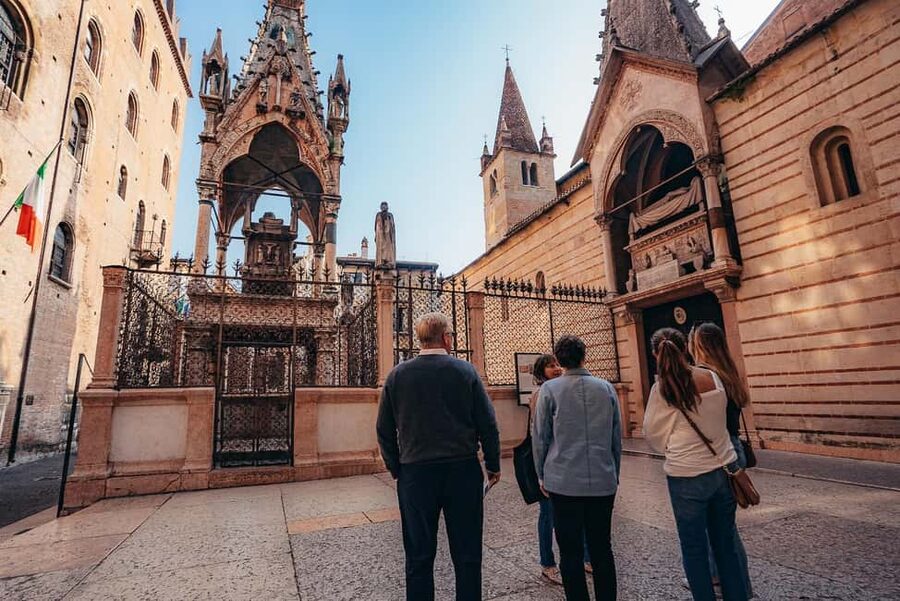
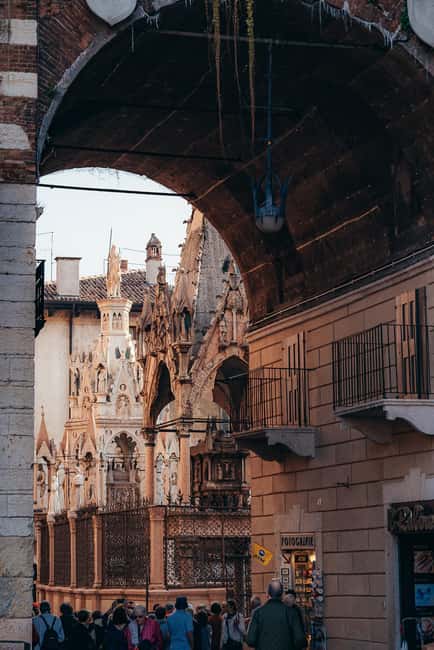
The Arche Scaligere are among the city’s most unusual monuments. These ornate Gothic tombs commemorate members of the Scaliger family, whose power shaped Verona in the 13th and 14th centuries.
You do not need to be an expert in medieval politics to enjoy this stop. The tombs are visually striking, enclosed by elaborate ironwork and decorated with stone sculpture. They show how ruling families used public monuments to display status, faith, and authority.
This is a good example of why the route feels broader than a standard Romeo-and-Juliet walk. You get the romantic story, but you also see the families and institutions that formed the real city. The guide can help separate legend from documented history without draining the fun from either one.
The tour’s strongest guides appear to be comfortable with this balance. Isabella is described as funny as well as well informed, while Andrea is praised for taking time with questions and explaining the important stops clearly. That combination matters on a walking tour. Facts are easier to remember when the person delivering them has a sense of timing and humor.
Juliet’s House and the limits of the famous story
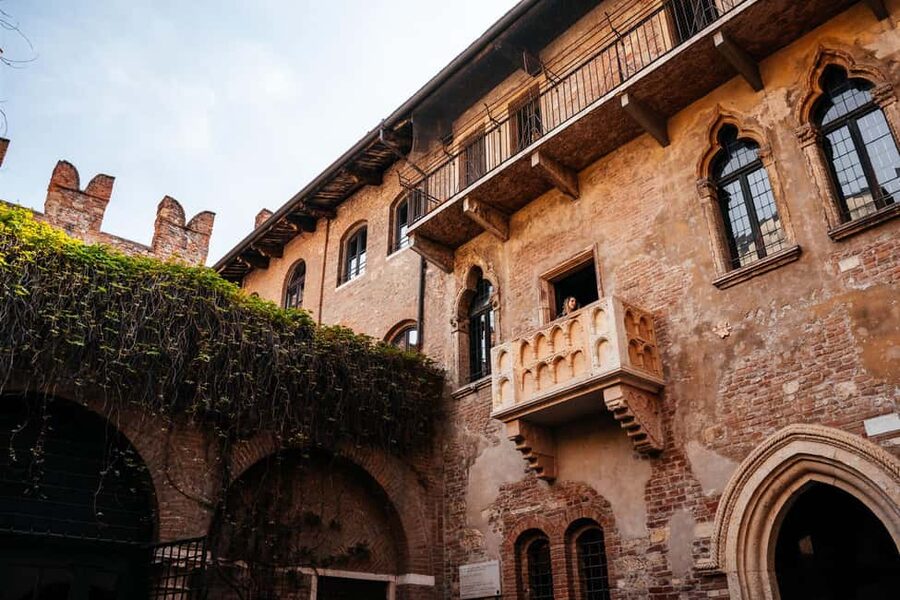
Juliet’s House is the most overtly romantic stop. You see the balcony associated with Shakespeare’s Juliet and hear legends and stories about Romeo and Juliet. It is an easy place to enjoy the theatrical side of Verona, even if you prefer your history firmly documented.
The stop is listed as a photo opportunity and guided visit. You should not expect the entire tour to become a long museum session devoted to Shakespeare. The balcony is one part of a wider route, and the guide uses it to explain Verona’s connection with the story and the way the legend has become part of the city’s identity.
That limited treatment is actually useful for many people. If you want a focused Shakespeare tour, you may find this experience too broad. If you want to see Juliet’s balcony without giving up the Roman, medieval, and civic sights, the balance works well.
The surrounding lanes are also part of the appeal. Verona’s center is compact, and walking between the landmarks lets you see how grand monuments sit beside ordinary streets and small corners. The guide’s local stories can make these short stretches as interesting as the formal stops.
A 30-minute pause in Piazza Bra
Before entering the Arena, you have a 30-minute break in Piazza Bra. This is a practical feature, not wasted time. Three hours of walking through stone streets can be tiring, especially in summer or in wet weather.
Use the pause to sit, get a drink, and check the next part of the schedule. If you are traveling with children or older family members, this rest may make the final Arena visit much more comfortable. It also gives you a chance to take photos of the piazza without having to listen and walk at the same time.
The tradeoff is that the tour does not offer a long leisurely café stop with time for extended conversation. One person specifically wished for more time to sit, drink, and chat with the group. If relaxed meals and long pauses are central to your idea of sightseeing, this tour may feel tightly planned.
What the small group changes
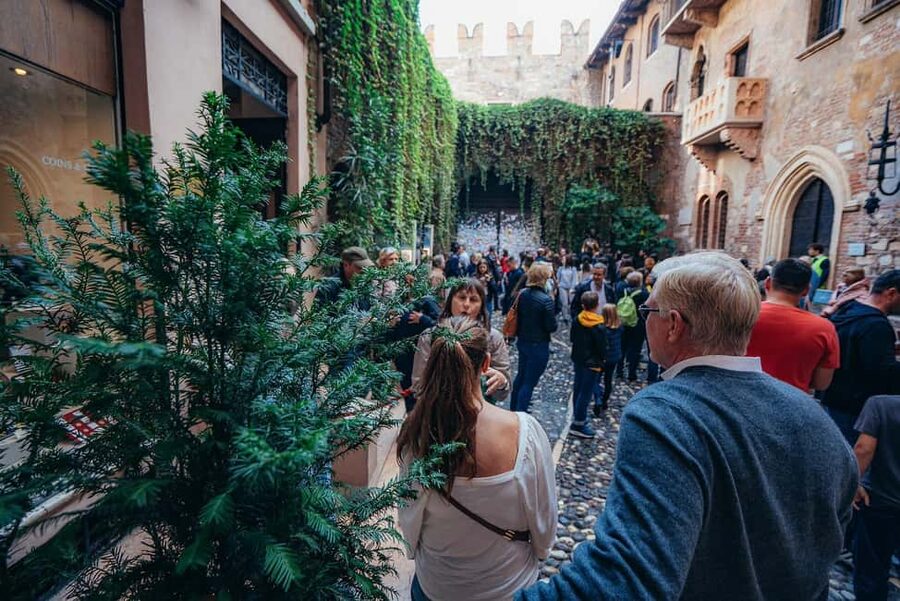
The group is limited to 12 people. That is a useful middle ground. You get the social ease of a group tour, but not the feel of a large crowd moving behind a flag.
A smaller group makes a difference at street corners and outdoor monuments, where a guide can keep everyone close without shouting. It also gives you a better chance to ask about food, neighborhoods, history, or places to return to later. Solo visitors may especially like this format, since it adds company without requiring a private booking.
Several guides are praised for personal interaction. Anna appreciated the experience as a solo visitor, while other participants valued guides who asked about their interests and adjusted their explanations. That does not guarantee the same style with every departure, but it suggests that the small format supports a more human exchange.
The languages offered are Italian and English. Confirm your chosen language when booking, since the live guide is not presented as multilingual on the same departure.
Is $81 a fair price?
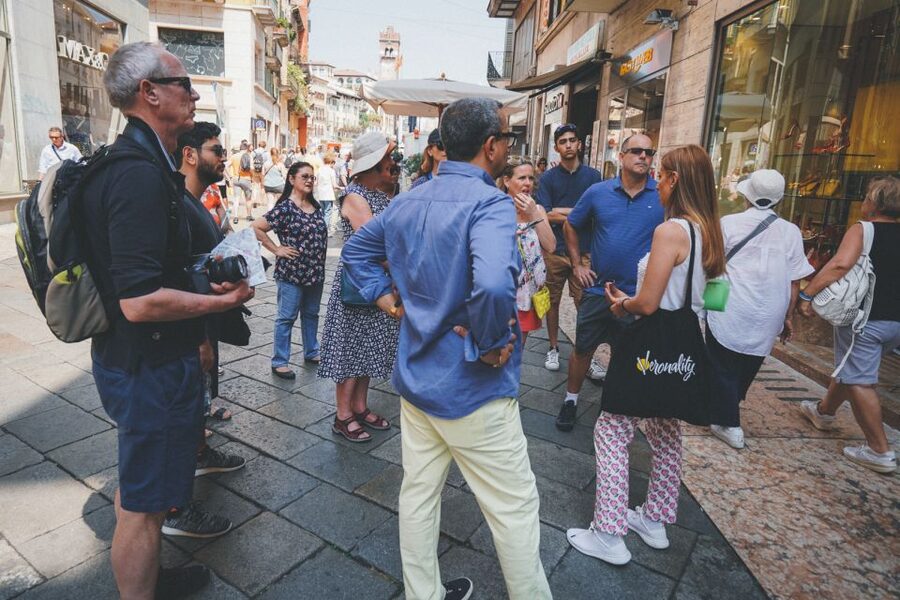
At $81 per person, this is not the cheapest way to see Verona. You can walk past many of these sights for free, and you can arrange Arena entry separately. The price makes more sense if you want one organized overview, a licensed local guide, and priority Arena access without having to plan the route yourself.
The tour covers a lot: Castelvecchio, its bridge, the Gavi Arch, Porta Borsari, Piazza delle Erbe, Piazza dei Signori, the Scaliger tombs, Juliet’s House, Piazza Bra, and the Arena. You are paying for the guide’s interpretation and for a coherent route through those places, not just admission to one attraction.
I would call it good value for a first visit, especially if you have limited time in Verona. It is less compelling for a repeat visitor who already knows the center and only wants to enter the Arena. In that case, an Arena ticket and a self-guided walk may cost less.
The 4.8 rating from 201 verified bookings supports the idea that the experience is generally consistent, especially in guide quality. The strongest praise centers on clear explanations, humor, enthusiasm, and a genuine affection for Verona. Frank, Isabella, Priscilla, Maria, Andrea, and Benedetta are among the guides singled out for making the city easy and enjoyable to understand.
Practical advice for a smoother walk
Wear shoes with good support. The tour moves through central streets and squares, and you will spend most of the experience on foot. Bring weather protection, since the tour runs rain or shine. A raincoat is more useful than an umbrella in a compact group, though the supplied information does not specify equipment provided by the operator.
Leave large bags and luggage elsewhere. They are not allowed on the tour, and hotel pickup and drop-off are not included. The meeting point is in the city center, so you need to arrange your own way there.
Minors must be accompanied by an adult, and unaccompanied minors are not permitted. Pets are also not allowed.
People with reduced mobility should ask the provider for precise access details before booking. Some parts of the route may not be easy for anyone with a disability. Since the experience combines streets, bridges, historic areas, and the Arena, conditions may vary from one stop to the next.
Free cancellation is available up to 24 hours before the start for a full refund. You can also reserve now and pay later, which helps if your Verona plans are still shifting.
Who should book this Verona walk?
I would choose this tour for a first visit, a short stay, or a day when you want a strong introduction without spending hours researching the route. It suits couples who want Juliet’s balcony and the Arena, families who need a planned route, and solo visitors who would enjoy a small social group.
It is also a good choice for anyone who likes history delivered through stories rather than long formal lectures. The guide style appears warm and conversational, with room for humor and questions.
I would hesitate if you dislike group schedules, need a fully accessible route, or want a slow morning with lengthy café breaks. The route is full, and the 30-minute pause is the main planned rest. You may also prefer a focused Arena tour if that monument is your only priority.
Should you book the Arena priority walking tour?
Book it if you want one well-planned introduction to Verona and value a local guide who can connect Roman, medieval, civic, and Shakespearean stories. The small group, broad route, and Arena entry make the $81 price easier to justify, especially on a first visit.
Skip it if you already know central Verona or prefer exploring at your own speed. For most newcomers, though, this is a practical way to get your bearings, see the major sights, and finish inside one of Italy’s most memorable ancient venues.
FAQ
Where does the tour begin?
The meeting point is in front of Teatro Ristori at Via Teatro Ristori, 3. Your guide will hold a yellow sign with the word Tour.
Where does the tour finish?
The tour finishes at the Verona Arena, also called the Arena di Verona, in Piazza Bra.
How long does the experience last?
The advertised duration is three hours. The schedule includes a 30-minute break before the Arena visit, followed by about 45 minutes inside the Arena.
Which languages are available?
Live guiding is available in Italian and English.
Is Arena entry included?
Yes. The tour includes a skip-the-line Arena ticket and a guided visit inside the amphitheater.
Can I bring luggage, pets, or an unaccompanied minor?
Pets and luggage or large bags are not allowed. Minors must be accompanied by an adult.
Just added around Verona
- Verona: Private 2-Hour Walking Tour★ 4.9 · 41 reviews
- Valpolicella Lunch or Dinner Wine & Food tasting with Amarone★ 5.0 · 43 reviews
- The 10 Tastings of Verona With Locals: Private Food Tour★ 4.5 · 45 reviews
- Arena di Verona Opera Ticket Package★ 4.0 · 46 reviews
- Unique Wine tasting in Verona, with Amarone docg★ 5.0 · 46 reviews
- Verona: the Arena at the Gladiators’ time★ 5.0 · 48 reviews
- Verona: Juliet’s House Fast-Track Entry Ticket & Audio Guide★ 3.5 · 52 reviews
- Valpolicella Wine Experience at Montresor winery★ 5.0 · 54 reviews
Walking Tours, compared.
Rialto Bridge & Offbeat Unusual Venice Walking Tour
Read our review →
Private 3 hrs Venice Tour: St Mark’s, Walking tour & Boat tour
Read our review →
Walking Guided Tour of the City Must-See Sites
Read our review →
Private Best of Venice Walking Tour with St Mark’s Basilica
Read our review →
Venice Sightseeing Small Group Walking Tour with a Local Guide
Read our review →Browse the lists this tour appears in