
Reviewed · HISTORICAL TOURS
Tour to discover the Unique History of Verona, the City of Art
Verona’s famous love story is only the final chapter. This walking tour begins at the Roman Arena and moves through medieval bridges, churches, noble tombs, political squares, and the streets tied to Romeo and Juliet. Guide Eugenio brings art, literature, local politics, and small architectural details into the story, giving you a fuller picture of the city.
I like the route’s broad sweep through Verona’s past, from ancient Rome to the Scaliger era and modern city life. I also like the small group limit of 15, plus the guide’s willingness to tailor the walk, offer restaurant and gelato suggestions, and sometimes collect you from a hotel or train station when arranged in advance.
The main caution is organization. Meeting times can shift, the starting point near Porta della Bra may be harder to spot during construction, and a few bookings have involved late schedule changes or cancellations. Confirm the time and meeting place carefully before setting out.
In This Review
- Key points to know before booking
- Why this Verona walk offers more than Juliet’s balcony
- Starting at the Arena di Verona
- Scaligero Bridge and Verona’s medieval power
- Roman Verona at Arco dei Gavi and Porta Borsari
- San Lorenzo and Santa Anastasia: Verona’s churches
- The Arche Scaligere and Casa di Romeo
- Piazza dei Signori and the civic heart of Verona
- Piazza delle Erbe and the everyday city
- Ending at Casa di Giulietta
- What the guide adds to the walk
- Price, pace, and practical value
- Who will enjoy this Verona tour most?
- Should you book the Unique History of Verona tour?
- FAQ
- How long does the Verona tour last?
- Where does the tour begin?
- Where does the tour end?
- What language is the tour offered in?
- What sights are included in the route?
- Is admission included at every stop?
- How many people can join the tour?
- Can I cancel for a full refund?
Key points to know before booking
- A full city-center route: Eleven stops cover Roman Verona, medieval power, major churches, public squares, and the Romeo and Juliet story.
- Eugenio is the central part of the experience: His strengths are art, literature, history, languages, humor, and local recommendations.
- Expect a walking tour, not a museum tour: Several sites are viewed from outside, and some admission fees are not included.
- Small groups matter: The maximum is 15 people, with private tours possible when scheduling leaves only one booking.
- Plan for roughly three hours: The listed duration is about 2 hours 30 minutes to 3 hours, with stops ranging from 5 to 20 minutes.
- Check your start time: Sessions are offered in morning and afternoon blocks, but individual times may change.
Why this Verona walk offers more than Juliet’s balcony
Many first visits to Verona follow a simple path from the Arena to Juliet’s House. That gives you the postcard sights, but it can leave the city feeling like a backdrop for a play. This tour adds the missing chapters: Roman gates, a medieval fortress bridge, church interiors, civic squares, and the tombs of the powerful Scaliger family.
That structure is the tour’s greatest strength. You do not simply collect photographs. You see how Verona changed hands, how its rulers used architecture to show power, and how religious buildings preserve stories in stone and paint.
Eugenio’s style also appears to be more conversational than scripted. He brings personal observations into the walk and invites questions. His background in art and literature is especially useful in the churches and squares, where a quick glance often misses the meaning of a fresco, monument, or carved detail.
The route is offered in English, and Eugenio has been described as speaking seven languages. His English has been praised for being lively and expressive. That matters in a city where the guide needs to explain not only dates, but also the political and literary ideas behind the buildings.
More History Tours in Verona
- Verona: History and Hidden Gems Guided Walking Tour
★ 5.0 · 1,379 reviews - Lazise: Historical Center Wine Tasting Tour
★ 4.9 · 110 reviews - Dark Historical Verona Walking Tour
★ 5.0 · 106 reviews
Starting at the Arena di Verona
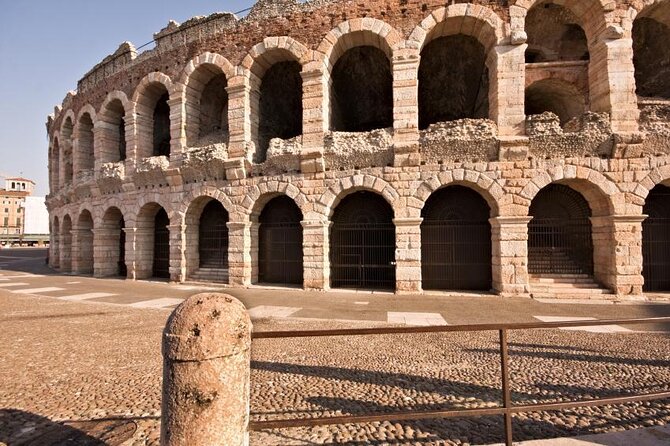
The meeting point is at I Portoni della Bra, Corso Porta Nuova 2. From there, the tour heads toward the Arena di Verona, the huge Roman amphitheater that dominates Piazza Bra.
The stop focuses on the Arena’s lesser-known story rather than only its size and famous opera performances. Admission is listed as free for the tour, so do not assume this portion includes entry inside the amphitheater. The value here is the explanation of the monument and its place in Verona’s past.
This is a good opening because the Arena gives you an immediate sense of scale. It also sets up the larger theme of the walk: Verona is not one period dressed up for tourists. Roman, medieval, Renaissance, and modern layers sit close together.
The square can be busy, and the meeting area may be less obvious if construction affects the gate. Use the address rather than relying only on a general description, and watch for any last-minute message about the exact meeting point.
Scaligero Bridge and Verona’s medieval power
The next stop is the Scaligero Bridge, also called the Castelvecchio Bridge. You have about eight minutes here, enough for photographs and a clear explanation of its military and political role.
The bridge is more than a pretty crossing over the Adige. Its strong brick structure and defensive character reflect the power of Verona’s Scaliger rulers. This is one of the places where a guide can help you read the building instead of simply admiring it.
The bridge is a fine example of the tour’s balance between major sights and short stops. You will not spend a long time at every monument, but you get a useful framework for understanding why it was built and what it meant to the city.
Roman Verona at Arco dei Gavi and Porta Borsari
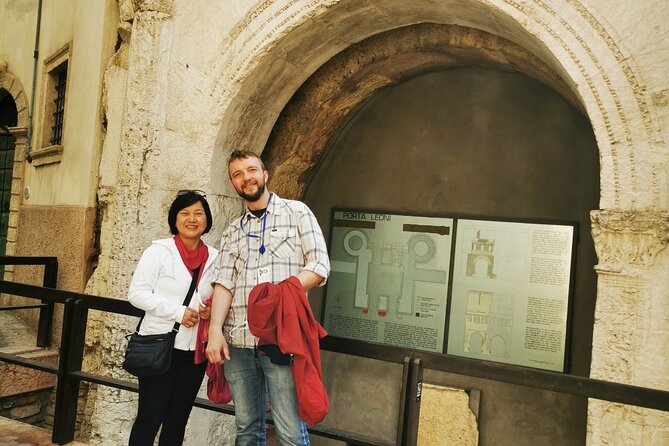
At Arco dei Gavi, the tour pauses for about 10 minutes. This Roman triumphal arch has had an unusual history, and that story gives the stop its appeal.
You then reach Porta Borsari, one of the most important reminders that modern Verona follows the outline of the Roman city. The gate once marked an entrance into Roman Verona, and its surviving stonework helps you picture the city as an organized imperial settlement rather than simply a medieval town.
Both stops are viewed without an included admission fee. They are also easy to overlook when you are rushing between Piazza Bra and the historic center. I value this part of the route because it makes the old city easier to read. Streets and walls begin to feel connected, not random.
A different sort of day out around Verona:
- Verona: Hop-on Hop-off Tour 24 or 48-Hour Ticket
★ 4.4 · 2,010 reviews - Verona: Priority Access Arena Guided Tour
★ 4.6 · 1,152 reviews - Verona: Juliet’s House Fast-Track Entry Ticket & Audio Guide
★ 4.2 · 1,121 reviews - Verona: Small Group Guided Walking Tour with Arena Tickets
★ 4.9 · 848 reviews
San Lorenzo and Santa Anastasia: Verona’s churches
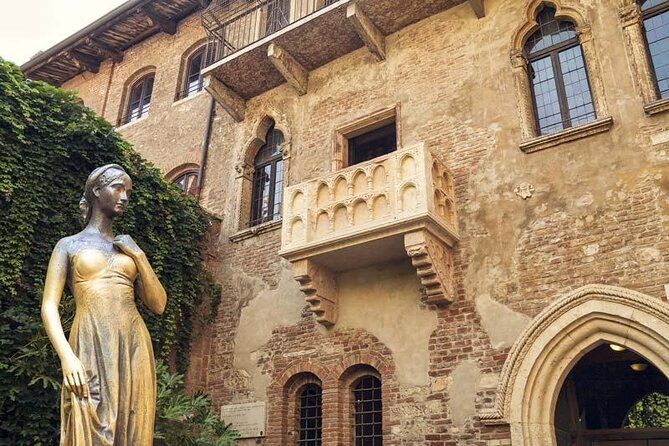
The walk continues to San Lorenzo, a Romanesque church dating to the 12th century. You have around 15 minutes here, with admission listed as included.
San Lorenzo is a quieter and more intimate stop than the Arena. Its age and Romanesque design give you a chance to see a different side of Verona’s religious architecture. This is also one of the places where Eugenio’s art and architecture background can add real value.
The route then reaches the Basilica di Santa Anastasia, described as the city’s largest church. The stop lasts around 10 minutes, but admission is not included, so check before booking if entering the basilica matters to you.
The churches are a strong part of the experience, but access can depend on what is happening inside. Weddings and other events have occasionally meant that a church was closed during a walk. If a particular interior is essential to your visit, treat it as a possibility rather than a guarantee.
The Arche Scaligere and Casa di Romeo
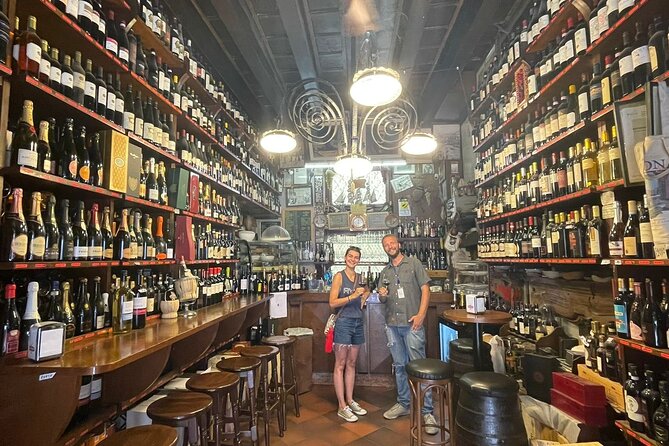
The Arche Scaligere are the monumental tombs of Verona’s Scaliger rulers. The stop lasts about 15 minutes and admission is listed as free for the tour.
These tombs are among the clearest expressions of medieval Verona’s ruling family. Their elaborate design shows how public power continued after death. A guide’s explanation is useful here because the details can look decorative until you understand the message behind them.
The route then makes a brief five-minute stop at Casa di Romeo, or Romeo’s House. This is the natural point to introduce the literary story of Romeo and Juliet, but the tour does not appear to reduce Verona to romance alone.
That is an important distinction. The city’s connection to Shakespeare is famous, but the medieval setting came first. Seeing the Scaliger tombs and Romeo’s House in the same walk helps you understand why the love story fits so strongly into Verona’s image.
Piazza dei Signori and the civic heart of Verona
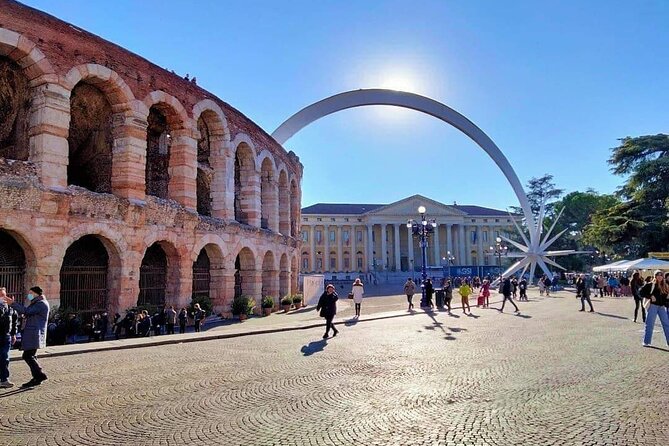
Piazza dei Signori receives about 20 minutes, making it one of the longer stops. This was Verona’s political center, and the square gives the guide room to explain the city’s government, ruling families, and public life.
I would pay close attention here if you want more than a list of dates. The strongest parts of this tour appear to be the links between architecture and politics. Buildings show who held authority, how wealth was displayed, and how the city’s fortunes shifted over time.
The square also provides a welcome change of pace. After Roman ruins, bridges, and churches, you get a space designed for civic life. It is a good place to ask questions about Verona’s past and present, since Eugenio has also shared information about local events and future plans for the city.
Piazza delle Erbe and the everyday city
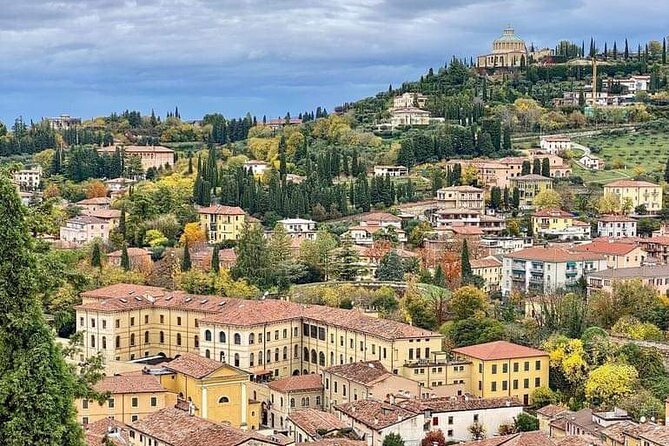
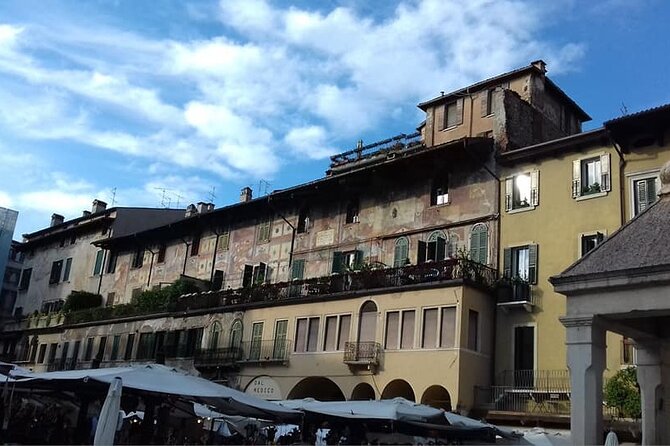
Piazza delle Erbe is another 20-minute stop. This is Verona’s central market square and one of the best places to watch the city at work.
The square is full of things to notice, so the guide’s help can be practical. Rather than wandering through without a plan, you can learn which buildings, monuments, and visual details deserve your attention. This is also a useful point to ask for food or drink suggestions.
Eugenio has recommended restaurants, wine spots, and gelato places to people on the walk. Those suggestions are not a formal tasting, but they can help you plan the rest of your stay. The tour is especially useful early in a Verona visit because you can return to places that caught your eye.
Ending at Casa di Giulietta
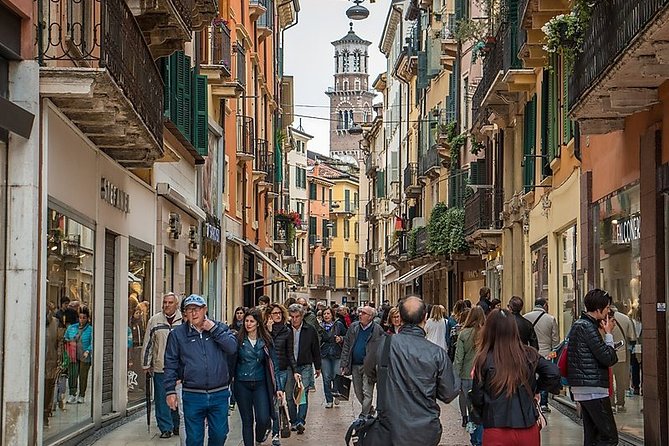
The final stop is Casa di Giulietta on Via Cappello 23. The tour ends here after about 20 minutes, close to Verona’s most famous attraction.
Juliet’s House is the expected finale, but it is worth approaching with clear expectations. The balcony is a popular tourist symbol, not a verified piece of Shakespeare’s story. One useful feature of this tour is that the literary tale is placed after the Roman, religious, political, and medieval sections of the city.
That order gives the ending more meaning. You see Juliet’s House as part of Verona’s modern identity, not the entire reason the city matters.
The end point is also practical. You finish in the historic center, near one of Verona’s busiest sights, with easy access to continue exploring on your own. It can be crowded, so take the guide’s explanation first and allow extra time if you want to enter or linger nearby.
What the guide adds to the walk
Eugenio is repeatedly praised for his command of art, history, literature, and local affairs. He has also been described as warm, funny, accommodating, and willing to answer detailed questions.
His strongest contribution is interpretation. He points out things you might otherwise walk past, including frescoes and architectural details whose meaning is not obvious at first glance. He can also present different viewpoints, which is useful if you have already taken another Verona tour.
The tone is not designed for everyone. One critical experience described the guide as rushed, overly personal, and too informal, with concerns about phone use and smoking. The guide’s direct style may appeal to people who want conversation, but you should not expect a polished, neutral script at every moment.
There have also been scheduling problems. Some participants received requests to move from afternoon to morning, while others faced a cancellation close to the start time. These incidents appear to be exceptions within a largely positive record, but they are serious enough to justify confirming the appointment shortly before the walk.
Price, pace, and practical value
At $70.14 per person, this is not the cheapest way to see Verona’s center. The price makes more sense if you want an informed guide, a long route, and context at eleven important sites rather than a short introduction to the Arena and Juliet’s House.
The small-group limit of 15 helps protect the experience from becoming a moving crowd. In some cases, schedule changes have resulted in a private walk for a family or an individual. Do not count on that outcome, but it shows why the final group size can vary.
The tour lasts about 2 hours 30 minutes to 3 hours. Most stops are short, with 20 minutes reserved for the two main squares and Juliet’s House. You should be comfortable walking and standing for much of the morning or afternoon.
The listed sessions run from 9:30 to 11:30, noon to 2:00, and 2:30 to 4:30, from Monday through Sunday during the stated operating period. The exact meeting time may be adjusted, so read your confirmation closely.
Pickup is offered, and some participants have arranged collection from a hotel or the train station. Treat this as something to confirm with the provider, not an automatic part of every booking. Public transportation is nearby, service animals are allowed, and most people can take part.
Free cancellation is available up to 24 hours before the start time. If the minimum number is not reached and the experience is canceled, you are offered another date or activity, or a full refund.
Who will enjoy this Verona tour most?
I would choose this walk if you want Verona’s history explained through buildings, stories, and city life. It suits first-time visitors who want a strong orientation, as well as repeat visitors who feel they have seen the usual sights but missed the details.
It is also a good match for people interested in art and literature. The churches, frescoes, Roman monuments, medieval tombs, and Shakespeare connection all receive space on the route.
Families and small groups may benefit from the flexible approach. Eugenio has adapted walks to different interests and ages, and his recommendations can help you use the rest of your time in Verona.
You may want another option if you prefer a tightly timed tour with no changes, a formal presentation, or guaranteed access inside every church. The route is broad, but admission is not included at every site, and closures can happen because of weddings or other events.
Should you book the Unique History of Verona tour?
Book it if your goal is to understand Verona rather than simply photograph it. The route covers an unusually wide range of the city, and Eugenio’s strongest qualities are his art background, literary knowledge, local perspective, and willingness to adjust the conversation.
Before paying, confirm the exact start time, meeting location, and pickup details. Also keep your schedule flexible enough to handle a possible change. If you can accept those practical limits, the tour offers good value for a serious introduction to Verona, especially early in a stay when you can use the restaurant, gelato, wine, and sightseeing suggestions afterward.
FAQ
How long does the Verona tour last?
The experience lasts approximately 2 hours 30 minutes to 3 hours.
Where does the tour begin?
The meeting point is I Portoni della Bra, Corso Porta Nuova 2, 37122 Verona.
Where does the tour end?
The walk ends at Casa di Giulietta, Via Cappello 23, 37121 Verona, near Juliet’s House.
What language is the tour offered in?
The tour is offered in English. Eugenio has also been described as speaking seven languages.
What sights are included in the route?
The route includes the Arena di Verona, Scaligero Bridge, Arco dei Gavi, San Lorenzo, Porta Borsari, Basilica di Santa Anastasia, Arche Scaligere, Romeo’s House, Piazza dei Signori, Piazza delle Erbe, and Casa di Giulietta.
Is admission included at every stop?
No. Some stops are free, San Lorenzo has admission included, and admission to Santa Anastasia is not included. The tour information does not list an included entrance to the Arena.
How many people can join the tour?
The maximum group size is 15 people.
Can I cancel for a full refund?
Yes. You can cancel at least 24 hours before the start time for a full refund. Changes or cancellations made less than 24 hours before the start time are not accepted for a refund.
Just added around Verona
- Verona: Private 2-Hour Walking Tour★ 4.9 · 41 reviews
- Valpolicella Lunch or Dinner Wine & Food tasting with Amarone★ 5.0 · 43 reviews
- The 10 Tastings of Verona With Locals: Private Food Tour★ 4.5 · 45 reviews
- Arena di Verona Opera Ticket Package★ 4.0 · 46 reviews
- Unique Wine tasting in Verona, with Amarone docg★ 5.0 · 46 reviews
- Verona: the Arena at the Gladiators’ time★ 5.0 · 48 reviews
- Verona: Juliet’s House Fast-Track Entry Ticket & Audio Guide★ 3.5 · 52 reviews
- Valpolicella Wine Experience at Montresor winery★ 5.0 · 54 reviews
Historical Tours, compared.
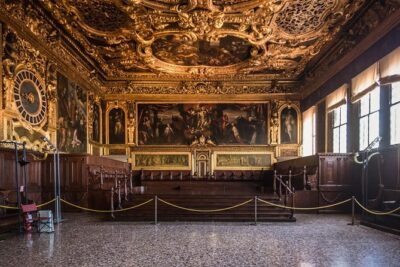
Venice’s Best: Basilica, Doge’s Palace, Gondola & History Gallery
Read our review →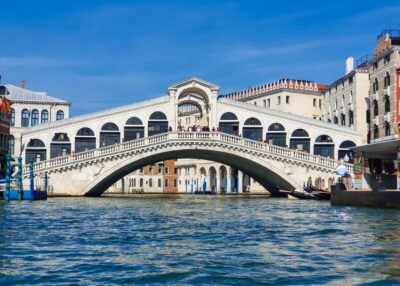
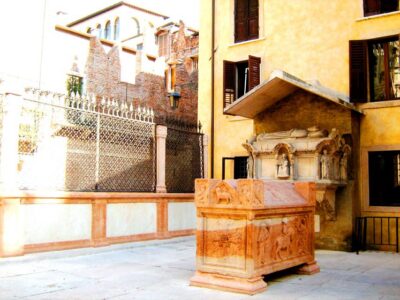
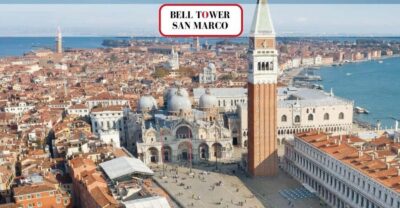
Bell Tower & St Mark’s Square History Gallery Ticket
Read our review →
Basilica, Doge’s Palace, History Gallery & Bell Tower Option
Read our review →
St. Mark’s Cathedral Priority Guided Tour & History Gallery
Read our review →
Browse the lists this tour appears in