
Reviewed · CITY TOURS
Trieste Exploration Game and City Tour on your Phone
Trieste’s past comes in layers here: Roman ruins, Habsburg-era streets, Italian civic squares, and a Serbian Orthodox church all fit into one compact walk. This phone-based exploration game gives you a clear route and short quizzes instead of a guide speaking at you.
I like the very low price, about $9.66 per person, and the freedom to begin any time during the listed hours. I also like the mix of major sights and smaller historical stops, especially the Roman Arch, Roman Theatre, and Canal Grande.
The main tradeoff is simple: you are on your own. The activity is not an audio tour, a live walking tour, or a ticket to the paid sights, so you need to read the information on your phone and arrange any entries separately.
In This Review
- Key points to know before you book
- A phone-led introduction to Trieste’s many pasts
- San Giusto Hill and the Castle of Saint Giusto
- The Arco di Riccardo and Trieste’s Roman beginning
- The Roman Theatre, built under Augustus
- Piazza dell’Unita d’Italia and the Italian chapter
- Teatro Lirico Giuseppe Verdi and Trieste’s opera tradition
- Piazza della Borsa and the city of commerce
- Saint Spyridon and Trieste’s Serbian community
- Canal Grande and the Habsburg free port
- What the $9.66 price really gets you
- Who should choose this self-guided format?
- Booking, languages, and cancellation details
- Should you book this Trieste exploration game?
- FAQ
- Where does the Trieste exploration game start?
- Where does the activity end?
- How long does the experience take?
- Is a personal guide included?
- Is this an audio tour?
- Which languages are available?
- Are entrance tickets included?
- Can I use the activity on my phone browser?
- What is the cancellation policy?
Key points to know before you book
- Eight central Trieste stops: The route links San Giusto, Roman remains, grand civic squares, a historic opera house, a Serbian Orthodox church, and Canal Grande.
- A self-guided game, not a guided tour: You follow directions, read short guides, and answer quizzes through an app or mobile browser.
- About 1 to 2 hours: The planned stops are roughly 15 minutes each, though your pace and any monument visits will affect the total.
- Three sights have admission excluded: Entry to the Castle of Saint Giusto, Teatro Lirico Giuseppe Verdi, and Saint Spyridon Church is not included.
- Four languages are available: You can use the experience in English, French, German, or Spanish.
- A useful budget option: At $9.66, it costs little more than a coffee and gives you a ready-made route through central Trieste.
A phone-led introduction to Trieste’s many pasts
This route works because Trieste is easy to read as a sequence of eras. You begin above the city at San Giusto, where Roman defenses and later medieval and Habsburg structures shaped the hilltop. From there, the route moves downhill toward the old city center, passing ancient ruins, grand public spaces, churches, and the canal.
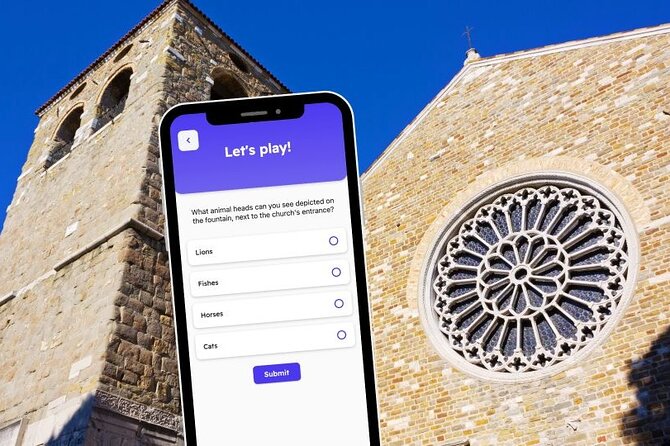
The activity uses your phone as both map and guide. You receive information about each monument, then answer quiz questions as you go. That small game element matters because it gives you something to do at each stop instead of simply glancing at a building and moving on.
You can use an Android or iOS app, or access the activity through a browser. The listed languages are English, French, German, and Spanish. Since there is no personal guide, this format suits you best if you like setting your own pace and stopping for photos without holding up a group.
The advertised opening period runs from July 1, 2024, through July 2, 2027, with access listed every day from midnight to 11:30 p.m. That broad window gives you plenty of flexibility, though the activity itself lasts only about one to two hours.
A few more Trieste days to weigh up
- Trieste Bus Tour with Audio Guide
★ 4.5 · 1,648 reviews - Trieste Bus Tour with Audio Guide
★ 4.0 · 214 reviews - Trieste: Miramare Castle & Museum Entry Ticket & Audio App
★ 4.2 · 213 reviews
San Giusto Hill and the Castle of Saint Giusto
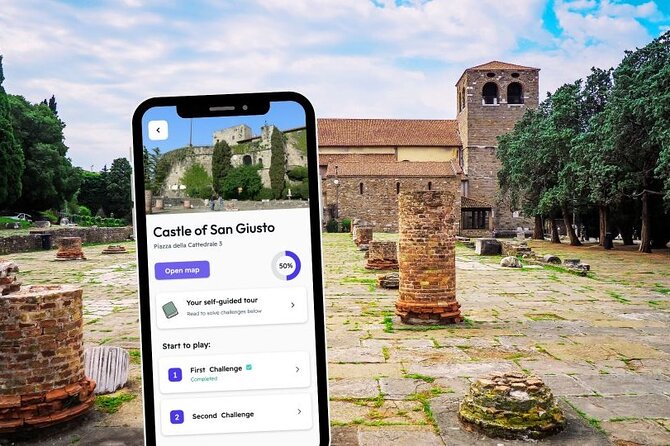
The route begins at Cattedrale di San Giusto Martire, at Piazza della Cattedrale 2. The first listed sight is the Castle of Saint Giusto, a strong opening because it places Trieste’s later story on top of an older Roman defensive site.
The castle took shape over several centuries. Construction began in the 15th century, with important additions continuing into the 17th century. Its foundations and setting connect it to fortifications that existed in Roman times, so this is not just a castle stop. It is a chance to see how military power kept adapting as the city changed.
You have about 15 minutes assigned here. That is enough for a quick look and some photographs, but not necessarily enough if you want to explore every paid area. Admission is not included, so check the entrance arrangements separately if you want to go inside.
I would treat this first stop as orientation. From the hill, you can understand that Trieste is not only a waterfront city. The route starts with defense and authority, then brings you down toward trade, public life, and religious communities.
The Arco di Riccardo and Trieste’s Roman beginning
Next comes the Arco di Riccardo, one of the oldest surviving structures in Trieste. The arch dates from the Roman period, around the 1st century BCE, which places it before the Roman Theatre and centuries before the city’s later Austro-Hungarian identity.
The stop is free and planned for about 15 minutes. That makes it an easy addition to the route, though you should expect a short street-side visit rather than a long museum-style experience. The value lies in seeing an actual Roman remnant within the modern city.
The quiz format is useful here. A very old arch can be easy to overlook when you are surrounded by later buildings. A prompt that asks you to look closely at its age or purpose helps fix the site in your memory.
The Roman Theatre, built under Augustus
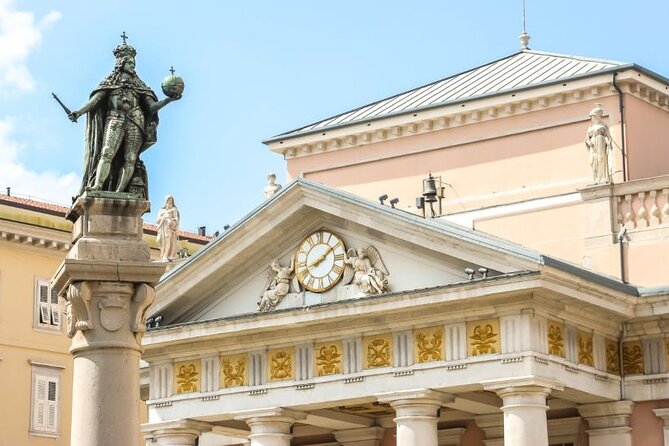
The Roman Theatre of Trieste follows naturally. Built in the 1st century AD during the reign of Emperor Augustus, it could hold between 3,500 and 6,000 spectators. That capacity gives you a better sense of Roman Trieste as a substantial urban center, not a minor outpost.
The theater is free to view, and the planned stop is another 15 minutes. You will want to use that time to understand the scale of the remains and their place in the present city. The activity provides background through written guides, but it does not supply spoken narration.
This is one of the route’s strongest history stops because it shows public entertainment as part of Roman city life. You can also compare it with the arch: one is a surviving architectural fragment, while the other suggests the size and social life of the ancient population.
A different sort of day out around Trieste:
- Lake Bled and Ljubljana Tour from Trieste
★ 4.5 · 193 reviews - Trieste: 2.5-Hour Prosecco Origins Tour and Tastings
★ 4.9 · 193 reviews - Trieste: Guided Foodie Walking Tour
★ 4.9 · 142 reviews - Postojna Cave & Predjama Castle from Trieste
★ 4.5 · 122 reviews
Piazza dell’Unita d’Italia and the Italian chapter
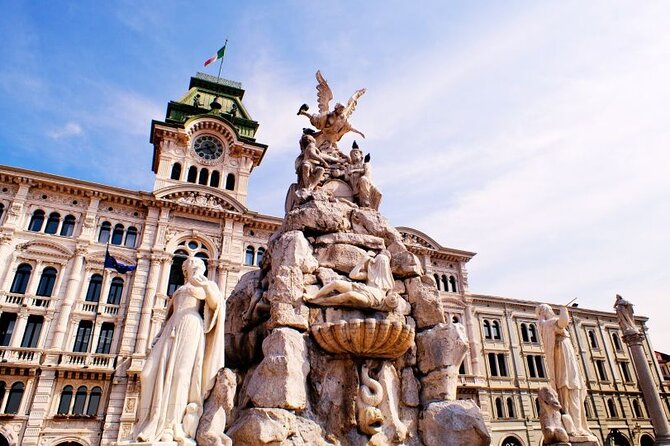
The route then reaches Piazza dell’Unita d’Italia, the broad civic square that has been part of Trieste’s urban life since the 19th century. Its name means Square of the Unification of Italy and refers to Trieste joining the Kingdom of Italy in 1918.
The square helps explain why Trieste can feel different from many other Italian cities. Its public architecture and history reflect its long position under Habsburg rule, its role as a major port, and its later incorporation into Italy. You are not simply seeing an attractive open space. You are standing in a place where political identity changed.
The visit is free and planned for 15 minutes. Give yourself a little time to look around before moving on, since a large square can feel like a quick photo stop if you only follow the next instruction. The quiz may encourage you to notice details that would otherwise pass by.
This is also a good place to pause the activity if you want a coffee or a longer look. Because the experience is self-guided, you do not need to match anyone else’s schedule.
Teatro Lirico Giuseppe Verdi and Trieste’s opera tradition
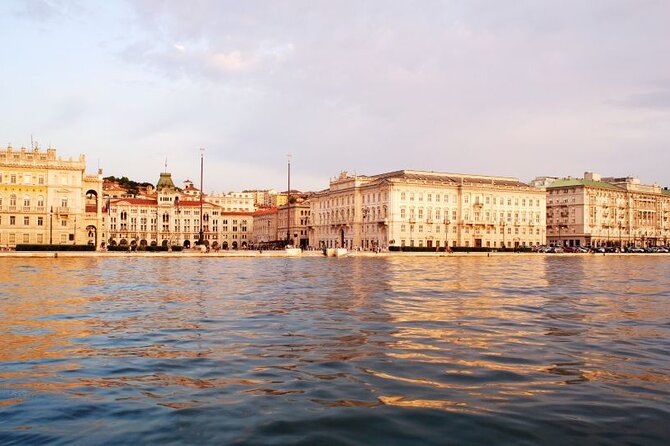
The Teatro Lirico Giuseppe Verdi opened in 1801, originally under the name Teatro Nuovo. In 1901, it was renamed for the composer Giuseppe Verdi, giving the building its present name and linking the theater to Italy’s opera tradition.
The stop is planned for about 15 minutes, but admission is not included. That distinction matters. The route can introduce the theater from the outside, while a performance or interior visit would require a separate arrangement.
The theater is a useful counterpoint to the Roman Theatre. Both are places built for large public audiences, but they belong to very different political and cultural periods. The Roman site speaks to imperial urban life, while Teatro Verdi reflects Trieste’s 19th-century cultural ambitions and its connection to the wider Italian world.
If you care about opera, check separately for entry or performances. The activity itself should not be treated as an opera-house ticket.
Piazza della Borsa and the city of commerce
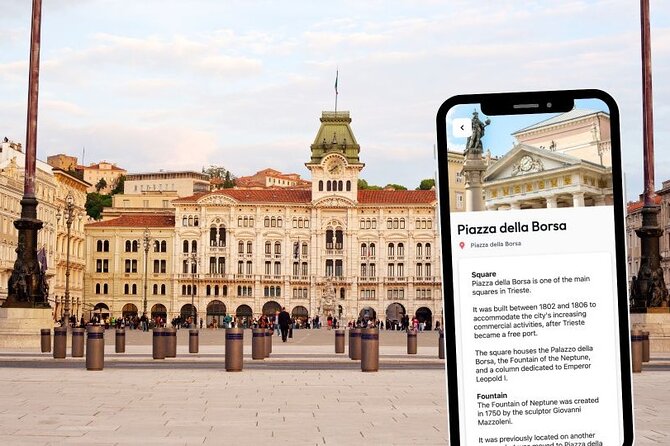
Piazza della Borsa continues the city-center walk. The square became a major focus of economic and social activity in the 19th century, and its name comes from the historic Borsa Vecchia, or Old Stock Exchange, building.
This stop adds an important piece to the route. Trieste’s story is not only about rulers, armies, and monuments. Its growth also depended on business and trade. The square helps you picture the city as a port where commercial activity shaped public life.
Admission is free, with about 15 minutes planned. Since the site is part of the regular city fabric, you can look at it without a formal entrance. The written guide and quiz provide the historical frame that a casual walk might miss.
I like this stop because it connects the grand scale of Piazza dell’Unita d’Italia with the practical work of making a port city function. You move from national symbolism to the buildings and spaces that supported daily commerce.
Saint Spyridon and Trieste’s Serbian community
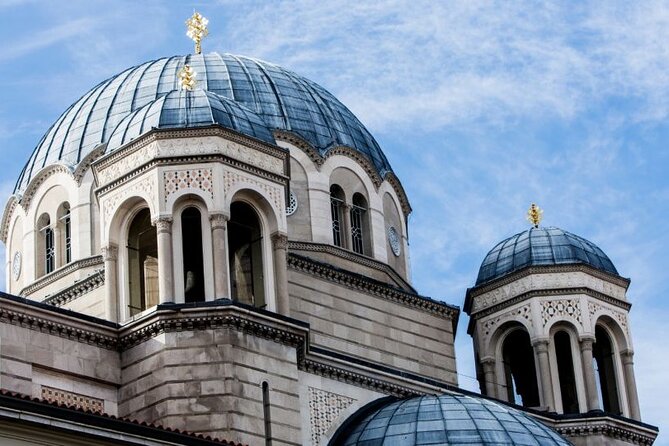
The Serbian Orthodox Church of Saint Spyridon brings a different religious and cultural voice into the walk. It was built between 1861 and 1869 for Trieste’s Serbian Orthodox community.
That community played an important role in the city’s commercial and cultural life, particularly during the 18th and 19th centuries, when Trieste was a major port under the Austro-Hungarian Empire. This is one of the most distinctive stops because it reminds you that port cities are shaped by communities arriving from many places.
The planned visit is 15 minutes, and admission is not included. If you want to enter, arrange or pay for access separately. Be respectful of the fact that this is a church, not simply a decorative stop on a sightseeing route.
The activity’s short written guide is especially useful here. Without context, you might notice the building but not understand why a Serbian Orthodox church belongs so firmly in Trieste’s story. It shows how trade brought people, faiths, and customs into the city.
Canal Grande and the Habsburg free port
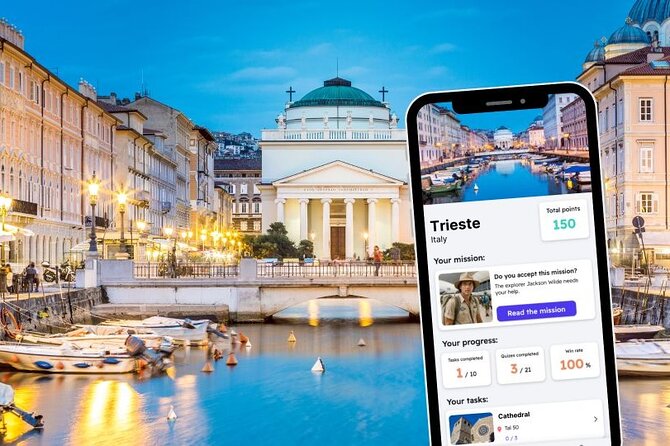
The final listed stop is Canal Grande, constructed between 1754 and 1756 while Trieste was a free port under the Habsburg Empire. The canal gives the route a fitting finish because it returns your attention to water, trade, and the city’s practical connection to the sea.
The canal stop is free and planned for 15 minutes. It is a pleasant place to finish the sightseeing sequence, especially after the hilltop castle and the dense concentration of central monuments. The setting also brings together several themes from the route: Habsburg administration, port commerce, and Trieste’s growth as an international city.
After this stop, the activity ends back at the starting meeting point. The supplied route therefore functions as a loop rather than a one-way walk that leaves you to find your own way home.
What the $9.66 price really gets you
At around $9.66 per person, the value is strong if you want structure without paying for a private guide. You receive the route, monument information, and quizzes, covering eight stops for less than the cost of many live city tours.
The low price does not mean you receive every part of a conventional tour. You do not get a personal guide, spoken narration, or entrance tickets. You also need your own phone and must manage the route yourself.
I would compare it with paying for a map or guidebook chapter. The advantage is that the route is already arranged and the quiz questions make the walk more active. The drawback is that you cannot ask a follow-up question when a historical detail catches your interest.
The activity is described as private, with only your group participating. In practice, that means you are not placed into a shared guided group. It does not mean a guide accompanies you. This distinction is worth understanding before booking.
Who should choose this self-guided format?
I would recommend it to independent visitors who want a short introduction to Trieste’s center and prefer flexible timing. It also suits couples, families, and small private groups who enjoy quiz-based sightseeing.
It is a good choice if you want to cover major themes quickly: Roman Trieste, the Habsburg period, Italian national history, opera, trade, and religious communities. The route gives you a practical first look before you decide which places deserve more time.
You may want another option if you need detailed historical discussion, spoken commentary, or help entering paid monuments. The activity will not replace a personal guide, and the 15-minute allocation at each stop is brief for anyone who likes long museum visits.
Bring a charged phone and allow extra time if you want to pause, take photographs, or visit the paid sites. The route itself is timed at roughly one to two hours, but your actual outing can be longer.
Booking, languages, and cancellation details
Confirmation is provided when you book. The activity is available on Android and iOS apps or through a browser, and the guide content and quizzes can be used in English, French, German, or Spanish.
Service animals are allowed, and the route is near public transportation. The information says most people can participate, but no detailed mobility notes are provided, so you should consider the hilltop starting point and city walking conditions for your own needs.
You can cancel for a full refund up to 24 hours before the experience start time. Cancellations made less than 24 hours before the start are not refunded, and changes inside that period are not accepted. The cut-off follows Trieste local time.
Should you book this Trieste exploration game?
Book it if you want a low-cost, flexible route that does more than point out postcard views. The strongest feature is the combination of ancient Roman sites, Habsburg-era landmarks, Italian civic spaces, and a Serbian Orthodox church in one short walk.
The quiz format is a real benefit if you enjoy learning by looking and answering rather than listening to a long lecture. Just remember what you are buying: a phone-based activity, not a personal guide, audio tour, or admission pass.
At $9.66, I see it as a smart first walk through Trieste. Add separate entrance tickets only where your interests justify them, and give yourself more than the planned 15 minutes at any stop you want to explore properly.
FAQ
Where does the Trieste exploration game start?
It starts at Cattedrale di San Giusto Martire, Piazza della Cattedrale 2, 34121 Trieste, Italy.
Where does the activity end?
The activity ends back at the meeting point.
How long does the experience take?
The estimated duration is one to two hours, with about 15 minutes planned at each of the eight stops.
Is a personal guide included?
No. This is a self-guided activity accessed through your smartphone, and no personal guide is included.
Is this an audio tour?
No. The activity includes written guides and quizzes, but it is not an audio tour.
Which languages are available?
The activity is available in English, French, German, and Spanish.
Are entrance tickets included?
No. Admission is not included for the Castle of Saint Giusto, Teatro Lirico Giuseppe Verdi, or Serbian Orthodox Church of Saint Spyridon. The Arco di Riccardo, Roman Theatre of Trieste, Piazza dell’Unita d’Italia, Piazza della Borsa, and Canal Grande are listed as free stops.
Can I use the activity on my phone browser?
Yes. You can use an Android or iOS app, or access the activity through your browser.
What is the cancellation policy?
You can cancel at least 24 hours before the experience start time for a full refund. Cancellations or changes made less than 24 hours before the start are not accepted, and payment is not refunded.
Just added around Trieste
- Private Tour to Slovenia from Trieste★ 4.0 · 3 reviews
- Lipica Stud Farm & Skocjan Caves – Small Group Tour from Trieste★ 4.5 · 3 reviews
- Trieste: coffee dive! espresso tasting★ 5.0 · 3 reviews
- Trieste: Freemasons and Secret Societies Guided Tour★ 4.3 · 3 reviews
- Trieste: Private Pasta-Making Class at a Local’s Home★ 3.8 · 4 reviews
- Habsburg Trieste Private Guided Walking Tour★ 5.0 · 4 reviews
- Airport transfer from Trieste Airport to Koper★ 5.0 · 4 reviews
- Private Transfer from Trieste Airport or City to Pula, Rovinj★ 5.0 · 4 reviews
City Tours, compared.
Walking Guided Tour of the City Must-See Sites
Read our review →

Verona e-bike tour: city center and panoramic views
Read our review →
City Walking Tour with Cable Car & Wine Aperitif
Read our review →
Winter Pass Top Attractions & City Walking Tour
Read our review →
Browse the lists this tour appears in