
Reviewed · AUDIO TOURS
Trieste Bus Tour with Audio Guide
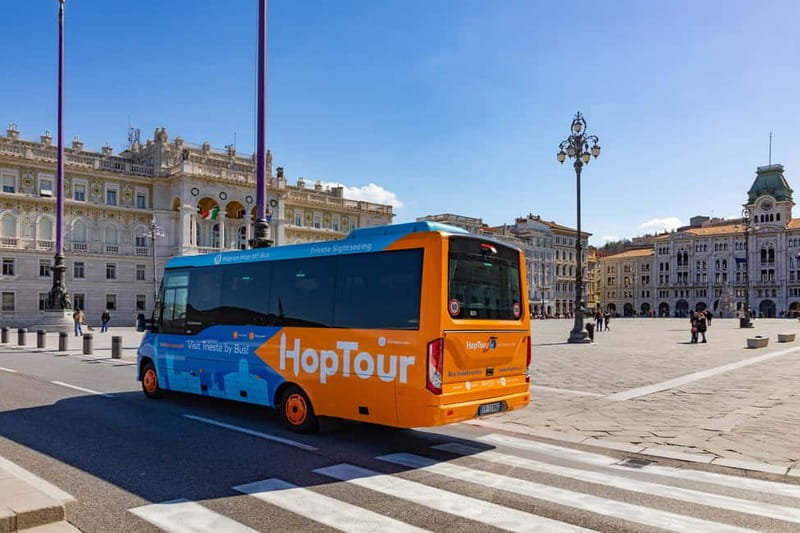
Trieste’s best introduction may be its waterfront: from Piazza Unità d’Italia and Molo Audace, the bus traces the city’s grand squares, old port, Roman theater, hilltop San Giusto, and seaside road to Miramare Castle. I like the clear audio commentary and the fact that the same ticket lasts 24 hours, so you can use the ride as both a city orientation and a practical way to reach outlying sights.
I also like the air-conditioned bus with USB charging, especially on a hot day or after arriving from a cruise with bags in tow. The main caution is timing: buses can be about an hour apart, and the Miramare stop leaves you roughly 700 meters from the castle, so a quick hop-off visit may feel rushed.
In This Review
- Key points at a glance
- Why this bus tour works well in Trieste
- From Piazza Unità to the old harbor
- Roman remains and Trieste’s church-lined center
- Canal Grande, Borsa Square, and the city center
- Goldoni Square, Carducci Boulevard, and the train station
- The coastal road to Barcola and Miramare
- What the audio guide adds
- Comfort, accessibility, and practical details
- How I would use the 24-hour ticket
- Who should book this Trieste tour?
- FAQ
- Where does the Trieste bus tour start?
- Where does the tour end?
- How long is the bus tour?
- Is the ticket valid for more than one ride?
- Is my seat guaranteed on every bus during the 24-hour period?
- Which languages are available for the audio guide?
- Does the tour include entrance to Miramare Castle or other monuments?
- How far is the Miramare Castle stop from the castle?
- Are pets allowed on the bus?
- Does the bus have air conditioning and USB charging?
Key points at a glance

- A full city-and-coast loop: See the Roman theater, Serbian Orthodox Church, Canal Grande, San Giusto Hill, Barcola, and Miramare Castle without arranging separate transport.
- A 24-hour ticket: Your booked ride lasts 1.5 hours, but the ticket remains valid for 24 hours.
- Clear multilingual commentary: Choose Italian, English, German, or Spanish audio synchronized with the route.
- Useful in hot weather: The air-conditioned bus gives your feet a break while still covering a lot of ground.
- Miramare requires a walk: The bus stops about 700 meters from the castle, which matters if you have limited energy or mobility.
- Pet-friendly with a condition: Dogs and other permitted pets must wear a muzzle.
Why this bus tour works well in Trieste

Trieste can feel spread out at first. Its central squares and churches are easy to explore on foot, but the old port, San Giusto Hill, Barcola, and Miramare Castle pull you in different directions. This tour links them in one circuit, giving you a useful map of the city before you decide where to spend your limited time.
The route begins at Molo Audace, in front of Piazza Unità d’Italia. That is an excellent place to start because the square faces the water and gives you an immediate sense of Trieste’s unusual mix of grand Austro-Hungarian architecture and Adriatic setting.
For $19, you get the bus, audio guide, onboard assistance, and a ticket valid for 24 hours. That is good value if you complete the full circuit and then use the service to reach one or two places you want to see more closely. It is less compelling if you only want a quick ride and will not use the hop-on, hop-off option.
The booked course lasts about 1.5 hours. You can remain onboard for the whole loop, or leave at a stop and take a later bus if there is space. Your seat is guaranteed only for the ride you originally booked, so do not treat every later departure as a guaranteed reservation.
A few more Trieste days to weigh up
- Trieste Bus Tour with Audio Guide
★ 4.0 · 214 reviews - Trieste: Miramare Castle & Museum Entry Ticket & Audio App
★ 4.2 · 213 reviews - Trieste Walking Tour with Audio and Written Guide by a Local
★ 4.5 · 73 reviews
From Piazza Unità to the old harbor
The opening stretch introduces Trieste through its waterfront and port. You pass Molo Audace, a pier built on the wreck of an old ship, then continue along the Mandracchio shore beside Piazza Unità d’Italia. This is the city’s grand public room, and seeing it from the road helps you understand how closely Trieste’s civic life is tied to the sea.
The bus then passes the Salone degli Incanti and Eataly along the Nazario Sauro shore. The Salone occupies a former fish market, while this part of the waterfront gives you a look at Trieste’s modern public spaces and food culture.
Next comes Via Ottaviano Augusto, with views toward the lighthouse and the La Lanterna baths, followed by Campo Marzio Station and the Sea Museum. These stops are useful for building a mental map of the southern waterfront, though most are pass-by points rather than formal sightseeing visits.
The old port area follows, including the Central Hydrodynamics building and Piazza Venezia. The port is one of the more distinctive parts of Trieste because the city’s trade, transport, and daily life have long been tied to the water. If you are interested in maritime subjects, note the Sea Museum and old port for a later visit.
Roman remains and Trieste’s church-lined center
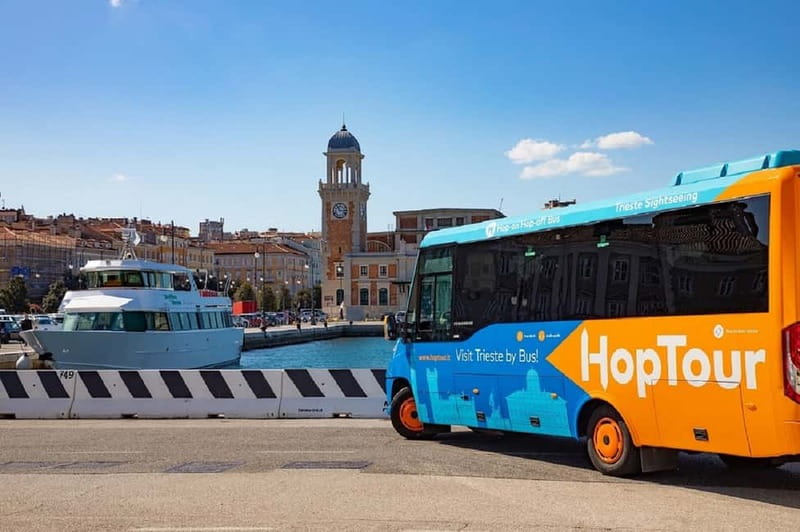
The bus turns inland toward the Roman Theatre of Trieste on Via del Teatro Romano. The theater is set below the modern streets, a reminder that Roman Trieste is not only a museum idea but part of the city’s physical structure.
You also pass Santa Maria Maggiore Church before reaching the Serbian Orthodox Church of Saint Spyridon on Saint Spiridione Street. Its domes and decorative exterior make it one of the city’s most recognizable religious buildings. The route then continues to Saint Antonio Square and the Church of Sant’Antonio Nuovo.
This section is one reason the bus is helpful on a first visit. You get quick views of several places that can blur together when you are walking unfamiliar streets. The audio guide adds context in English, German, Italian, or Spanish, and the commentary is synchronized with what appears outside the window.
Do not expect the audio to replace a walking visit. It gives you the basic story and points out what you are seeing, but the churches, theater, and squares reward a slower look. I would mark two or three favorites during the ride, then return on foot after the loop.
Canal Grande, Borsa Square, and the city center
The route continues along Roma Street, passing Vittorio Veneto Square, the Canal Grande, and Ponterosso Square. The canal cuts into the center and gives Trieste an elegant, slightly unexpected urban view. This is one of the easiest sections to revisit on foot after the ride.
From there, the bus reaches Borsa Square along Italia Boulevard. The area connects several important central streets, so it is a handy place to orient yourself if you are planning a walking circuit through the center.
The tour then climbs toward San Giusto Hill. You pass the Castle of San Giusto and the Church of San Giusto, both important stops for anyone interested in Trieste’s older defensive and religious core. The bus does not include admission to either monument, so the ticket covers the ride and commentary only.
San Giusto is also where you notice the advantage of having transport. The hill can be a tiring walk, especially in warm weather. The bus lets you see the setting first and decide later if you want to spend time at the castle and church.
A different sort of day out around Trieste:
- Lake Bled and Ljubljana Tour from Trieste
★ 4.5 · 193 reviews - Trieste: 2.5-Hour Prosecco Origins Tour and Tastings
★ 4.9 · 193 reviews - Trieste: Guided Foodie Walking Tour
★ 4.9 · 142 reviews - Postojna Cave & Predjama Castle from Trieste
★ 4.5 · 122 reviews
Goldoni Square, Carducci Boulevard, and the train station
After San Giusto Hill, the bus descends through Goldoni Square and along Carducci Boulevard. This part of the route is less about one single sight and more about showing how the central districts fit together.
You then pass Oberdan Square, known for its tram station, and Libertà Square beside Trieste’s train station. This is especially useful if you are arriving or departing by rail. One practical option is to take the full circuit after arriving, then use your remaining time to walk from the city center or station to the sights that interested you most.
The bus can also be handy when you have luggage. A passenger carrying large bags after leaving a cruise found the route useful for reaching the train station while getting an introduction to the city. The available information does not promise luggage storage as a formal service, but the bus has an under-bus compartment that has been used for large bags.
The coastal road to Barcola and Miramare
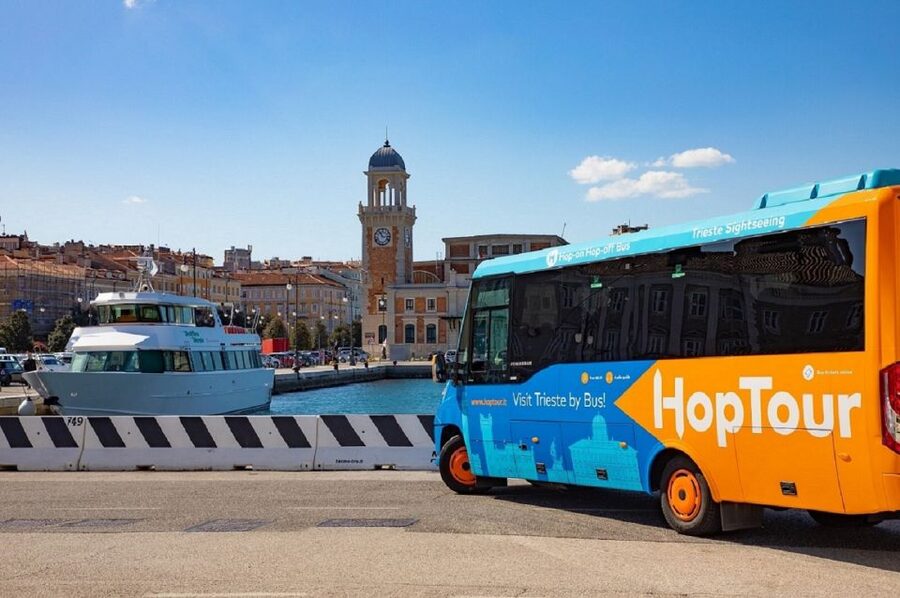
The trip changes character after the station. Along Miramare Boulevard, you pass the old port, then travel toward Barcola and its pinewood. This is the part of the circuit where the city opens toward the Adriatic, and the ride gives you a break from dense streets and stone facades.
Barcola Beach and the Topolini Baths follow. These seaside bathing platforms are a distinctly local feature, and they show how Trieste uses its waterfront for everyday recreation. The bus only passes by unless you choose to get off, so keep your eyes open as you approach this stretch.
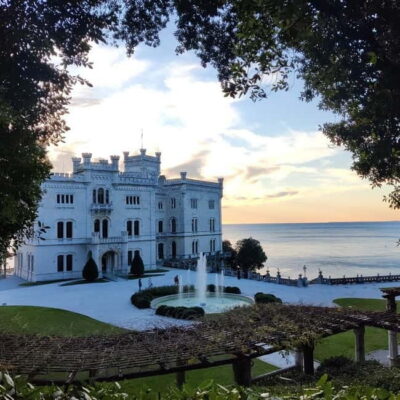
The route then reaches the Barcola crossroads and Miramare Castle. The castle itself is one of the major reasons to take the full loop, but plan carefully. The bus stop is about 700 meters away, and the walk there and back can take enough time to limit your visit, especially on a hot day or for anyone who walks slowly.
If Miramare is your priority, check the bus schedule before leaving the vehicle. The service can have roughly an hour between buses, so a casual hop-off can turn into a long wait. You will need to balance the walk to the castle, time in the grounds, and the next departure.
The bus passes the Barcola seafront again before returning toward the station and center. This gives you a second chance to note the coast if the weather improves or visibility changes. On a cloudy day, the outward views may be limited, so the coastal portion is most rewarding when the air is clear.
What the audio guide adds
The audio guide is included and available in four languages: English, Italian, German, and Spanish. Commentary is synchronized with the route, so you can match the spoken explanation to the monument outside rather than constantly searching for the right place on a map.
The tone is designed for orientation, with history and cultural information in manageable portions. I like this format for Trieste because the city has several layers, Roman, maritime, imperial, religious, and modern, and a little explanation helps connect them.
Onboard staff also help with timing and stop information. You can ask how long to spend at a stop and how to use the next bus. The staff have been described as friendly, patient, punctual, and helpful, which matters when the hop-on, hop-off system is not completely obvious at first.
One small point needs attention: the booking time does not always make the 24-hour hop-on, hop-off arrangement clear. When you board, confirm how to signal that you want to rejoin a later bus and ask about the day’s departure intervals. That simple question can save you a frustrating wait.
Comfort, accessibility, and practical details
The bus is air-conditioned and equipped with USB chargers. That is more than a small luxury on a hot Trieste afternoon, particularly if you have been walking uphill to San Giusto or waiting with a phone running maps and photographs.
The bus is also useful for older passengers and anyone who cannot manage a full city walk. It removes the need to climb every slope and covers the long coastal stretch in one ride. Still, the Miramare stop involves a walk, and the tour does not include entrance tickets or a dedicated visit inside any monument.
Pets are allowed only when wearing a muzzle. If you are bringing an animal, treat this as a firm condition rather than a minor suggestion.
The tour ends where it begins, at the Molo Audace area in front of Piazza Unità d’Italia. The starting point is sometimes described as Piazza Unità d’Italia and sometimes as Molo Audace, so look for the bus at the waterfront in front of the square. A lack of prominent signage can make the pickup point harder to spot, so arrive with enough time to locate the vehicle.
Free cancellation is available up to 24 hours before departure, and you can reserve now and pay later. Those terms are useful if your Trieste plans depend on a cruise schedule or changing weather.
How I would use the 24-hour ticket
On a short visit, I would begin with the complete circuit and stay onboard. That gives you the broadest view of Trieste in about 1.5 hours and helps you choose where to return.
On a longer visit, I would use the first ride to identify two central stops, perhaps the Roman Theatre and Canal Grande, then plan a separate walk. I would treat Miramare as its own outing unless I had enough time to handle the 700-meter walk and wait for the next bus.
Starting early is important if you want to make several hop-off stops. With buses potentially an hour apart, one long coffee stop or a slow museum visit can change the rest of your day. Keep the route map available, and ask the onboard guide about the next departure before you leave the bus.
The tour is also a sensible first activity after arriving by train or cruise. It gives you the city layout without demanding a full day of walking, and it can carry you toward the train station at the end of your stay.
Who should book this Trieste tour?
I would choose it for a first visit, a short stop, a hot day, or a trip with older family members. It is also a good fit if you want to see the coast and Miramare without arranging separate transport.
I would be less likely to book it if you already know Trieste well or plan to spend the day inside museums and churches. The audio guide is useful, but this is still a panoramic introduction, not a guided walking tour with entry to the sights.
At $19, the value is strongest when you stay for the full loop and use the 24-hour validity. You get an efficient overview, comfortable transport, helpful staff, and a chance to return to selected stops. Just plan around the long gaps between buses and the walk from the Miramare stop.
FAQ
Where does the Trieste bus tour start?
Board the bus at Molo Audace, in front of Piazza Unità d’Italia.
Where does the tour end?
The tour returns to the meeting point at Molo Audace and Piazza Unità d’Italia.
How long is the bus tour?
The scheduled tour lasts about 1.5 hours.
Is the ticket valid for more than one ride?
Yes. The ticket is valid for 24 hours, and you can hop off and take a later bus if there is a seat.
Is my seat guaranteed on every bus during the 24-hour period?
No. Your seat is guaranteed only for the course you originally booked. Later buses are subject to available seating.
Which languages are available for the audio guide?
The audio guide is available in English, Italian, German, and Spanish.
Does the tour include entrance to Miramare Castle or other monuments?
No. Entrance tickets to attractions and monuments are not included.
How far is the Miramare Castle stop from the castle?
The stop is about 700 meters from Miramare Castle, so allow time for the walk there and back.
Are pets allowed on the bus?
Yes, but pets are allowed only if they are wearing a muzzle.
Does the bus have air conditioning and USB charging?
Yes. The bus is air-conditioned and includes a USB charger.
Just added around Trieste
- Trieste: Private guided tour of Trieste★ 5.0 · 48 reviews
- Trieste: digital audioguide made with a local for your tour★ 4.2 · 49 reviews
- Experience Slovenian Coast line with Wine Tasting from Trieste★ 5.0 · 50 reviews
- Trieste Private Walking Tour with a Local★ 4.5 · 52 reviews
- Transfer from Trieste to Venice Airport★ 5.0 · 53 reviews
- Miramare Castle and the park★ 5.0 · 55 reviews
- Piran & Panoramic Slovenian Coast from Trieste★ 5.0 · 76 reviews
- Prosecco Origins Wine Experience★ 5.0 · 79 reviews
Audio Tours, compared.
La Fenice Opera House Entry Ticket with Audio Guide
Read our review →
Juliet’s House Fast-Track Entry Ticket & Audio Guide
Read our review →
Gondola Tour under the Bridge of Sighs & Audio Guide
Read our review →
St. Mark’s Basilica Priority Ticket and Audio Guide
Read our review →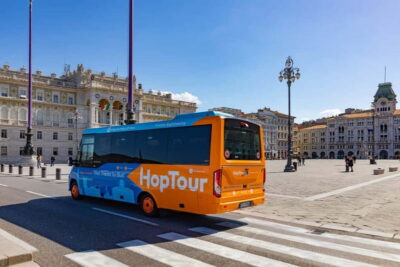
Miramare Castle & Museum Entry Ticket & Audio App
Read our review →Browse the lists this tour appears in