
Reviewed · WALKING TOURS
Habsburg Trieste Private Guided Walking Tour
Trieste’s Habsburg-era center is best understood on foot, one square and narrow street at a time. This private walk links the seafront Piazza Unità d’Italia with the old commercial quarter, Canal Grande, grand palaces, and the café-lined streets of Borgo Teresiano.
I like the private format, which gives you room to ask questions and, when timing allows, adjust the focus. I also like the clear route through central Trieste, especially if this is your first visit and you want to get your bearings quickly.
The main consideration is price: at $147.87 per person, this is a serious spend for two and a half hours. It makes the most sense for a small group that values personal guidance, rather than for someone happy to explore with a map.
In This Review
- Key points before you book
- Why Trieste’s Habsburg story works so well on foot
- Piazza Unità d’Italia: Trieste’s grand opening scene
- Borgo Teresiano: the commercial heart of the route
- Canal Grande and the palaces around Palazzo del Tergesteo
- Piazza Ponterosso and Via San Nicolò
- Daniella, Esther, and the value of the guide
- Is $147.87 per person a fair price?
- Who should book this private walk?
- Practical details that affect your day
- Should you book the Habsburg Trieste walk?
- FAQ
- Where does the Habsburg Trieste Private Guided Walking Tour begin?
- Where does the tour end?
- How long does the walking tour last?
- What language is the tour offered in?
- Is this a private tour?
- What places are included on the route?
- Are entrance tickets included?
- Is public transportation available near the tour?
- What is the cancellation policy?
Key points before you book
- Piazza Unità d’Italia opens the story: Begin beside the sea, surrounded by Trieste’s grand historic palaces.
- Borgo Teresiano gets the most time: About an hour is set aside for Piazza della Borsa, the Verdi Theatre, and the former Habsburg commercial quarter.
- The route stays in central Trieste: You visit Canal Grande, Palazzo del Tergesteo, Palazzo Gopcevich, and Palazzo Scaramagnà.
- A private guide changes the pace: Only your group takes part, so questions and small schedule changes are easier to manage.
- English is offered: Guides have included Daniella and Esther, both praised for clear, engaging explanations and strong local knowledge.
- No paid entrances are included: The experience is an outdoor walking tour, so admission fees for any site requiring a ticket are extra.
Why Trieste’s Habsburg story works so well on foot
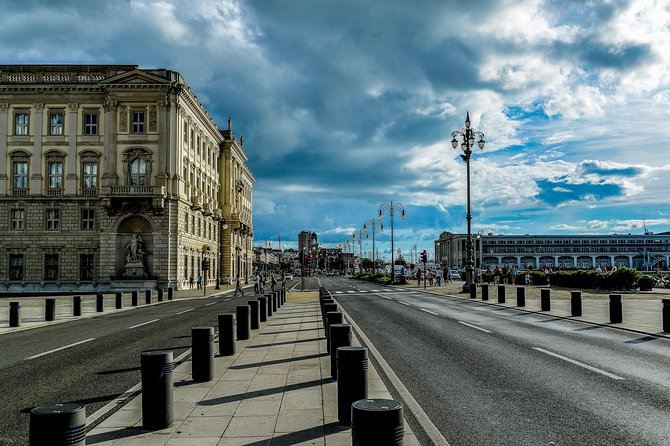
Trieste can feel different from the Italian cities you may have visited farther south. Its broad seafront square, orderly nineteenth-century streets, grand civic buildings, and Central European air reflect its long role within the Habsburg world.
That mixture is the point of this tour. You are not simply ticking off monuments. You are following the way the city developed as a major port under Habsburg rule and later within the Austro-Hungarian Empire. The guide connects the buildings to the political and commercial forces that shaped Trieste.
A private walk is useful here because the story can otherwise seem scattered. One building looks Italian, another recalls Vienna, and the narrow streets may feel like a maze when you first arrive. A good guide helps you see that these pieces belong to one urban story.
I would especially value this tour early in a stay. The route covers several central areas without requiring transport, and one review specifically praised it as a useful way to become familiar with Trieste’s narrow streets. You can then return to the places that caught your eye, perhaps for a meal, a coffee, or a closer look at a palace facade.
The walk lasts about two hours and thirty minutes, so it is long enough to provide a proper introduction without taking over your day. You should still expect to be on your feet for the full route. Comfortable shoes matter, and you will get more from the experience if you leave room in your schedule rather than rushing to the next appointment.
More Walking Tours in Trieste
- Trieste: Guided Foodie Walking Tour
★ 4.9 · 142 reviews - Trieste: 2-Hour Private Walking Tour
★ 4.8 · 87 reviews - Trieste Walking Tour with Audio and Written Guide by a Local
★ 4.5 · 73 reviews
Piazza Unità d’Italia: Trieste’s grand opening scene
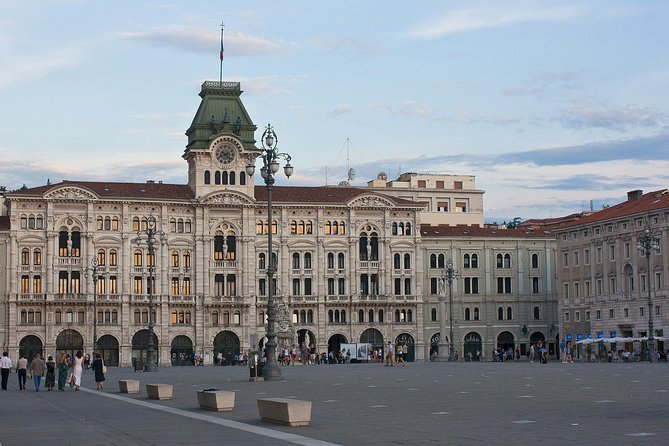
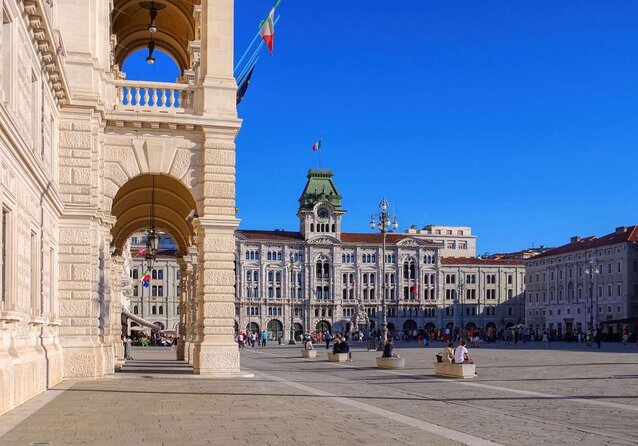
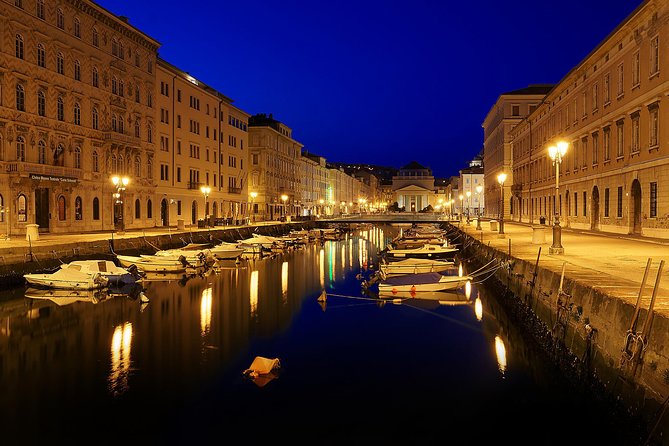
The tour begins at Piazza Unità d’Italia, at number 8. This is Trieste’s great public square, facing the sea and framed by imposing historic palaces. It is a strong starting point because the setting immediately shows you the city’s unusual character: an Italian city with a distinctly Central European civic style.
About fifteen minutes are planned here. That may sound brief, but the square works best as an introduction rather than a full architectural lecture. Your guide can point out the relationship between the open waterfront and the formal buildings, then explain how Trieste’s position on the Adriatic helped make it important to the Habsburg Empire.
Take a moment to look across the square before following the guide inland. The sea view is not a minor backdrop. It helps explain why Trieste became such a valuable port and why so much money went into its public architecture.
The square is also a practical meeting point. It is central, easy to recognize, and close to the rest of the route. Since the walk ends back at the starting point, you can use the area as a convenient base for the rest of your day.
One small limitation is the planned timing. Fifteen minutes gives you an overview, not a full study of every palace or detail. If you love architecture and want to stop often for photographs, mention that at the beginning. The private setup may make a slower pace possible, but the total tour time remains limited.
Borgo Teresiano: the commercial heart of the route
The tour then moves into Borgo Teresiano, the area associated with Trieste’s planned expansion under the Habsburgs. This is the longest portion of the walk, with about one hour devoted to the neighborhood.
That extra time matters. Borgo Teresiano is not just a single monument. It is a district to understand through its streets, public spaces, commercial buildings, and links to the canal. The guide’s job is to help you read the neighborhood rather than merely pass through it.
You will see Piazza della Borsa, a former center of business activity, and the theatre dedicated to Giuseppe Verdi. These places give the tour a useful balance. You get architecture, civic life, trade, and culture in the same stretch of town.
I like this part of the route because it shows how the Habsburg connection affected everyday city life. The empire’s influence was not limited to rulers and military events. It shaped commerce, urban planning, public buildings, and the social life that gathered around theatres and squares.
The setting also gives you a better sense of Trieste as a port city with links beyond Italy. Your guide can explain the city’s position within the Austro-Hungarian world and why its identity is more layered than a quick stop might suggest.
A private tour is particularly useful here. You can ask for clarification when names, dates, or political changes become complicated. If your group has a family connection to Vienna or the former Habsburg territories, as one participant did, the guide can spend more time on the parts that matter most to you.
Do not expect entry to the theatre or other buildings that charge admission. The listed experience does not include entrance tickets, and the itinerary focuses on the streets and exterior setting. That keeps the walk moving and avoids adding ticket costs, but it also means you should not book this expecting a series of interior visits.
Canal Grande and the palaces around Palazzo del Tergesteo
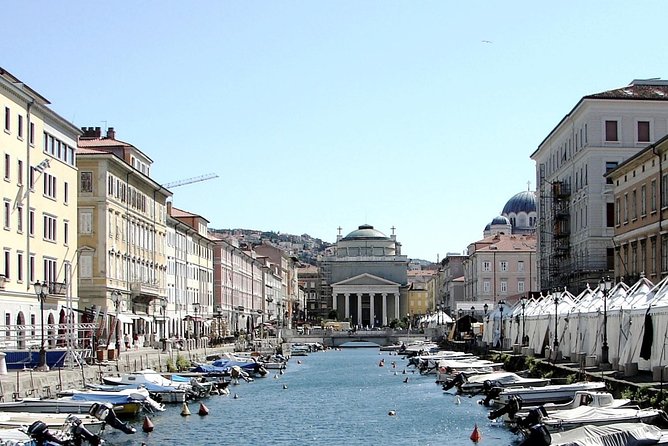
The next section lasts about forty-five minutes and brings you through picturesque Canal Grande toward Palazzo del Tergesteo. From there, the route continues to Palazzo Gopcevich and Palazzo Scaramagnà.
The canal gives the walk a change of mood. After the broad seafront and formal squares, the waterway offers a more enclosed urban view. It also reinforces Trieste’s connection to trade and movement. The city was built around its port functions, and the canal helps you see that commercial side at street level.
Palazzo del Tergesteo is an important stop for understanding Trieste’s nineteenth-century prosperity. Even without entering, the building and its surroundings help show the scale and ambition of the city during its Habsburg period.
Palazzo Gopcevich and Palazzo Scaramagnà add more architectural detail to this part of the route. Your guide can draw your attention to facades, proportions, decorative features, and the way these buildings fit into the wider center. This is where an informed explanation can turn an attractive walk into a useful lesson in the city’s past.
I would not treat this portion as a museum substitute. You are seeing the buildings in their streetscape, not touring every interior or collection. That is a benefit if you want to cover ground, take photographs, and understand how the city fits together. It is less suitable if your main goal is detailed interior architecture.
The route is also a reminder that Trieste rewards attention to small details. A quick self-guided walk might take you past these palaces without explaining their place in the city’s development. The guide supplies the connections, and you can spend less time worrying about navigation.
A different sort of day out around Trieste:
- Trieste Bus Tour with Audio Guide
★ 4.5 · 1,648 reviews - Trieste Bus Tour with Audio Guide
★ 4.0 · 214 reviews - Trieste: Miramare Castle & Museum Entry Ticket & Audio App
★ 4.2 · 213 reviews - Lake Bled and Ljubljana Tour from Trieste
★ 4.5 · 193 reviews
Piazza Ponterosso and Via San Nicolò
The final section takes about thirty minutes and leads into Piazza Ponterosso, described as the heart of the old Borgo Teresiano. From there, you walk through Via San Nicolò, known for its boutiques and restaurants.
This is a pleasant way to finish because the route shifts from formal civic spaces to streets with a more everyday feel. After hearing about dynasties, ports, and imperial administration, you get a look at where people shop, eat, and move through the city today.
Via San Nicolò is also useful for planning the rest of your visit. You can note restaurants for later, look at the boutique storefronts, and decide which streets deserve another walk. The guide’s local perspective may help you understand which parts of the center are worth revisiting, though the supplied details do not promise restaurant recommendations or reservations.
Piazza Ponterosso helps tie the route together. It belongs to the same planned district you explored earlier, but it feels more intimate than Piazza Unità d’Italia. Seeing both spaces in one walk lets you compare Trieste’s grand public face with its smaller commercial streets.
The tour ends back at the original meeting point. That is convenient if you are arranging transport or meeting someone afterward. It also means the activity does not function as a one-way transfer to another part of town.
Daniella, Esther, and the value of the guide
The guide is the most important variable in a history-focused walking tour. Buildings can be seen without help, but the reason to pay for this experience is the explanation, local context, and ability to ask questions.
Daniella has been praised for growing up in Trieste and for making the route flow naturally. That local connection can be valuable because she may explain the city as a place lived in, not only as a set of dates and architectural labels.
Esther has also guided the walk. Her background includes leading a Jewish-sites walk in Trieste, and the Habsburg route can pair well with that subject. If you have an interest in Central European history, Jewish heritage, Vienna, or the changing borders of the region, these two walks may give you different but related views of the city.
You should not assume that you will receive a particular guide unless the booking details confirm it. Still, the named guides give you a helpful idea of the kind of experience to expect: an English-language walk led by someone able to discuss Trieste beyond the basic sightseeing script.
The private format also has a practical advantage. One participant missed the original pickup time after oversleeping, then received help rearranging the tour. The guide adjusted the remaining time to focus on what the group wanted to see. That does not guarantee the same flexibility in every situation, but it shows why a private booking can be more forgiving than a fixed group departure.
Is $147.87 per person a fair price?
At $147.87 per person, this tour is not a budget introduction to Trieste. The value depends heavily on group size and how much you want personal attention.
For one person or a couple, the cost is high for a two-and-a-half-hour outdoor walk. You are paying for the private guide, not for entrance tickets, transport, food, or a full-day excursion. If you are comfortable reading about Trieste in advance and finding the main squares yourself, you may prefer a less expensive option.
The calculation changes for a larger group, especially since group discounts are available. A private tour can become more reasonable when the cost is shared among several people, while still giving your party control over questions and pace.
I would also consider the value of your time. If you have only a short stay in Trieste, a focused introduction can help you avoid wandering without context. One participant had very little time in the city and found the private arrangement useful because the schedule could be modified.
The strongest case for booking is your interest in the Habsburg dynasty and Austro-Hungarian Empire. If that subject is central to your trip, the guide’s explanations may be worth more to you than the ticket price alone. If you mainly want a quick photo stop at the major square, the price is harder to justify.
Who should book this private walk?
I would recommend it most strongly to:
- First-time visitors to Trieste who want to understand the center before exploring alone.
- History-minded visitors interested in the Habsburg dynasty, Vienna, or the Austro-Hungarian Empire.
- Families and private groups that want to ask questions without sharing the guide with strangers.
- Cruise or short-stay visitors who need a focused introduction within a limited schedule.
- People who enjoy architecture but want help reading buildings and streets rather than only photographing them.
- Visitors combining themes, such as Habsburg history and Jewish heritage in Trieste.
It may be less suitable for you if you want interior admissions, a food tour, transportation, or a full day outside the central streets. It is also not the best match if you dislike walking or prefer a loose, unstructured afternoon.
The route is in the city center and stays near public transportation. Service animals are allowed, and most people can take part, though you should plan for continuous walking and narrow streets. The available information does not specify a detailed accessibility assessment, so contact the provider if your group has particular mobility needs.
Practical details that affect your day
Confirmation is provided at booking, and the experience is offered in English. The meeting point is Piazza Unità d’Italia, 8, 34121 Trieste, and the tour returns there at the end.
Allow more time than the stated two hours and thirty minutes if you want to take photographs, ask extended questions, or stop before and after the walk. The scheduled stops total about two hours and thirty minutes, but real pacing can vary with the group.
There are no admission charges for the listed stops because they are public outdoor areas. Any site that requires an entrance fee is excluded, so check your expectations before booking.
Free cancellation is available if you cancel at least twenty-four hours before the local start time. Cancellations or changes made inside that window are not accepted for a refund.
Should you book the Habsburg Trieste walk?
Book it if you want Trieste to make sense, not simply to look attractive. The tour gives you a clear route through Piazza Unità d’Italia, Borgo Teresiano, Canal Grande, and Via San Nicolò, while placing those streets within the Habsburg and Austro-Hungarian story.
I would be especially inclined to book for a first visit, a short stay, or a group with a strong interest in Central European history. Daniella and Esther have both been praised for engaging, local explanations, and the private format can allow useful changes when your schedule goes wrong.
Skip it if $147.87 per person feels too steep for an outdoor walk or if you need museum interiors and included admissions. For the right group, though, this is a focused and flexible way to get your bearings in Trieste before setting out on your own.
FAQ
Where does the Habsburg Trieste Private Guided Walking Tour begin?
The tour begins at Piazza Unità d’Italia, 8, 34121 Trieste, Italy.
Where does the tour end?
The activity ends back at the original meeting point in Piazza Unità d’Italia.
How long does the walking tour last?
The tour lasts approximately two hours and thirty minutes.
What language is the tour offered in?
The tour is offered in English.
Is this a private tour?
Yes. Only your group participates in the activity.
What places are included on the route?
The route includes Piazza Unità d’Italia, Borgo Teresiano, Piazza della Borsa, the Giuseppe Verdi theatre area, Canal Grande, Palazzo del Tergesteo, Palazzo Gopcevich, Palazzo Scaramagnà, Piazza Ponterosso, and Via San Nicolò.
Are entrance tickets included?
No. The tour does not include entrance to sites that require an admission fee.
Is public transportation available near the tour?
Yes. The meeting area is near public transportation.
What is the cancellation policy?
You can cancel for a full refund if you cancel at least twenty-four hours before the experience’s local start time. Cancellations or changes made less than twenty-four hours before the start are not refunded or accepted.
Just added around Trieste
- Private Tour to Slovenia from Trieste★ 4.0 · 3 reviews
- Lipica Stud Farm & Skocjan Caves – Small Group Tour from Trieste★ 4.5 · 3 reviews
- Trieste: coffee dive! espresso tasting★ 5.0 · 3 reviews
- Trieste Exploration Game and City Tour on your Phone★ 5.0 · 3 reviews
- Trieste: Freemasons and Secret Societies Guided Tour★ 4.3 · 3 reviews
- Trieste: Private Pasta-Making Class at a Local’s Home★ 3.8 · 4 reviews
- Airport transfer from Trieste Airport to Koper★ 5.0 · 4 reviews
- Private Transfer from Trieste Airport or City to Pula, Rovinj★ 5.0 · 4 reviews
Walking Tours, compared.
Rialto Bridge & Offbeat Unusual Venice Walking Tour
Read our review →
Private 3 hrs Venice Tour: St Mark’s, Walking tour & Boat tour
Read our review →
Walking Guided Tour of the City Must-See Sites
Read our review →
Private Best of Venice Walking Tour with St Mark’s Basilica
Read our review →
Venice Sightseeing Small Group Walking Tour with a Local Guide
Read our review →Browse the lists this tour appears in