
Reviewed · MUSEUMS
Venice: Leonardo Da Vinci Museum Entrance Ticket
Leonardo da Vinci’s genius comes into focus when you can turn a crank, test a wooden bridge, or study a machine rebuilt from his sketches. This hands-on museum near Campo San Rocco makes his ideas easier to grasp than a wall of labels ever could.
I like the clever mix of working models and high-resolution painting reproductions. I also like the family appeal: children can solve puzzles and try machines, while adults can stop to consider Leonardo’s work as an engineer, artist, and anatomist. The main drawback is its size. You can see the museum in 30 to 60 minutes, though careful readers and families often stay about 90 minutes.
In This Review
- Key points
- Why this small museum works so well
- Finding the museum near Campo San Rocco
- Earth, Water, Fire, and Air
- The working models are the main event
- Leonardo the anatomist and artist
- How long should you allow?
- Is the $10 ticket good value?
- Who will enjoy this most?
- A practical plan for your visit
- Should you book the Leonardo da Vinci Museum?
- FAQ
- Where is the Leonardo da Vinci Museum in Venice?
- How much does admission cost?
- How long does a visit take?
- Is the museum guided?
- What languages are available?
- Can I take photos inside?
- Are children allowed to enter alone?
- Is there a shop at the museum?
- Can I cancel the booking?
Key points
- Four themed sections: Follow Leonardo’s ideas through Earth, Water, Fire, and Air.
- Machines you can operate: Test working reproductions built from his original designs, with changes made where the original proportions required it.
- Good for mixed ages: Hands-on puzzles, drawing activities, and mechanical models keep children and adults involved.
- More than inventions: See anatomy studies, manuscripts, and backlit reproductions of major paintings.
- Easy central location: Find the museum at Campo San Rocco, opposite the Scuola Grande di San Rocco and behind the Frari church.
- Flexible visit length: Spend 30 minutes on a quick stop, or about 1.5 hours if you read and try everything.
Why this small museum works so well
Venice has grand churches, ornate palaces, and masterpieces that ask you to stand quietly and look. This museum asks you to do something. You pull, turn, build, compare, and test. That change of pace matters, especially after hours of admiring art from behind a rope.
The subject is Leonardo, but the lesson is broader. His notebooks joined art, mechanics, anatomy, water management, flight, and military engineering. The displays help you see that he was not simply the painter of the Mona Lisa and The Last Supper. He was a restless observer who kept asking how things moved and how the human body worked.
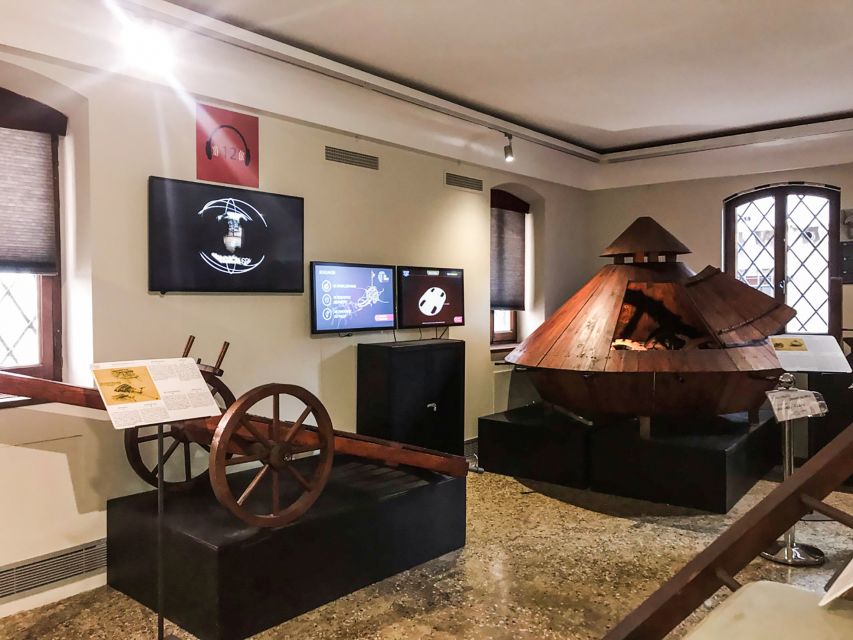
The museum is contemporary in presentation, with images, information panels, multimedia material, and working models. It is not a large national museum filled with original Leonardo paintings or personal objects. Think of it as an educational exhibition built around reproductions and practical experiments.
That distinction helps set expectations. If you want original Renaissance masterpieces, choose Venice’s major churches and galleries. If you want to understand how Leonardo’s ideas functioned, this is a more active and approachable stop.
More museums in Venice:
- Venice’s Best: Basilica, Doge’s Palace, Gondola & History Gallery
★ 4.5 · 2,478 reviews - Venice: Vivaldi’s Four Seasons Concert & Music Museum Visit
★ 4.8 · 2,065 reviews - Charming Gondola Ride on the Grand Canal & Gondola Gallery™
★ 4.0 · 1,313 reviews
Finding the museum near Campo San Rocco
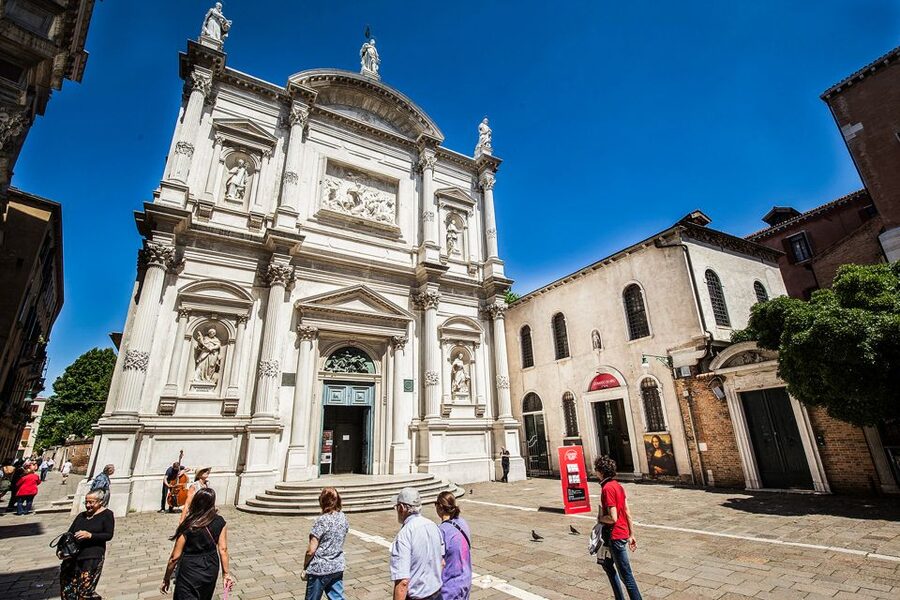
The entrance is at the Leonardo da Vinci Interactive Museum, Campo San Rocco, 3052 Venezia. It is in the Scolette di San Rocco building, opposite the Scuola Grande di San Rocco and behind the Church of the Frari.
The setting is useful for planning. You can combine the museum with the Frari and Scuola Grande di San Rocco, then continue through the San Polo area. It gives you a break from the busiest routes near St. Mark’s Square without sending you far from central Venice.
Present your ticket at the reception desk. There is no meeting with a guide, and no guided tour is included. One useful detail: the audio guide QR code is at the front of the shop. Scan it when you arrive, since you may otherwise need to return to the entrance later.
The museum accepts photos inside, which suits an exhibition built around machines and visual details. Keep your phone ready for the QR material, but give yourself time to use the exhibits rather than simply photographing them.
Earth, Water, Fire, and Air
The exhibition is arranged around four elements: Earth, Water, Fire, and Air. This gives the visit a simple path and connects different parts of Leonardo’s work.
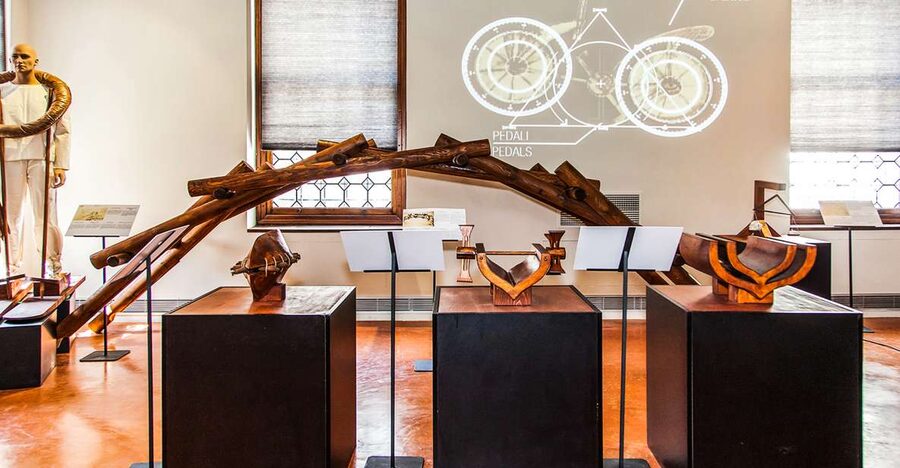
The Earth section introduces machines and structures linked to movement, building, and physical force. Wooden mechanisms and construction models show how Leonardo studied balance, leverage, and weight. You do not need an engineering background to get something from them. The point is to see a sketch become a working object.
The Water section looks at Leonardo’s interest in water flow and hydraulic ideas. Reconstructed devices make his observations more concrete. You can see why water mattered to a thinker concerned with canals, motion, and the practical control of nature.
The Fire section turns toward force, weapons, and mechanical power. Some of Leonardo’s designs were practical, while others were proposals that reveal the range of his imagination. The reproductions let you study the mechanisms without needing to interpret a small notebook drawing.
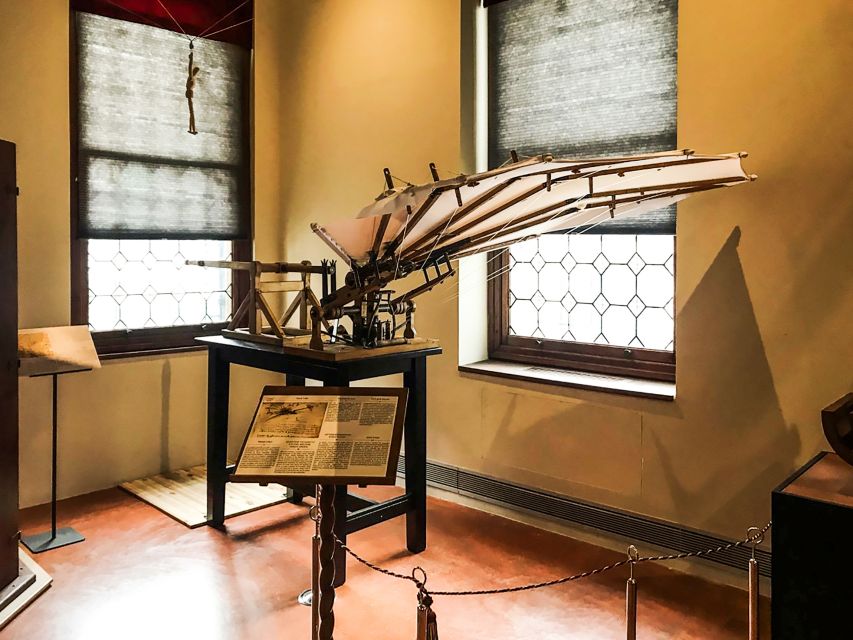
The Air section is likely to appeal most to anyone interested in flight. Leonardo watched birds and thought carefully about wings, lift, and human movement through the air. The models show the early stages of ideas that later became part of aviation, even though his machines were not modern aircraft.
The exact order may feel less important than the chance to move between subjects. I found the four-part layout useful because it prevents the exhibition from becoming a jumble of unrelated inventions.
The working models are the main event
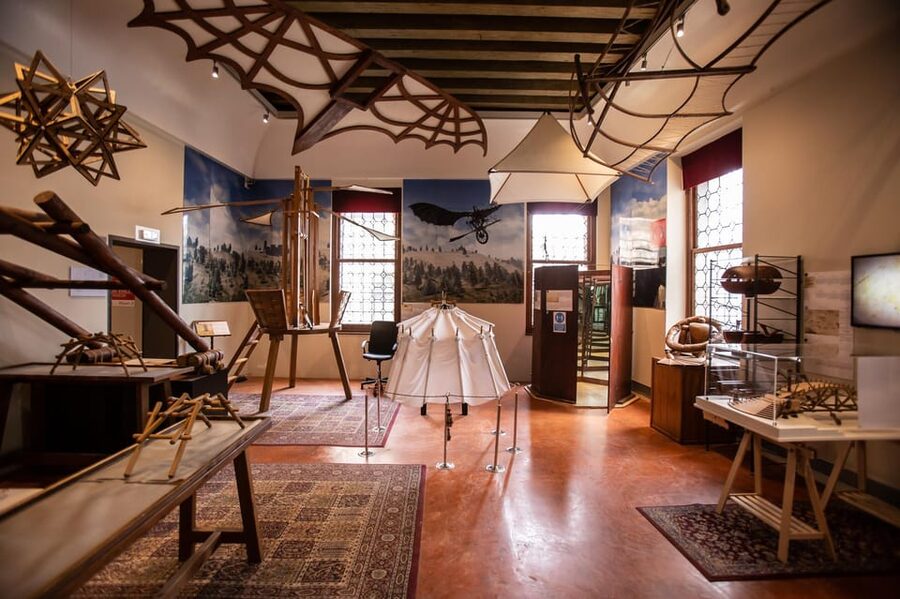
The strongest part of the museum is the chance to interact with the machines. These are faithful reproductions based on Leonardo’s designs, with adjustments made when original proportions would not work at full scale or in a modern exhibition setting.
You might turn a handle, move a mechanism, or test a structure. The action is simple, but it changes how you read the information. A diagram of gears can seem abstract. A gear that transfers movement in front of you becomes instantly clear.
One of the memorable activities is a wooden bridge puzzle. It is easier with a second person, so do not be shy about asking someone in your group to help. Building wooden structures is another worthwhile activity, though one station may not always have every piece in place. Treat these as puzzles rather than formal demonstrations, and you will have more fun.
The museum also includes a mirror box that shows your reflections from several angles. It is a small exhibit, but it is visually striking and especially good for children. The upstairs displays include more puzzles and practical activities, while iPads allow children to draw in a style inspired by Leonardo.
You should supervise younger children and remind older ones that the machines are exhibits, not toys. The hands-on format is the museum’s strength, but careless handling can spoil the experience for the next person.
A few more Venice days to weigh up
- Venice: Doge’s Palace Reserved Entry Ticket
★ 4.6 · 42,716 reviews - Venice: Grand Canal Gondola Ride with App Commentary
★ 4.1 · 18,908 reviews - Boat Trip: Glimpse of Murano, Torcello & Burano Islands
★ 4.3 · 15,699 reviews - Venice: Grand Canal by Gondola with Live Commentary
★ 4.1 · 13,681 reviews
Leonardo the anatomist and artist
The machines get most of the attention, but the museum also explains Leonardo’s medical and artistic work. His anatomy studies show the same habit of careful observation that shaped his engineering sketches.
You can examine material related to the human body and see how Leonardo tried to understand bones, muscles, and internal structures. This section adds balance to the exhibition. Without it, you might leave thinking only about flying machines and bridge designs.
High-resolution backlit reproductions of major paintings give you a chance to look closely at works that are normally far away, crowded, or difficult to study in person. These are reproductions, not original paintings, but they help connect Leonardo’s technical observation with his art.
That connection is one of the best reasons to visit. The same person who studied the mechanics of water also studied the curve of a hand. The same eye that planned machines also noticed how light falls across a face. The museum makes those links in a straightforward way.
Multimedia displays add background on Leonardo’s life and work. Written information is available in Italian, English, French, German, Spanish, and Russian. A film gives a concise account of his life, which is helpful if your group includes people who know little about him.
How long should you allow?
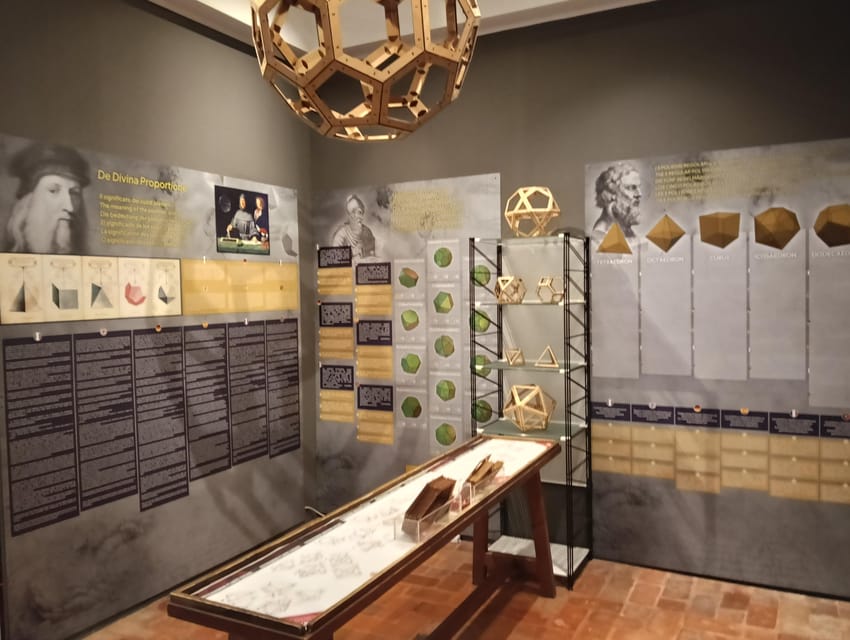
Plan on about one hour for a normal visit. A quick walk through can take 30 to 60 minutes, while families and curious adults often spend around 1.5 hours trying the activities and reading the displays.
The museum’s compact size can be a benefit. You will not lose half a day, and children are less likely to tire before reaching the end. It also fits neatly into a Venice day built around churches, squares, and wandering.
The limitation is equally clear: if you expect a large museum with many galleries, you may wish it were bigger. The exhibition occupies a long room, two small downstairs spaces, and four rooms upstairs. That is enough for a focused visit, but not enough for a full afternoon unless you are unusually absorbed by the models.
Last entrance is one hour before closing, so check the opening times for your date and avoid arriving near the cutoff. The ticket is valid for one day, not for an extended period of repeat entry.
Is the $10 ticket good value?
At $10 per person, the museum offers solid value for a short central Venice activity. The price works best when you treat it as a one-hour educational stop, not as a major art museum.
The value rises if you are traveling with children. A family can learn together, and the interactive stations give younger minds something to do besides read labels. Teenagers may also respond well to the mechanical side, especially if they are interested in inventions, design, or flight.
Adults who already know a great deal about Leonardo may find the exhibition basic in places. The explanations are informative without being highly academic, and the reproductions cannot replace original works. Still, the ability to handle models gives the museum a purpose beyond biography.
There is also a 10 percent discount on purchases in the bookshop. The shop sells Leonardo-themed gifts and souvenirs, which can be a practical place to find a small present tied to the visit.
Children under three enter free. Children under 15 must be accompanied by an adult. The ticket also allows free cancellation up to 24 hours before the scheduled visit, and you can reserve now and pay later if that option is offered for your date. Those terms are useful when your Venice plans are still shifting.
Who will enjoy this most?
I would choose this museum for families, curious adults, school-age children, and anyone who wants a break from traditional sightseeing. It is especially good for a mixed-age group because the activities do not require everyone to enjoy the same level of detail.
It also suits a short Venice visit. If you have only two days, the museum fits easily between the Frari, San Polo, and other central sights. It is close enough to major stops that you do not need to build an entire afternoon around it.
Art lovers should come with realistic expectations. You will learn about Leonardo’s paintings and see detailed reproductions, but this is not a gallery of original Renaissance art. Engineers and puzzle fans may enjoy the machines more than people who prefer quiet, traditional exhibitions.
The museum is also useful on a hot day. The indoor setting offers a calm pause from Venice’s streets, and the exhibits give you something active to do while you cool down.
A practical plan for your visit
I would arrive with a little time rather than rushing in at the end of the day. Start by scanning the QR code near the front of the shop, then look at the introductory material before heading through the four sections.
Let children try the easier activities first, then return to the machines that need more patience. For the wooden bridge puzzle, use two people. If you are visiting as an adult group, do not skip the hands-on stations. They are not only for children.
Read enough to connect each model to Leonardo’s larger interests, but do not feel you must study every label. A good visit combines a few working machines, the mirror exhibit, the anatomy section, the painting reproductions, and the short film.
If the museum is quiet, you can move at your own pace. If several families arrive together, the interactive stations may require patience. The compact floor plan means you can usually see where space is tight and decide which exhibit to try next.
Should you book the Leonardo da Vinci Museum?
Yes, if you want a reasonably priced, self-guided museum that turns Leonardo’s ideas into something you can test. At $10, it is an easy addition to a Venice itinerary, particularly for families and anyone who likes practical exhibits.
Skip it if you are seeking original Leonardo paintings, a formal guided tour, or a large collection that fills several hours. Book it if you want a focused hour near the Frari, a cool indoor pause, and a clear reminder that Leonardo was far more than a painter.
FAQ
Where is the Leonardo da Vinci Museum in Venice?
The museum is at Campo San Rocco, 3052 Venezia, in the Scolette di San Rocco building. It is opposite the Scuola Grande di San Rocco and behind the Church of the Frari.
How much does admission cost?
The listed price is $10 per person. Children under three years old receive free admission.
How long does a visit take?
A quick visit can take 30 to 60 minutes. Allow about 1.5 hours if you want to try the machines, solve the puzzles, and read the displays carefully.
Is the museum guided?
No. The ticket provides entry only, and a guided tour is not included. You visit independently and present your ticket at reception.
What languages are available?
Descriptions are available in Italian, English, French, German, Spanish, and Russian. Multimedia displays also provide information about Leonardo’s life and work.
Can I take photos inside?
Yes. Photography inside the museum is included with the ticket.
Are children allowed to enter alone?
No. Children under 15 years old must be accompanied by an adult.
Is there a shop at the museum?
Yes. The bookshop sells Leonardo-themed gifts and souvenirs. The ticket includes a 10 percent discount on bookshop purchases.
Can I cancel the booking?
You can cancel up to 24 hours in advance for a full refund. A reserve-now, pay-later option is also available when offered for your selected visit.
Just added around Venice
- Exclusive Private Venice Jewish Ghetto Tour★ 5.0 · 41 reviews
- The Secret Corners of Burano★ 5.0 · 41 reviews
- Verona: Private 2-Hour Walking Tour★ 4.9 · 41 reviews
- St Mark’s Basilica & Doge’s Palace Skip the Line – Semi-Private★ 5.0 · 42 reviews
- Venice: 3-Course Dining Experience at Local Home★ 4.8 · 41 reviews
- Wine Tasting in Venice★ 4.6 · 42 reviews
- Venice Skip lines at Doge’s & St. Mark’s with Exclusive Sky Walk★ 4.5 · 42 reviews
- Venice Saint Mark’s Basilica afternoon guided tour★ 4.5 · 42 reviews
Museums, compared.
Venice’s Best: Basilica, Doge’s Palace, Gondola & History Gallery
Read our review →
Vivaldi’s Four Seasons Concert & Music Museum Visit
Read our review →
Charming Gondola Ride on the Grand Canal & Gondola Gallery™
Read our review →
Bell Tower & St Mark’s Square History Gallery Ticket
Read our review →
Venice Museum Pass & Doge’s Palace Entrance Ticket
Read our review →
Basilica, Doge’s Palace, History Gallery & Bell Tower Option
Read our review →
Browse the lists this tour appears in