
Reviewed · VERONA TOURS
Dante in Verona: From Inferno to Paradise
Dante’s Verona is more than Romeo and Juliet. This 90-minute walking tour shows how the exiled poet lived as a guest of the Scaligeri family, then links his life and ideas to the city’s squares, churches, bridges, and medieval monuments. I like the clear theme: you see familiar Verona through Dante’s eyes rather than simply ticking off sights.
I also like the mix of city history and literary storytelling. Guides such as Giovanni and Leonardo explain difficult ideas in plain language, while a live acting element gives the Divine Comedy a human voice. The main drawback is that you cover a lot in a short time, so this is a brisk introduction rather than a full study of Dante or Verona. Comfortable shoes matter, and the experience is not suitable for pregnant women.
In This Review
- Key points to know before booking
- Why Dante changes the way you see Verona
- Starting at San Fermo and Porta Leoni
- Piazza Erbe and Juliet’s House
- The Scaliger tombs and Piazza dei Signori
- Lamberti Tower and the city from below
- Ponte Pietra and the approach to the Duomo
- The live acting and the role of the guide
- Pace, access, and what to bring
- Is $45 a fair price?
- Who should book this Verona tour?
- FAQ
- How long does Dante in Verona last?
- What languages are available?
- Where does the tour begin?
- Where does the tour finish?
- Which Verona sights are included?
- Is the tour wheelchair accessible?
- Can I cancel or pay later?
- Should you book Dante in Verona?
Key points to know before booking
- Dante meets medieval Verona: Follow the poet’s connection with the Scaligeri family through the city where he spent time in exile.
- A literary route with major sights: See Piazza Erbe, Juliet’s House, the Arche Scaligere, Piazza dei Signori, Ponte Pietra, and the Duomo.
- Inferno, Purgatory, and Paradise: Hear selected passages tied to local traditions and places.
- Giovanni and Leonardo are named guides: Both are praised for making complex history and symbolism easy to follow.
- A good first look at Verona: The relaxed pace and central route can help you understand the city before exploring it alone.
- $45 for 1.5 hours: The price is fair if you want a focused guide and a fresh angle on Verona, but less appealing if you prefer a standard sightseeing walk.
Why Dante changes the way you see Verona
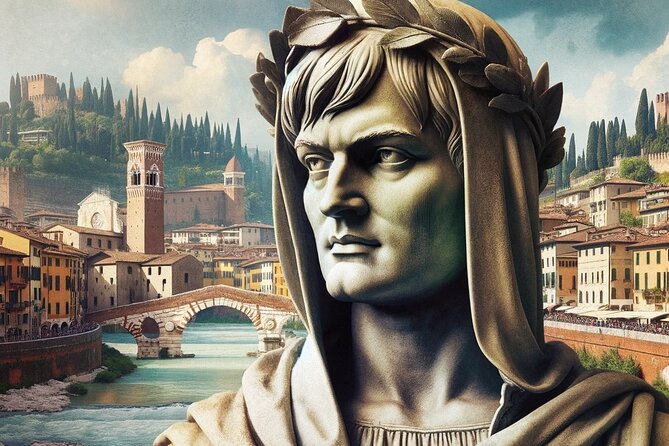
You may arrive in Verona thinking first of the Arena, Juliet, and the polished shopping streets. This tour shifts your attention to Dante Alighieri, who spent time in Verona as a guest of the powerful Scaligeri family. Their castles, bridges, palaces, tombs, and decorated walls give the walk a strong medieval setting.
The route also gives you a useful introduction to Dante as a person. He was not only the author of the Divine Comedy. He was a traveler, a political exile, and a man moving among Italy’s rival courts. That human side matters because it makes the poem easier to approach.
I especially like the way the guide connects the three parts of the Divine Comedy to the places around you. You are not sitting in a lecture room hearing abstract explanations. You are walking through old streets while the guide explains how Inferno, Purgatory, and Paradise can be read alongside Dante’s ideas, life, and time in Verona.
You do not need to be a Dante specialist. One person can arrive knowing the poem well, while another may know only the title. The guides Giovanni and Leonardo have been praised for explaining difficult themes in an accessible way, including for people dealing with a language barrier. That makes this a sensible choice for mixed-interest couples and families.
A few more Verona days to weigh up
- Verona: Hop-on Hop-off Tour 24 or 48-Hour Ticket
★ 4.4 · 2,010 reviews - Verona: History and Hidden Gems Guided Walking Tour
★ 5.0 · 1,379 reviews - Verona: Priority Access Arena Guided Tour
★ 4.6 · 1,152 reviews
Starting at San Fermo and Porta Leoni
The meeting point is in front of the church at Piazza San Fermo, in a small square along a road with a bar on the corner. It is about an eight-minute walk from the Arena, so allow time to leave the busy central area and find the church.
San Fermo is a fitting start because it puts you among Verona’s older religious and urban layers right away. The tour then moves toward Porta Leoni, where you get a short sightseeing stop of about ten minutes. The name refers to the lions associated with the ancient Roman gate, and the stop helps establish the long timeline of the city before the guide turns more fully to Dante and the medieval period.
This opening portion is useful if you want context rather than a quick list of dates. You begin to see Verona as a city shaped by Roman, medieval, religious, and political forces. The guide’s task is to show how Dante fits into that story.
Piazza Erbe and Juliet’s House
The walk continues through central Verona, including a ten-minute sightseeing stop in Verona itself and a visit to Piazza Erbe. This is one of the city’s key public spaces, and it gives the tour an open-air setting for discussing daily life, power, trade, and tradition.
Piazza Erbe can be crowded and full of visual distractions, so the Dante theme helps you notice details you might otherwise pass. Rather than treating the square as a photo stop, the guide uses it to connect the city’s public life with the world Dante knew.
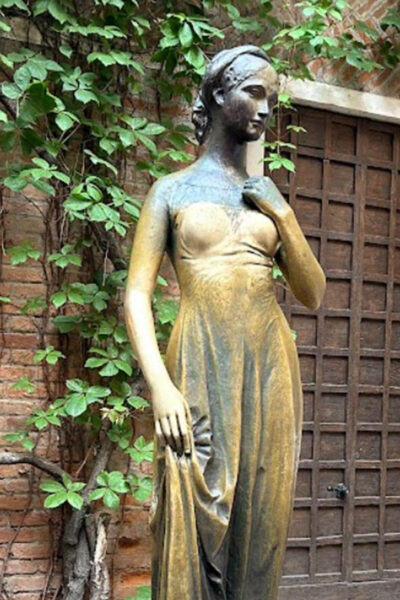
Juliet’s House receives about five minutes. This is a short pause, not a full visit devoted to the building or the Romeo and Juliet tradition. That distinction is important. If your main goal is Juliet’s balcony, you will want separate time here, but if you are tired of Verona’s romantic branding, this brief stop keeps the focus on Dante.
I appreciate that the tour includes the famous sight without allowing it to take over. You get your bearings, hear how the city’s stories overlap, and then move on to monuments that better suit the political and literary theme.
The Scaliger tombs and Piazza dei Signori
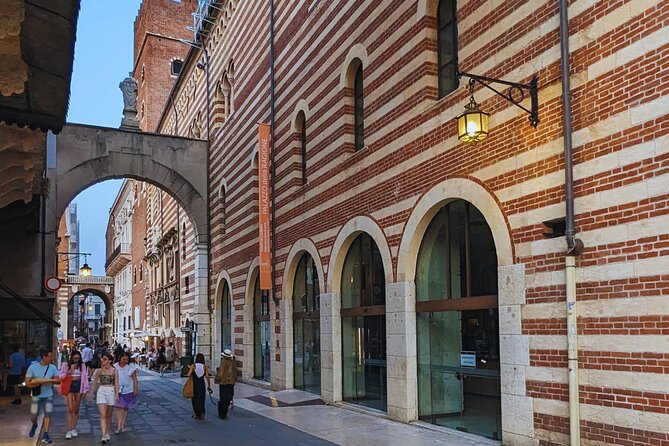
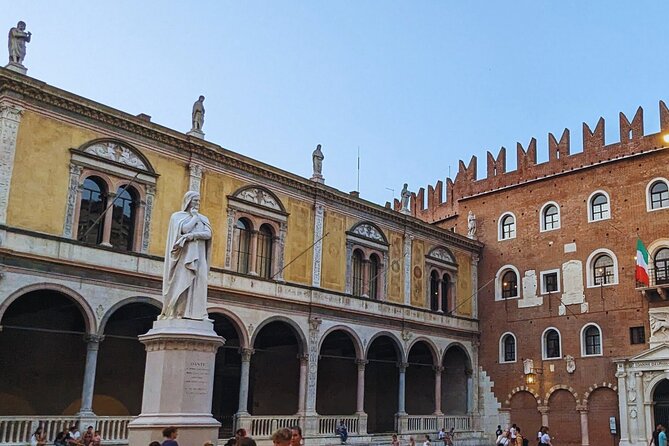
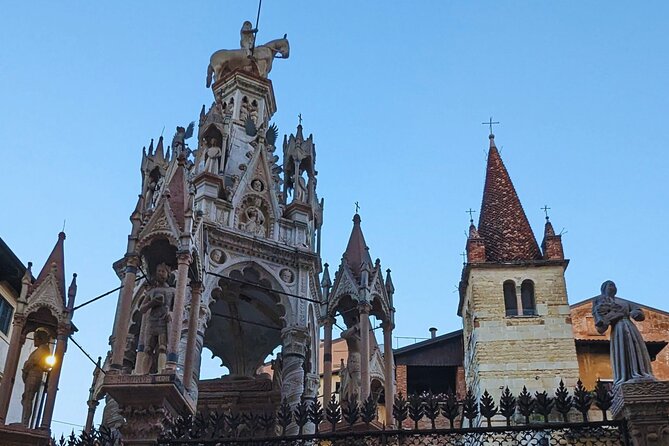
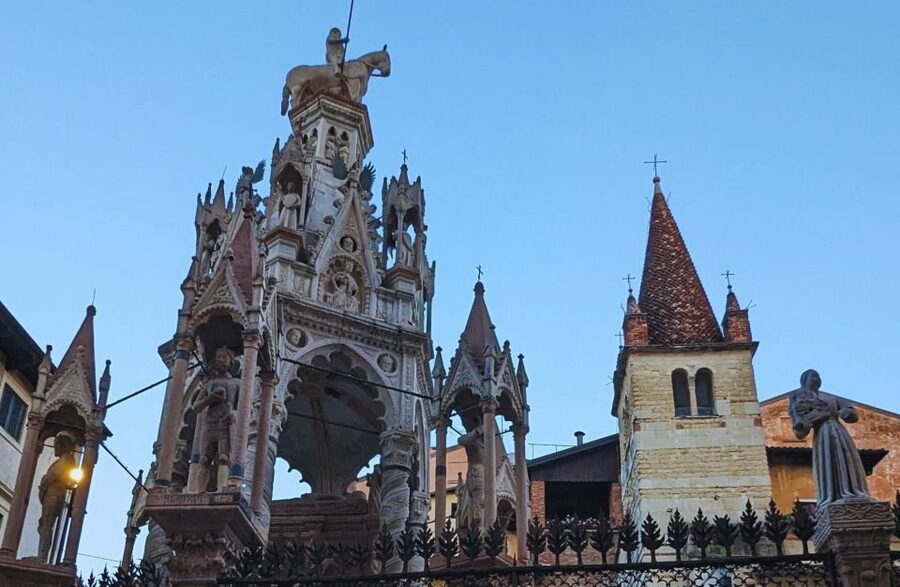
The Arche Scaligere are among the strongest stops on the route. You have about ten minutes to see these ornate tombs, connected to the Scaligeri family who hosted Dante in Verona. Here the poet’s personal story and the city’s ruling dynasty come together in a direct way.
This is where the tour’s central idea becomes easiest to grasp. Dante was not observing Verona from a distance. His time in the city was tied to the family whose power shaped its buildings and public spaces. The tombs offer a visible reminder of the world of courts, dynasties, alliances, and exile behind the poem.
The route then reaches Piazza dei Signori for two stops of about ten and five minutes. The square is closely linked to Verona’s civic and political identity, making it a natural place to discuss Dante’s life and the wider conflicts of medieval Italy.
The guide may use the square to explain symbolism, political ideas, or the role of Dante’s writing in Italian culture. This is one of the places where guide quality matters most. Giovanni has been praised for explaining the symbolism in the Divine Comedy and for placing Dante within Italian history, not just literary history. Leonardo is also noted for bringing in wider facts about Verona, which helps keep the tour grounded.
The stops are short, but they are not empty pauses. Expect a compact explanation followed by movement to the next location. If you want time to study every carving and inscription, you may find the schedule quick. If you like a clear route with regular changes of scene, the rhythm works well.
A different sort of day out around Verona:
- Verona: Juliet’s House Fast-Track Entry Ticket & Audio Guide
★ 4.2 · 1,121 reviews - Verona: Small Group Guided Walking Tour with Arena Tickets
★ 4.9 · 848 reviews - Verona: Arena di Verona Opera Ticket
★ 4.6 · 721 reviews - Verona: Pasta and Tiramisu Cooking Class with Fine Wine
★ 4.8 · 633 reviews
Lamberti Tower and the city from below
The Lamberti Tower gets roughly five minutes. The tour does not include a tower climb, and the focus remains on sightseeing from the route. Even so, the tower gives the guide a strong visual reference for Verona’s medieval skyline and civic power.
I find short stops like this useful on a walking tour because they keep the larger city in view. Dante’s story can become too inward and literary if you only hear about poems and ideas. Looking up at Verona’s towers and public buildings reminds you that his work came from a particular society, one shaped by rival families and city politics.
Five minutes is enough for orientation and explanation, but not for a long architectural study. You should think of the tower as part of the route’s larger argument rather than as a separate attraction.
Ponte Pietra and the approach to the Duomo

Ponte Pietra is another five-minute sightseeing stop. The ancient arch bridge gives the walk a change of mood and a strong view of Verona’s historic setting. It is also a practical reminder that the city’s identity is tied to the Adige River and to movement across it.
The bridge is a good place for storytelling because you can pause, look around, and connect the physical city with Dante’s journey from one stage of life to another. The guide may also use the location to bring the poem’s journey between Inferno, Purgatory, and Paradise into the conversation. The supplied details promise passages from all three parts, connected to local traditions, but not a full reading of each section.
The walk finishes at Verona Cathedral, formally Cattedrale di Santa Maria Matricolare. You spend about ten minutes sightseeing at the Duomo, and the tour ends there. This is helpful for planning the rest of your day because you finish near another major church rather than returning to the starting point.
The cathedral stop also gives the experience a quieter final note after the busy squares. You can look at Verona through religious, artistic, and literary ideas at once. The guide’s explanation of why Dante wrote the Divine Comedy is especially valuable here. One guide has been praised for presenting it as a work meant to help people understand a shared human journey, not simply as an old poem to admire from afar.
The live acting and the role of the guide
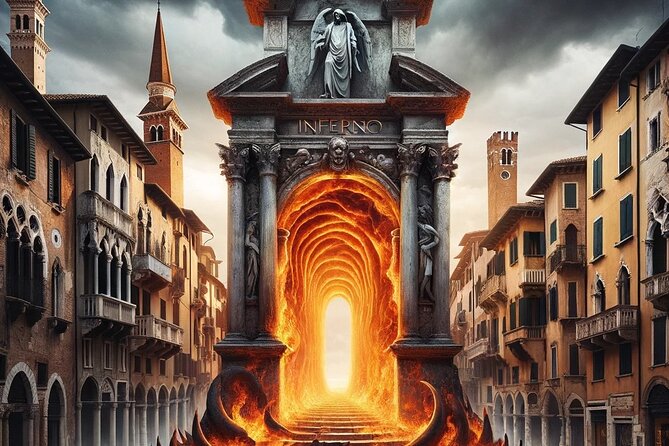
The live acting element is a useful touch, provided you enjoy a little performance in your sightseeing. It gives Dante a presence on the route and helps break up explanations about medieval politics, theology, and literary structure.
This is not advertised as a theater production, so keep your expectations in check. The acting supports the walk rather than replacing the guide’s interpretation. The main value remains the connection between place, biography, and text.
Guide quality appears to be one of the tour’s strongest points. Giovanni is praised for his command of Dante, thirteenth-century Italian history, and the poem’s symbolism. Leonardo is described as friendly, passionate, and helpful in explaining Verona beyond Dante. Another guide, a young woman, was remembered for explaining why the Divine Comedy was written and for answering questions carefully.
That range is important. You are not booking only a fixed script. The tone can depend on who leads your departure, but the named guides suggest strong preparation and enthusiasm for the subject. If you want to ask about Dante’s relevance today, Italian history, or the meaning of the poem, this tour appears better suited than a basic city walk.
The route is conducted in English or Italian. The English explanations have been praised as understandable even when the subject is difficult. Still, literary ideas can be demanding in any language, so you should listen closely and ask questions when something is unclear.
Pace, access, and what to bring
The experience lasts 1.5 hours and is described as relaxed, though the number of stops means you will keep moving. The schedule gives roughly five to ten minutes at most locations. You will not have long free periods for shopping, private photos, or extended church visits.
Wear comfortable shoes. This is a walking tour through the historic center, with several outdoor stops and old urban surfaces. The activity is listed as wheelchair accessible, but the practical ease of the route can still depend on the conditions of individual streets and the pace of the group. If access is important to you, confirm the details before booking.
The tour is not suitable for pregnant women. That restriction should be taken seriously when choosing among Verona activities.
The meeting point can be reached on foot from the Arena in about eight minutes. Look for the church in the small square near a bar on the corner, and wait in front of it. A little extra time is wise because the starting point is not described as a large landmark or transport hub.
Is $45 a fair price?
At $45 per person, this is not the cheapest way to walk around Verona. You can see Piazza Erbe, Juliet’s House, Piazza dei Signori, and Ponte Pietra without paying for a guide. The question is what you want from the visit.
I think the price is fair if you care about interpretation. You are paying for a focused story, a live guide in English or Italian, connections to all three parts of the Divine Comedy, and a route that combines major sights with Dante’s years in Verona. That angle is difficult to recreate from a standard city map.
The value is also stronger if you are visiting Verona for the first time. The tour gives you a framework for understanding the city, and you can return later to the places that interest you most. One guide’s approach has been described as making independent walks more meaningful afterward, which is exactly what a good orientation tour should do.
The price is less convincing if you want interior visits, long time at each monument, or a broad survey of every major sight. The tour focuses on storytelling and links between places. It is not a museum visit, a full-day history course, or a dedicated Juliet experience.
Flexible booking helps reduce the risk. You can cancel up to 24 hours before the start for a full refund, and the reserve-now, pay-later option lets you hold a place without paying today. Check available starting times when you book.
Who should book this Verona tour?
I would choose this for readers who like history with a clear theme. It suits anyone curious about Dante, but also people who know little about him and want a lively introduction rather than a long academic talk.
It is a particularly good fit for:
- Couples who want something beyond the usual Verona highlights
- Readers planning to start or return to the Divine Comedy
- Visitors who enjoy political, religious, and literary history together
- Families with older children who can follow a guided walking route
- Repeat visitors looking for a new way to read the city
- People who want a strong first activity before exploring Verona independently
You may want to skip it if you dislike literary discussion, need long rests between stops, or want plenty of time for photographs. The itinerary is central and efficient, but the 90-minute format leaves little room for wandering.
FAQ
How long does Dante in Verona last?
The tour lasts 1.5 hours.
What languages are available?
The tour is offered in English and Italian.
Where does the tour begin?
It begins in front of the church at Piazza San Fermo. The meeting point is about an eight-minute walk from the Arena, in a small square along a road with a bar on the corner.
Where does the tour finish?
It finishes at Cattedrale di Santa Maria Matricolare, also known as Verona Cathedral.
Which Verona sights are included?
The route includes Porta Leoni, Piazza Erbe, Juliet’s House, the Arche Scaligere tombs, Lamberti Tower, Piazza dei Signori, Ponte Pietra, and Verona Cathedral.
Is the tour wheelchair accessible?
Yes, the activity is listed as wheelchair accessible.
Can I cancel or pay later?
You can cancel up to 24 hours in advance for a full refund. The reserve-now, pay-later option allows you to book without paying immediately.
Should you book Dante in Verona?
Book it if you want Verona to make more sense. The tour’s best feature is not simply the number of sights. It is the way Giovanni, Leonardo, or another guide can tie the Scaligeri family, Dante’s exile, medieval Verona, and the Divine Comedy into one walk.
For $45, you receive a compact, guide-led experience with a clear intellectual purpose and a touch of live performance. You will not get long visits inside each monument, but you will leave with a better grasp of why these streets, squares, tombs, and bridges matter. For a first visit, or for anyone who wants to see Verona through a less familiar story, this is a strong choice.
Just added around Verona
- Verona: Private 2-Hour Walking Tour★ 4.9 · 41 reviews
- Valpolicella Lunch or Dinner Wine & Food tasting with Amarone★ 5.0 · 43 reviews
- The 10 Tastings of Verona With Locals: Private Food Tour★ 4.5 · 45 reviews
- Arena di Verona Opera Ticket Package★ 4.0 · 46 reviews
- Unique Wine tasting in Verona, with Amarone docg★ 5.0 · 46 reviews
- Verona: the Arena at the Gladiators’ time★ 5.0 · 48 reviews
- Verona: Juliet’s House Fast-Track Entry Ticket & Audio Guide★ 3.5 · 52 reviews
- Valpolicella Wine Experience at Montresor winery★ 5.0 · 54 reviews
Verona Tours, compared.
Juliet’s House Fast-Track Entry Ticket & Audio Guide
Read our review →
Small Group Guided Walking Tour with Arena Tickets
Read our review →
Pasta and Tiramisu Cooking Class with Fine Wine
Read our review →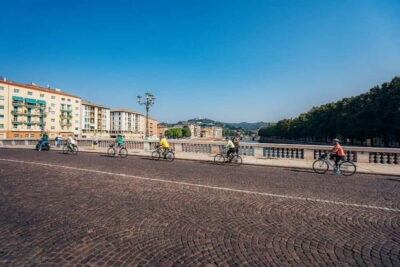
Browse the lists this tour appears in