
Reviewed · TRIESTE TOURS
Discover Trieste on Foot
Trieste makes sense faster when someone explains the layers beneath its handsome streets. This private walk connects the seafront Piazza Unità d’Italia, the old stock exchange, the Canal Grande, and a Roman theatre in about two hours. Guide Demian, also listed as Damian in some responses, is especially good at linking city history with the present day.
I like the private format, since your guide can adjust the pace and answer your questions without a large group slowing things down. I also like the practical advice built into the walk, including suggestions for coffee and meals. The main drawback is time: two hours gives you a strong orientation, but not a full tour of every corner of Trieste.
In This Review
- Key points before you book
- Why two hours can work well in Trieste
- Starting at Piazza Unità d’Italia by the sea
- Piazza della Borsa and Trieste’s commercial power
- Canal Grande and the James Joyce connection
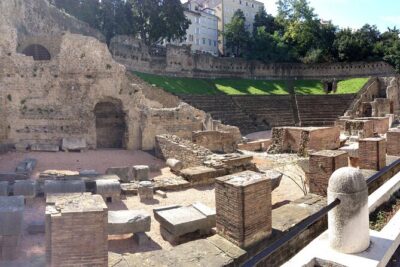
- The Roman Theatre and the city’s oldest layer
- What the private guide adds
- Is $228.29 good value for your group?
- Who will get the most from this walk?
- My call: book it for orientation, not for a full sightseeing day
- FAQ
- How long does Discover Trieste on Foot last?
- What is the price of the private tour?
- Is the tour private?
- What language is the tour offered in?
- Where does the tour begin?
- Can I request pickup?
- What sights are included?
- Are food and drinks included?
- Can I cancel for a full refund?
Key points before you book
- Piazza Unità d’Italia opens the story: Begin beside the sea in Trieste’s grand central square, described as Europe’s largest square facing directly onto the water.
- The route joins several eras: Habsburg commerce, an 18th and 19th-century canal district, and a 1st-century Roman theatre all fit into one compact walk.
- Your group gets a private guide: The price is $228.29 for up to 15 people, not per person.
- Demian is the guide name to look for: He is praised for clear historical explanations, current local context, and useful dining and coffee suggestions.
- The pace can be adjusted: The walk suits groups with moderate physical fitness and can be tailored to your interests.
- It works well as a first look: You finish where you began, making it easy to continue exploring Trieste on your own.
Why two hours can work well in Trieste
Trieste is a city of crossings. Italian, Austrian, Slovenian, Roman, and maritime influences meet here, and the center is compact enough to sample several periods on foot. That makes this tour useful when you have limited time or want a clear plan before exploring alone.
The route is not built around rushing from one sight to another. Each stop has a different role in the city’s story. Piazza Unità d’Italia introduces Trieste as a port and political center. Piazza della Borsa explains its commercial importance under the Austro-Hungarian Empire. The Canal Grande shows how the city expanded and modernized, while the Roman Theatre reaches back to the 1st century.
I like this sequence because it gives you a simple framework. Instead of collecting disconnected photographs, you can see how Trieste grew from an ancient settlement into a major imperial port and then into the city you see today.
The walk lasts about two hours, so you should expect an orientation rather than a museum-heavy visit. The stops are viewed from outside, and the listed admission cost is free. If you want extended time inside museums, churches, or historic buildings, you will need to continue independently after the tour.
A few more Trieste days to weigh up
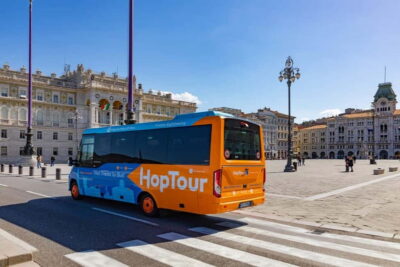
- Trieste Bus Tour with Audio Guide
★ 4.5 · 1,648 reviews - Trieste Bus Tour with Audio Guide
★ 4.0 · 214 reviews - Trieste: Miramare Castle & Museum Entry Ticket & Audio App
★ 4.2 · 213 reviews
Starting at Piazza Unità d’Italia by the sea
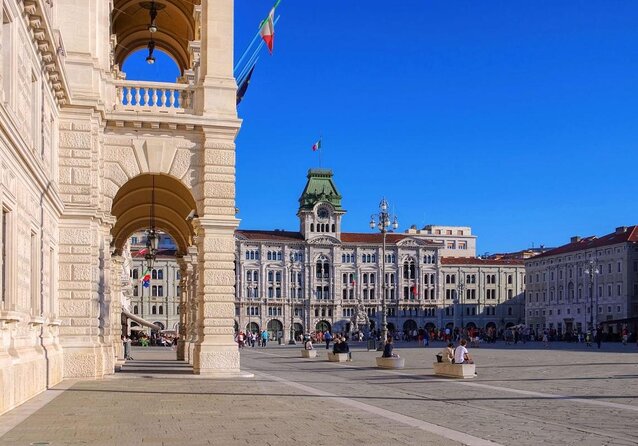
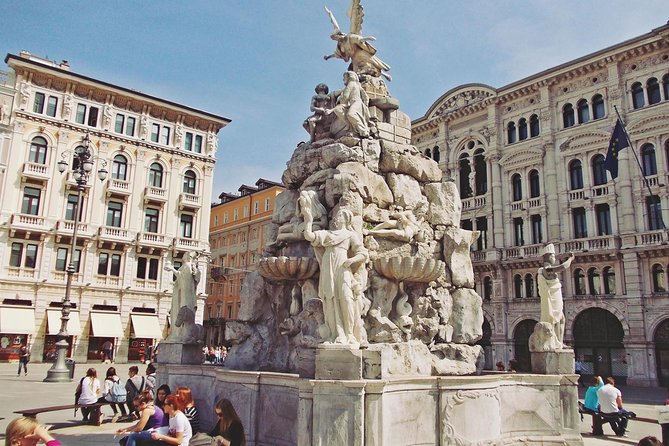
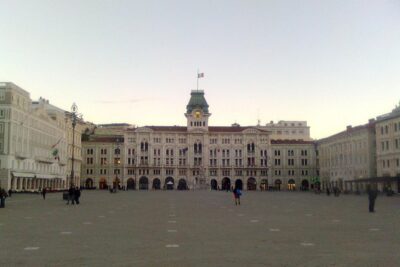
The tour begins at Piazza Unità d’Italia, Trieste’s most dramatic urban space. One side opens directly to the sea, giving the square an unusual sense of width and light. The surrounding buildings frame the water-facing edge, so this is a good place to understand Trieste’s public face before moving into the older streets.
About 15 minutes are allocated here. That is enough for a guide to point out the square’s importance and explain how its position reflects Trieste’s relationship with the sea. I would pay attention to the scale of the buildings and the open view toward the waterfront. This is not just a pretty starting point. It tells you that Trieste was built to face outward, toward shipping, trade, and the wider Adriatic world.
The square is also a practical meeting place. The official starting point is Piazza Unità d’Italia, though pickup can be arranged from the place where you are staying. If you use pickup, confirm the details at booking so you know exactly where the walk begins.
Because the tour ends back at the meeting point, you can use this square as your launch point for the rest of the day. It is a convenient arrangement if you plan to stay in the center after the guide leaves.
Piazza della Borsa and Trieste’s commercial power
The next stop is Piazza della Borsa, about 10 minutes. The name points to Trieste’s former stock exchange, an important clue to the city’s economic role during the Austro-Hungarian period.
This stop helps correct a common impression of Trieste. The city is not simply an attractive Italian port with a few imperial buildings. It was important enough to have its own financial market, and its position under the Habsburgs shaped its trade, population, architecture, and public life.
I find this kind of context especially useful because a guide can explain what you are looking at without turning the walk into a list of dates. Demian is praised for making historical facts feel relevant, including difficult subjects connected to recent Trieste and Slovenian history. That matters here, since Trieste’s identity is not a simple one-country story.
The stop is brief, and there is no admission fee. You should think of it as a visual and historical explanation rather than a long visit inside an institution. The value comes from the connection between the square, the old financial world, and the city’s place in the Habsburg realm.
Canal Grande and the James Joyce connection
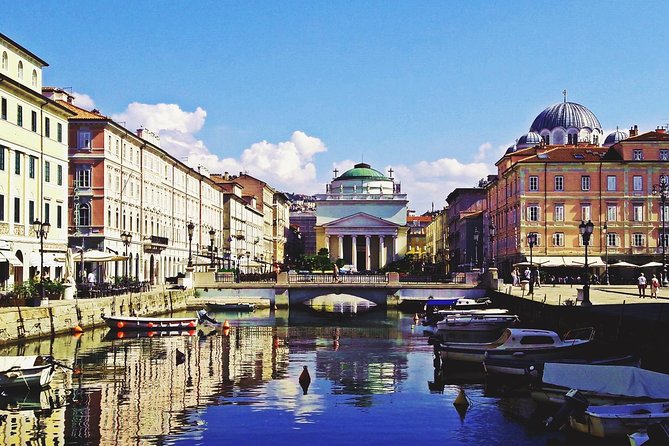
Piazza del Ponterosso and the Canal Grande receive about 10 minutes. The canal once served as the main channel for Trieste’s salt pans. In the 18th and 19th centuries, the area changed into a modern urban quarter associated with Maria Theresa, the Habsburg empress.
This is one of the most useful stops for understanding how Trieste changed over time. The canal was not merely decorative. It was part of the city’s working infrastructure, and later development turned the area into a planned district linked to the ambitions of the Habsburg rulers.
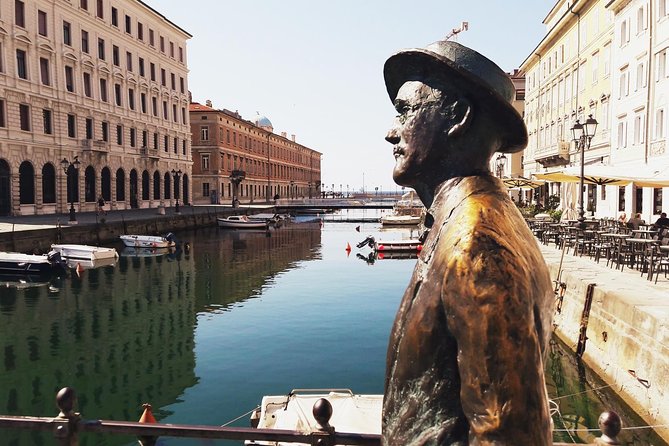
A statue of James Joyce is located in the area, adding a literary thread to the walk. The itinerary does not promise a long Joyce-focused discussion, so I would treat the statue as an interesting local detail within the broader story rather than the main purpose of the stop.
The short time allocation means your guide will likely concentrate on the canal’s original function, the district’s later development, and the local connections that are easy to miss on your own. If Joyce, Habsburg urban planning, or the salt pans particularly interest you, tell your guide. The private format makes that sort of adjustment possible.
This part of the walk also shows why a local guide can be useful. Without explanation, a canal, a statue, and a line of city buildings may seem like separate sights. Together, they show how work, government, and culture shaped one part of Trieste.
A different sort of day out around Trieste:
- Trieste: 2.5-Hour Prosecco Origins Tour and Tastings
★ 4.9 · 193 reviews - Lake Bled and Ljubljana Tour from Trieste
★ 4.5 · 193 reviews - Trieste: Guided Foodie Walking Tour
★ 4.9 · 142 reviews - Postojna Cave & Predjama Castle from Trieste
★ 4.5 · 122 reviews
The Roman Theatre and the city’s oldest layer
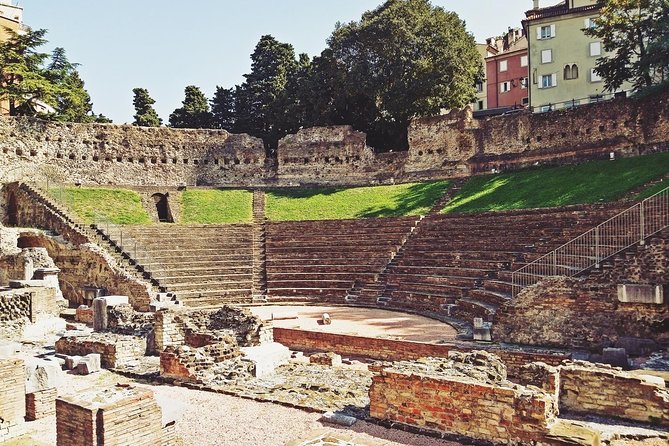
The final listed stop is the Teatro Romano di Trieste, the remains of a 1st-century Roman theatre. About 10 minutes are set aside here, and admission is free.
The theatre gives the tour a strong ending because it pushes Trieste’s story far beyond the Habsburg period. The city’s roots reach back to Roman times and earlier. Seeing the remains after the grand imperial squares creates a useful contrast: modern Trieste is not built on one historical period, but on several layers placed close together.
You should expect to view the remains as part of the walking route, not to spend a long time inside a major archaeological complex. The stop is compact, but the point is powerful. It reminds you that the city’s strategic location mattered long before the stock exchange or the Habsburg building projects.
I like ending here because it leaves you with a clear sense of time. You begin with the sea-facing public square, move through trade and urban change, and finish with the Roman foundations. For a two-hour introduction, that is an efficient structure.
What the private guide adds
The strongest reason to choose this walk is the guide rather than the number of sights. Four stops alone would not justify a high price if you only wanted a checklist. The private format changes the value because you can ask questions, pause when needed, and request more attention to history, art, current affairs, coffee, or food.
Demian is repeatedly praised for his command of Trieste’s past and present, his clear explanations, and his friendly manner. He is also described as willing to walk at the group’s pace and answer questions. Those details matter more than a polished route on paper. A good city orientation should leave you better prepared for the rest of your visit, and this one is designed to do that.
You may receive a multilingual guide, and the advertised language is English. If precise language needs are important for your group, confirm them when booking. The guide’s ability to discuss sensitive regional history is another useful feature, especially if you want more than surface-level facts about Trieste’s relationship with nearby Slovenia and its changing political identity.
I would use the guide actively. Ask which areas deserve more time, where to stop for coffee, and which places are best for a meal. One of the useful touches associated with Demian is offering recommendations for both. The walk can then become a practical first step for the rest of your stay.
Is $228.29 good value for your group?
The price is $228.29 for a private group of up to 15 people. That works out to about $15.22 per person if you fill all 15 places. For five people, it is about $45.66 each, and for two people, about $114.15 each.
That makes the tour much better value for a family or larger group than for one or two people. A couple may find a group walking tour cheaper, if one is available at a suitable time. On the other hand, a private walk gives you control over the pace and keeps the conversation focused on your own interests.
The price includes a professional guide and the private tour. Food and drinks are not included, and the stops themselves have no admission charge. You are paying mainly for interpretation, flexibility, and time saved in getting oriented.
I would consider the price fair for a larger group that wants a personal introduction without arranging separate transport or research. For a small group on a tight budget, compare the cost against your interest in private guiding. The value is strongest if you will use the advice for the rest of your time in Trieste.
Who will get the most from this walk?
I would recommend it to first-time visitors, cruise passengers, families, and anyone with only a short stay. It gives you a fast grounding in the city without requiring a full day.
It also suits people who enjoy history but do not want a lecture detached from the streets. The route shows how the city’s Roman, Habsburg, maritime, and literary strands fit together. If you prefer to learn through buildings, squares, and public spaces, this format works well.
The tour is less suitable if you want long indoor visits, substantial free time at each sight, or a focused art tour. It is also not a completely effortless activity. The guidance says you should have a moderate level of physical fitness, so expect a walking route through the city rather than a seated sightseeing trip.
Pickup is offered from your accommodation, but the stated meeting point is Piazza Unità d’Italia. Public transportation is nearby. The mobile ticket is useful if you are moving through Trieste during a larger trip and want the booking details on your phone.
Cancellation is flexible up to 24 hours before the start time, when you can receive a full refund. Cancellations or changes made less than 24 hours ahead are not accepted for a refund, and the cut-off uses Trieste’s local time.
My call: book it for orientation, not for a full sightseeing day
I would book Discover Trieste on Foot if I wanted a private, efficient introduction to a complicated city. The route covers four strong examples of Trieste’s past, and the guide’s historical range appears to be the real strength. Demian is a particularly appealing choice if you want both established facts and thoughtful discussion of recent regional issues.
I would skip it if your priority is entering major attractions or spending hours at each site. This is a walking framework, not an all-day cultural program.
For a group of several people, the fixed price becomes easier to justify. For a couple, book it only if personal attention, a flexible pace, and local food and coffee suggestions are worth the added cost. Used as the first activity of a Trieste stay, it should help you spend the rest of your time with a much clearer sense of where you are and what you are seeing.
FAQ
How long does Discover Trieste on Foot last?
The tour lasts approximately two hours.
What is the price of the private tour?
The price is $228.29 per group, with up to 15 people included.
Is the tour private?
Yes. Only your group participates in the activity.
What language is the tour offered in?
The tour is offered in English. A multilingual guide may operate the tour.
Where does the tour begin?
The stated meeting point is Piazza Unità d’Italia, 34121 Trieste, Italy.
Can I request pickup?
Yes. Pickup can be arranged from the place where you are staying.
What sights are included?
The walk includes Piazza Unità d’Italia, Piazza della Borsa, Piazza del Ponterosso and the Canal Grande, and the Teatro Romano di Trieste.
Are food and drinks included?
No. Food and drinks are not included in the tour price.
Can I cancel for a full refund?
Yes, if you cancel at least 24 hours before the experience begins. Cancellations or changes made less than 24 hours before the start time are not accepted for a refund.
Just added around Trieste
- Private Tour to Slovenia from Trieste★ 4.0 · 3 reviews
- Lipica Stud Farm & Skocjan Caves – Small Group Tour from Trieste★ 4.5 · 3 reviews
- Trieste: coffee dive! espresso tasting★ 5.0 · 3 reviews
- Trieste Exploration Game and City Tour on your Phone★ 5.0 · 3 reviews
- Trieste: Freemasons and Secret Societies Guided Tour★ 4.3 · 3 reviews
- Trieste: Private Pasta-Making Class at a Local’s Home★ 3.8 · 4 reviews
- Habsburg Trieste Private Guided Walking Tour★ 5.0 · 4 reviews
- Airport transfer from Trieste Airport to Koper★ 5.0 · 4 reviews
Trieste Tours, compared.
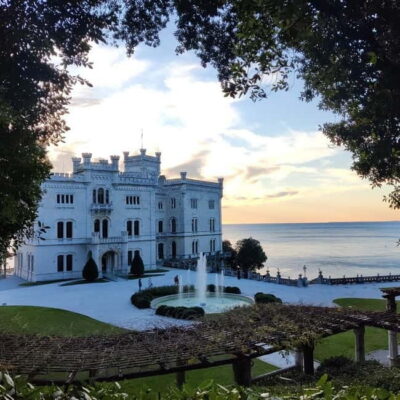
Miramare Castle & Museum Entry Ticket & Audio App
Read our review →
Browse the lists this tour appears in