
Reviewed · DOGE'S PALACE TOURS
Immersive Beauty: A Tailored Private Tour of the Doge’s Palace
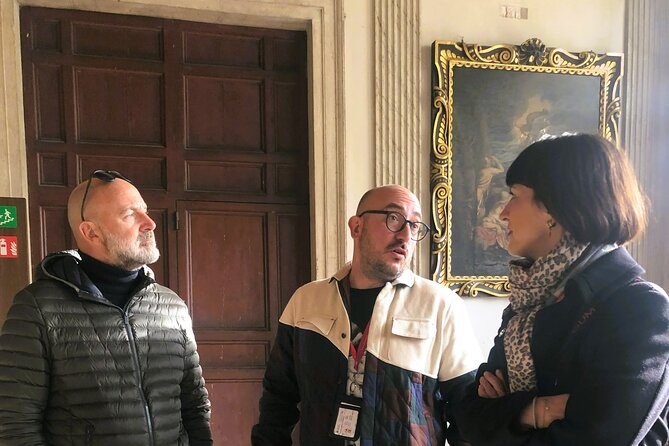
The best part of this private Doge’s Palace tour is its focus on the building as a working seat of power, not just a pretty museum. With licensed guide Valerio, you move from St. Mark’s Square into council rooms, court chambers, the armory, the Bridge of Sighs, and the prisons, while connecting art to the machinery of Venetian government. The private format lets you shape the visit around your interests.
I especially like two things here: Valerio can adjust the pace and subject matter for your group, and he helps arrange fast-track admission so you are not left guessing at the entrance. The main consideration is price: at $185.43 per person, palace admission is still extra, so this makes more sense for visitors who want context and personal attention than for anyone seeking the cheapest way inside.
In This Review
- Key points at a glance
- Why a private Doge’s Palace tour helps
- Starting in Piazza San Marco
- The Scala dei Giganti and the palace entrance
- Loggia, Golden Staircase, and the Atrio Quadrato
- Where Venice made decisions
- The Council of Ten and the Compass Room
- Armoury and Venetian justice
- The Great Council and the election rooms
- Crossing the Bridge of Sighs
- The New Prisons and the final perspective
- What $185.43 per person buys you
- Who should book this experience?
- Should you book it?
- FAQ
- How long does the private Doge’s Palace tour last?
- What language is the tour offered in?
- Who guides the tour?
- Are Doge’s Palace entrance tickets included?
- Is the tour private?
- Where does the tour begin?
- Where does the tour end?
- Can the itinerary be customized?
- Can I cancel for a full refund?
Key points at a glance
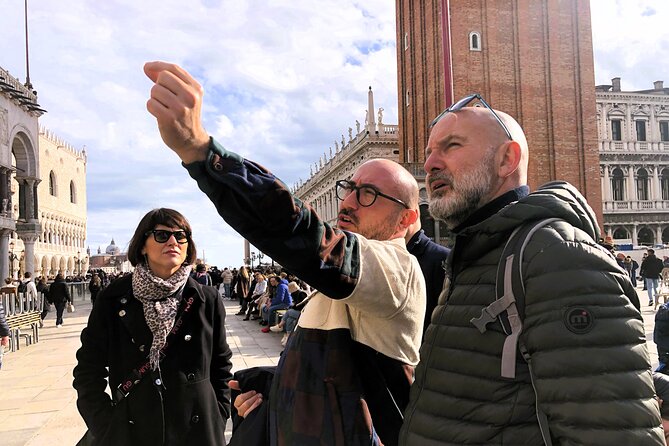
- Private time with Valerio: Only your group takes part, making it easier to ask questions and change the emphasis.
- A full political tour: The route covers the Council of Ten, Senate, Collegio, Great Council, and election rooms.
- The palace’s darker side: Cross the Bridge of Sighs and enter the New Prisons, not just the grand state rooms.
- Fast-track help: The guide assists with purchasing Doge’s Palace tickets at the best available rate, but admission is not included.
- Good for families and mixed interests: The tour can be adapted for children, art lovers, history fans, or first-time visitors.
- Central meeting point: Start at Caffè Florian in Piazza San Marco and finish at the same meeting point.
Why a private Doge’s Palace tour helps
The Doge’s Palace can overwhelm you quickly. It is packed with enormous paintings, marble stairways, political offices, ceremonial rooms, court spaces, and passages linked to Venice’s prison system. Without a guide, it is easy to admire the decoration while missing what each room was meant to do.
This tour gives the palace a clear structure. Venice was not ruled by a single absolute monarch in the usual sense. Its government relied on councils, elected officials, senators, judges, and tightly controlled political bodies. As you move through the palace, the rooms become a map of that system.
The private setup matters most when your group has different needs. You can ask for more art, more political history, more Venetian justice, or more stories about the building itself. Families can request explanations suited to children. A previous family visit worked especially well by connecting the palace decoration to Greek and Roman mythology, which kept children involved while adults followed the larger history.
The tour is offered in English. The experience is private, so your own group takes part rather than joining a larger party. That gives you room to stop for questions, though a two-hour visit still requires a fairly brisk pace if you want to cover most of the route.
More Doge's Palace visits:
- Venice: Doge’s Palace Reserved Entry Ticket
★ 4.6 · 42,716 reviews - Doge’s Palace & St. Mark’s Basilica with Terrace Access Tour
★ 4.7 · 10,697 reviews - Venice: Doge’s Palace, St Mark’s Basilica, and Pala d’Oro
★ 4.4 · 6,235 reviews
Starting in Piazza San Marco
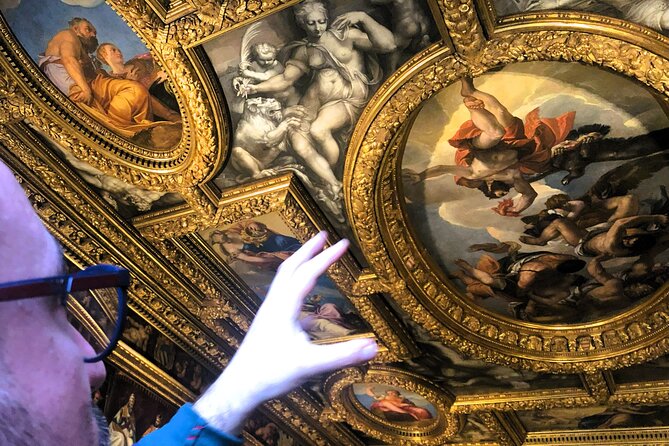
Meet at Caffè Florian, at P.za San Marco 57, one of the most recognizable addresses in Venice. The opening look at Piazza San Marco is short, about five minutes, but it gives Valerio a chance to explain why this square became the ceremonial and political heart of the city.
You will be surrounded by the Doge’s Palace, St. Mark’s Basilica, arcades, and the open square itself. This is not meant to be a full tour of every building around the piazza. Instead, it sets up the relationship between the palace and the city outside it.
I like this beginning because it prevents the Doge’s Palace from feeling isolated. The palace was built to face the square and the lagoon, displaying the Republic’s power to officials, merchants, visitors, and ordinary residents. Your guide can also help you get oriented before the palace’s many stairways and rooms begin.
The meeting point is convenient for public transportation, and the activity ends back at the same location. Confirmation is provided at booking, and service animals are allowed.
The Scala dei Giganti and the palace entrance
Inside the palace, the first major stop is the Scala dei Giganti, or Staircase of the Giants. Its large sculptures and formal design announce authority before you reach the state rooms.
This is a useful place to hear how architecture served politics in Venice. The staircase was not simply a way to move between floors. It helped create a sense of ceremony and rank, preparing officials and visitors for the government spaces above.
The stop is listed at about five minutes, but you may spend longer here if you are interested in sculpture, symbols, or the layout of the courtyard. Since the palace is a working architectural sequence rather than a collection of unrelated rooms, these transition spaces deserve more attention than they often receive.
Admission to the palace is not part of the $185.43 tour price. Valerio assists with obtaining skip-the-line tickets, but you should treat the ticket cost as an additional expense. Ask for the total cost for your party before booking if you are comparing this with a standard admission tour.
Loggia, Golden Staircase, and the Atrio Quadrato
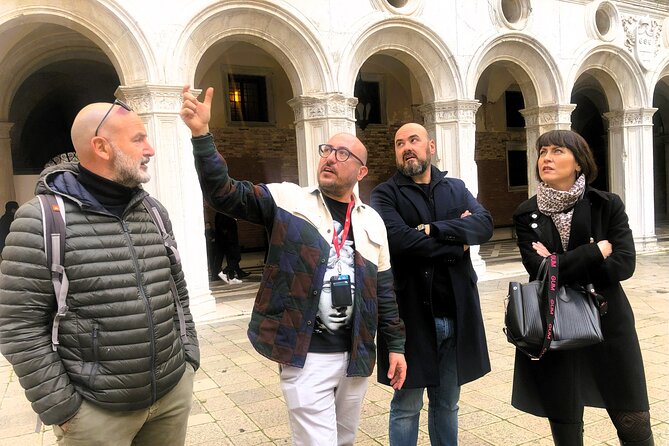
The Loggia opens views toward St. Mark’s Basilica and the square. This is one of the places where the palace’s public face becomes clear. You are looking back toward the ceremonial center of Venice, from a building designed to project control and grandeur.
Next comes the Scala d’Oro, the Golden Staircase. The name is deserved: its decoration reflects the wealth and prestige associated with the Doge and the Republic. Valerio’s role here is not simply to point out gilded surfaces, but to explain why so much effort went into making official movement through the palace feel grand.
The route continues to the Atrio Quadrato, the square atrium. This room may be less famous than the Golden Staircase, but it helps you understand how the palace functioned day to day. I appreciate this kind of stop because it gives practical shape to the building. You are not only seeing masterpieces. You are following the spaces through which officials, diplomats, judges, and palace staff moved.
These early rooms are brief stops on paper. A private guide can adjust them, but the overall visit remains about two hours, so you should tell Valerio at the start if you want to linger over architecture rather than move quickly toward the political chambers.
A few more Venice days to weigh up
- Venice: Grand Canal Gondola Ride with App Commentary
★ 4.1 · 18,908 reviews - Boat Trip: Glimpse of Murano, Torcello & Burano Islands
★ 4.3 · 15,699 reviews - Venice: Grand Canal by Gondola with Live Commentary
★ 4.1 · 13,681 reviews - Venice: La Fenice Opera House Entry Ticket with Audio Guide
★ 4.6 · 11,742 reviews
Where Venice made decisions
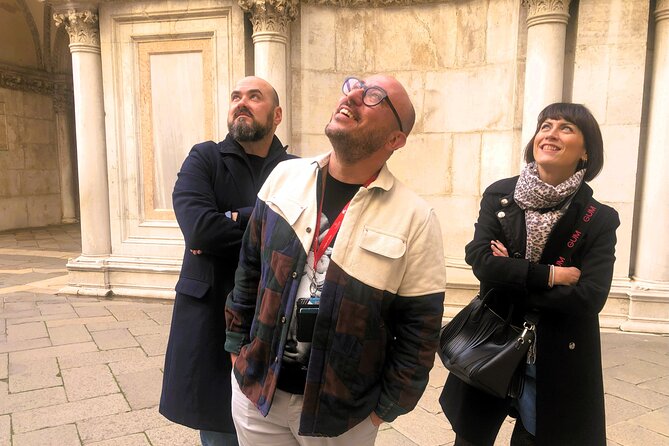
The Sala delle Quattro Porte, or Four Doors Room, leads you into the political core of the palace. Its artwork and elaborate surfaces frame the business of government, diplomacy, and official access.
The Sala dell’Anticollegio follows as an antechamber to the Collegio. Works associated with artists such as Tintoretto and Veronese add a strong artistic layer to the visit. Here, art was not placed only for decoration. It helped present Venice as wealthy, orderly, cultured, and favored by history.
The Sala del Collegio was central to political decision-making. This is a good point to ask about the Doge’s actual role and the balance between ceremonial leadership and the many councils that limited power. The Venetian Republic often spread authority across institutions, which made the system complicated and, at times, secretive.
The Senate chamber continues that story. Senators met here to discuss matters of state, and the room helps explain how policy, trade, war, and diplomacy were handled. These rooms can blur together if you only look upward at the ceilings. Valerio’s explanations give each one a job and a place in the government.
The Council of Ten and the Compass Room
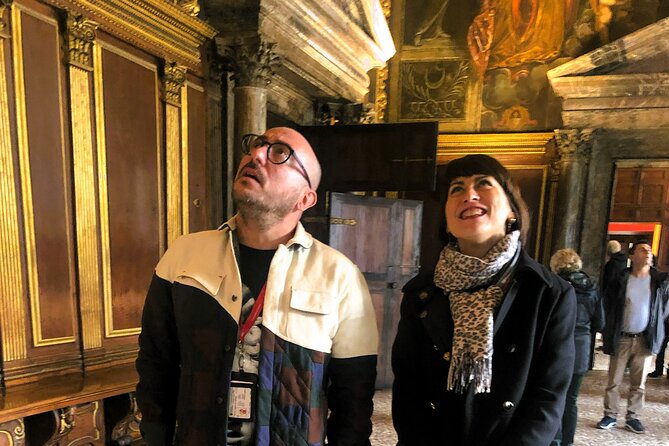
The Consiglio dei Dieci, or Council of Ten, brings a more secretive tone. This body dealt with political stability and order, and its role reflects the Republic’s concern with internal threats as well as outside enemies.
The Sala della Bussola, or Compass Room, is tied to justice, surveillance, and anonymous accusations. A small window allowed citizens to submit denunciations without revealing their identities. That system shows the uneasy balance between public order and personal freedom in Venetian government.
This is one of the most interesting parts of the route for anyone curious about espionage and political control. You hear how secret reports could help the state identify suspicious activity, but also how such systems could create fear and mistrust. The room makes Venice’s polished public image feel more complicated.
The exact access available to restricted or secret areas should be confirmed with Valerio before the tour. The experience highlights secret itineraries and areas not open to standard tours, but the supplied details do not identify every restricted room or guarantee access to a particular one. Ask directly if a specific hidden route is important to you.
Armoury and Venetian justice
The Armeria, or armory, shifts attention from government to defense. Here, the subject is Venice’s military power, strategic alliances, battles, and the need to protect a maritime state.
The room helps balance the palace’s political story. Venice was not only a city of merchants and painters. Its wealth depended on trade routes, naval strength, diplomacy, and the ability to protect its interests across the Adriatic and beyond.
The Sala della Quarantia Civil, also called the Chamber of the Quarantia Civil Vecchia, introduces the civil justice system. This is an important stop if you want to understand how rules were enforced inside the Republic. The palace held courts as well as councils, and its grand corridors connected law, politics, and punishment.
The Sala del Guariento adds another artistic pause. The room’s artwork brings you back to the cultural achievements of Venice after the heavier subjects of military defense and justice. A tailored visit lets you ask Valerio to spend more time on painting, symbolism, or the relationship between art and state power.
The Great Council and the election rooms
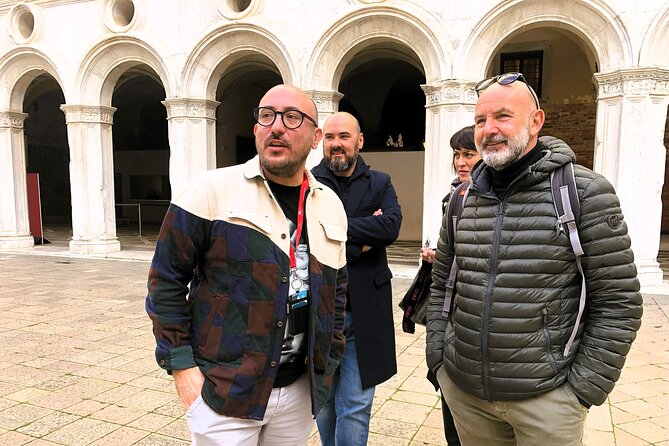
The Sala del Maggior Consiglio, or Great Council Chamber, is the visual and political high point of the tour. It is the palace’s largest room and was used for grand assemblies.
The scale matters. You can better understand how Venetian political life worked when you stand in a room designed for a large governing body rather than a single ruler. The chamber reflects the Republic’s public image of shared authority, even though access to political power was tightly restricted.
The Sala dello Scrutinio follows with its focus on elections, voting, and the complicated process of choosing officials. Venice developed elaborate methods to prevent any one family or faction from taking complete control. Those methods were not simple democracy in the modern sense, but they created a distinctive system of managed participation.
The Quadreria, or picture gallery, provides another chance to focus on art. If your group has limited interest in government, tell Valerio early. He can place more weight on paintings, architecture, and legends, rather than giving every political chamber equal time.
Crossing the Bridge of Sighs
The Ponte dei Sospiri is one of Venice’s most photographed structures, but its real story is less romantic than its name suggests. The bridge connected the Doge’s Palace with the New Prisons, allowing prisoners to pass from judgment to confinement.
You will hear both the legends and the historical reality. The familiar idea of prisoners sighing at their last view of Venice has a strong grip on popular imagination, but the bridge also represents a practical link in the judicial system.
This is a memorable transition because the mood changes sharply. The ornate halls of government give way to the darker side of the Republic. It also helps explain why a palace visit should not stop at the grand rooms. The bridge is most meaningful when you understand what it connected.
The crossing takes about ten minutes in the planned route. Depending on the palace’s operating conditions, movement through the building may be directed by staff, so follow the guide’s instructions.
The New Prisons and the final perspective
The Prigioni Nuove, or New Prisons, show a less polished Venice. You learn about confinement, prisoners, and the judicial procedures of the time.
The prison section is not as visually lavish as the state apartments, but it gives the tour moral and historical balance. Venice’s institutions produced art, trade, law, and political order, yet they also relied on surveillance and punishment. Seeing both sides makes the Doge’s Palace more than a showcase of marble and paintings.
The tour ends back at the meeting point after a final look at the palace’s cultural and political legacy. Since the activity is private, this is a useful moment to ask for practical advice about the rest of your Venice visit. Valerio has also helped some groups with restaurant suggestions, reputable shopping, and ideas for exploring Murano and Burano, but those additions are not part of the two-hour palace tour itself.
What $185.43 per person buys you
The listed price is $185.43 per person, with group discounts available. Palace admission is extra, including any special fares for families, seniors, young visitors, or students.
That makes the value depend heavily on your priorities. You are paying for a licensed local guide, a private group, itinerary flexibility, and help with skip-the-line arrangements. You are not simply buying entry.
For two people, the cost can feel substantial. For a small group splitting the private guide fee, it may compare more favorably with several separate admissions and a standard group tour, especially if you want to ask many questions or avoid a one-size-fits-all route.
I would not book this solely for fast entry. The ticket assistance is useful, but the real value is having someone explain the political structure, identify important artworks, and connect the palace to Venice’s wider story. If you prefer to wander silently and read labels at your own pace, the extra cost may not be justified.
Who should book this experience?
This tour suits first-time visitors who want a strong introduction to Venice’s most important government building. It is also a good match for repeat visitors who have seen the palace before but want more attention to its courts, elections, political surveillance, or prison system.
Families can benefit from the private format because Valerio can adjust explanations for different ages. Art lovers should ask for extra time in the Anticollegio, Guariento’s Room, Great Council Chamber, and picture gallery. History fans will likely prefer the Senate, Council of Ten, Compass Room, and election rooms.
The two-hour length is efficient, but not leisurely if you want to study every painting. Tell Valerio what matters most before entering. Free cancellation is available up to 24 hours before the start time. Changes or cancellations inside that window are not accepted for a refund.
Should you book it?
Book this tour if you want the Doge’s Palace explained as a living system of power, law, art, and punishment, and if you value a guide who can shape the visit around your group. Valerio’s strong points are personal attention, clear context, practical help, and an obvious affection for Venice.
Skip it if your main goal is inexpensive entry or a completely independent visit. Remember to budget for palace tickets, and ask in advance which restricted or secret areas are available on your date. For a private experience that turns a huge and sometimes confusing palace into a readable story, this is a solid choice.
FAQ
How long does the private Doge’s Palace tour last?
The tour lasts approximately two hours.
What language is the tour offered in?
The experience is offered in English.
Who guides the tour?
The tour is led by Valerio Coppo, a licensed local guide with deTourist Venice Valerio Coppo.
Are Doge’s Palace entrance tickets included?
No. Entrance tickets are not included in the tour price. Valerio assists with purchasing skip-the-line tickets at the best possible rate.
Is the tour private?
Yes. Only your group participates in the activity.
Where does the tour begin?
The meeting point is Caffè Florian, P.za San Marco 57, 30124 Venezia VE, Italy.
Where does the tour end?
The activity ends back at the meeting point.
Can the itinerary be customized?
Yes. The itinerary can be adjusted according to your group’s preferences and interests.
Can I cancel for a full refund?
Yes, if you cancel at least 24 hours before the experience start time. Cancellations or changes made less than 24 hours before the start time are not accepted for a refund.
Just added around Venice
- Shuttle to Lake Braies departing from Cortina d’Ampezzo★ 4.0 · 5 reviews
- Guided Tour and Wine Tasting in the Sandro De Bruno Winery★ 5.0 · 5 reviews
- Verona: Horseback Riding and Wine Tasting Experience★ 5.0 · 5 reviews
- Private boat tour, visit the major islands Venice★ 5.0 · 5 reviews
- Venice Mestre: M9 Museum Permanent Exhibition Entry Ticket★ 4.4 · 5 reviews
- Vespa 125 rental to explore the UNESCO Hills★ 5.0 · 5 reviews
- The Heart of Venice: A Self-Guided Audio Tour★ 4.5 · 5 reviews
- Venice: La Fenice Theater Tour★ 4.8 · 5 reviews
Doge's Palace Tours, compared.
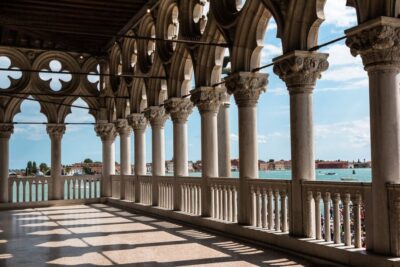
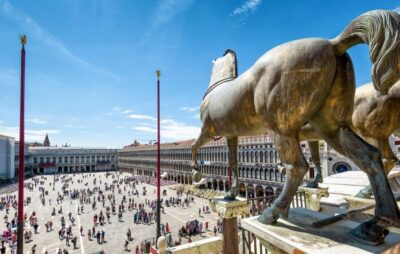
Doge’s Palace & St. Mark’s Basilica with Terrace Access Tour
Read our review →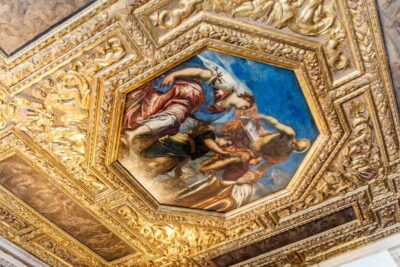
Doge’s Palace, St Mark’s Basilica, and Pala d’Oro
Read our review →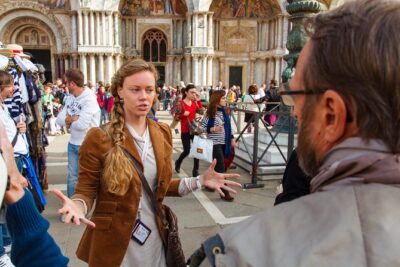
Legendary Venice: Doge’s Palace, St Mark’s & VIP Terrace Access
Read our review →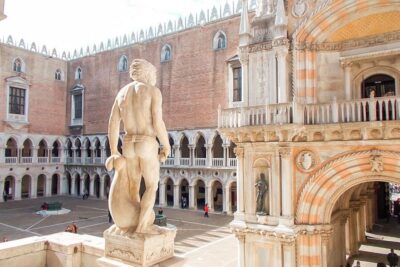
St. Mark’s Basilica & Doge’s Palace Tour with Ticket
Read our review →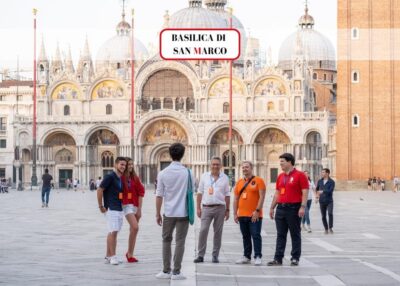
St Mark’s Basilica, Doge Palace, & Bell Tower Option
Read our review →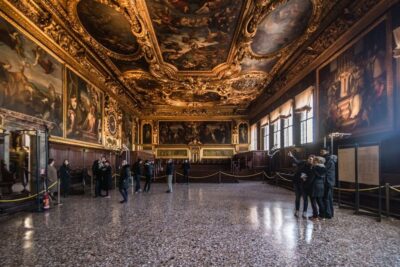
Doge’s Palace, Bridge of Sighs & Prisons Guided Tour
Read our review →Browse the lists this tour appears in