Reviewed · PRIVATE
Venice for First-Timers: Essential Private Tour
Venice is more than palaces and pretty canals. This private tour explains the fragile lagoon that made the city possible, then shows how tides, wind, lunar cycles, and the MOSE flood barriers still shape life here. Guide Valerio Coppo brings a local’s view, with useful food and sightseeing tips along the way.
I like the focus on acqua alta, a subject most first-time visitors barely understand, and the small group limit of eight. I also like that Valerio can point you toward less crowded streets, local churches, cafés, gelato shops, and restaurants. The main drawback is the short length: at about two hours, this is an introduction, not a full tour of Venice.
In This Review
- Key points to know before booking
- Why Venice begins with water, not monuments
- The three openings that connect Venice to the Adriatic
- What really causes acqua alta
- The 1966 flood and Venice’s modern problems
- MOSE and the effort to hold back the sea
- Campo Santa Maria Formosa and the human side of flooding
- A local guide who adds practical Venice advice
- Is $185.85 per person a fair price?
- Who should book this Venice introduction?
- What to know before you go
- Should you book it?
- FAQ
- Where does the tour take place?
- How long does the tour last?
- How much does the tour cost?
- Is this a private tour?
- Is the tour offered in English?
- What does the tour explain about acqua alta?
- Does the tour discuss the MOSE barriers?
- What is the cancellation policy?
Key points to know before booking
- The lagoon is the main story: You learn why Venice was built here and how the Republic shaped the waters around it for survival.
- Acqua alta gets a clear explanation: The tour separates ordinary tides from flooding caused by several forces working together.
- MOSE adds a modern chapter: You hear how the floating barriers may protect Venice from severe high water.
- Valerio Coppo is a local guide: His advice can help you find authentic places to eat, drink, and explore after the tour.
- The group is capped at eight: You get a private experience for your party, with room to ask questions.
- The tour suits a first day: It gives you a useful framework for understanding Venice before you explore on your own.
Why Venice begins with water, not monuments
Most introductions to Venice begin with St. Mark’s Square, the Doge’s Palace, or a gondola ride. This one begins with the lagoon. That choice gives you a better explanation for why the city exists at all.
The Venetian lagoon is not simply a scenic body of water. It connects to the Adriatic Sea through three port inlets, allowing seawater to flow in and out with the tides. That movement helps maintain the lagoon’s natural balance, while also creating the conditions that can put Venice underwater.
The Republic of Venice spent centuries shaping this difficult environment. Rivers were diverted, barriers were built, and waterways were managed to protect the city from both the sea and excess sediment. You get a sense of the enormous effort involved. Venice was not placed in an easy setting. It survived because its people learned to work with a changing environment.
I find this a strong way to begin a Venice visit because it changes how you look at the city. Every canal, quay, inlet, and raised walkway becomes part of a larger story. You stop seeing high water as a random nuisance and begin to understand it as a natural event made more serious by the city’s location and modern pressures.
The tour is also a good fit if you want more than a string of artistic facts. It gives you the physical setting first, then connects that setting to history, engineering, weather, and daily life.
A few more Venice days to weigh up
- Venice: Doge’s Palace Reserved Entry Ticket
★ 4.6 · 42,716 reviews - Venice: Grand Canal Gondola Ride with App Commentary
★ 4.1 · 18,908 reviews - Boat Trip: Glimpse of Murano, Torcello & Burano Islands
★ 4.3 · 15,699 reviews
The three openings that connect Venice to the Adriatic
One part of the experience explains the three port inlets linking the lagoon with the Adriatic Sea. These openings allow the water to circulate according to the rhythm of the tides.
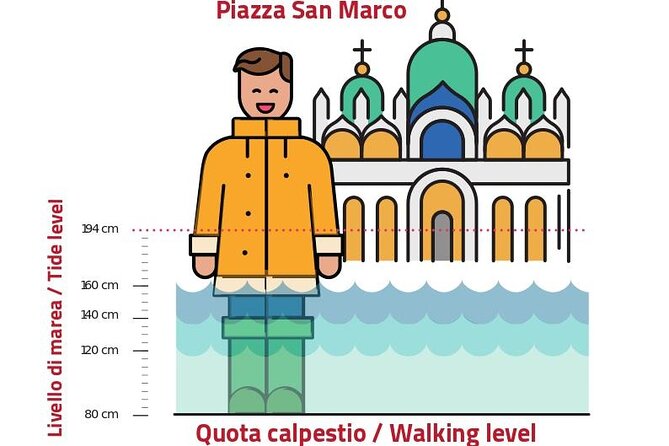
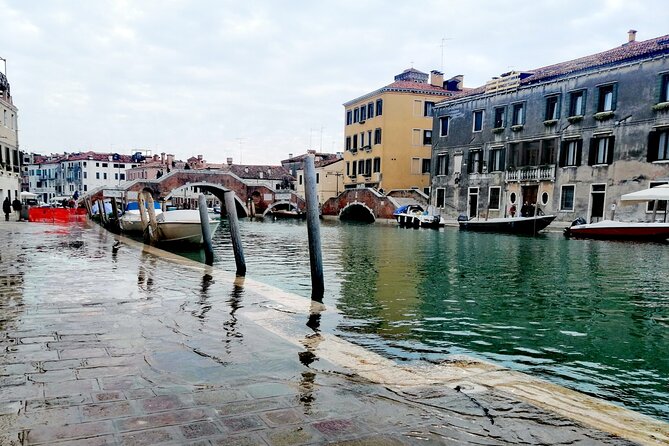
That cycle matters. High tide itself is not automatically a disaster. The tour explains that water becomes a serious problem for the city when it rises beyond about 80 centimeters, the level commonly used to identify acqua alta.
This distinction is useful. If you hear that Venice has an 80-centimeter tide, you might assume the city is about to flood badly. In practice, the effect depends on how high the water rises above ordinary levels and which parts of the city are most exposed.
At around 140 centimeters, the impact becomes much more severe. More of the city can be affected, movement becomes harder, and low-lying squares and streets face serious disruption. The tour helps you understand why a relatively small difference in water height can produce a very different day in Venice.
The setting also gives the guide room to explain the lagoon as an ecosystem. The exchange of seawater is part of the system’s health, so simply blocking all tides would not be a sensible answer. Venice needs protection, but it also needs the natural movement of water that keeps the lagoon functioning.
What really causes acqua alta
The tour’s most useful correction is that rain is not the main cause of acqua alta. Rain can add to the trouble, but the larger mix includes astronomical tides, lunar phases, strong winds, and low air pressure.
The moon affects the tides, so certain phases can help produce higher water levels. Strong winds can push water toward the lagoon, while low pressure can allow the sea level to rise. When several conditions line up, Venice faces a much greater risk.
Some of these factors can be predicted. Others are harder to judge precisely, especially when weather systems change quickly. That explains why high water warnings are helpful but cannot always tell you exactly how streets and squares will look at a given hour.
I like this part because it replaces a simple explanation with a practical one. Venice is not flooding because it rained for an afternoon. It is responding to a chain of natural forces, combined with the city’s low position and the way its historic center is built.
You also learn why two tides with similar numbers can feel different. The timing, location, wind, pressure, and duration all matter. A tide at 80 centimeters may leave many paths usable, while a higher tide can affect much more of the city.
For a first-time visit, this information has real value. It helps you read local warnings and understand why raised walkways appear in certain places. It also makes you more patient when water changes your route. The city is dealing with a natural cycle, not simply failing to keep its streets dry.
The 1966 flood and Venice’s modern problems
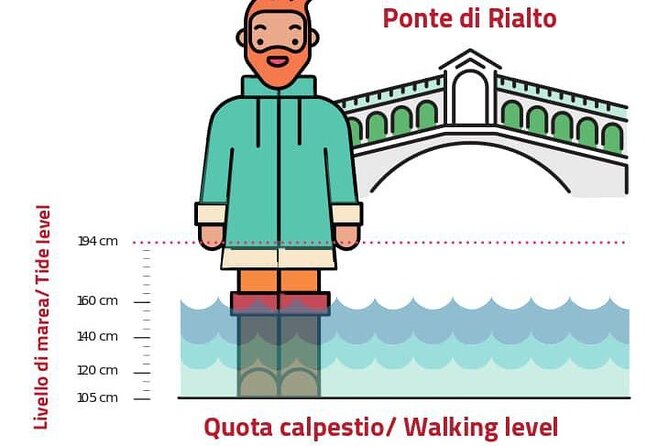
The tour looks back to the 1960s, when an exceptional weather event caused one of the most tragic floods in Venice’s history. In 1966, the tide reached the highest level ever recorded in the city at that time, an event remembered as the aqua granda.
This was not just a bad day for sightseeing. The flood affected homes, businesses, monuments, and the lives of the people who lived in Venice. It also changed the way authorities and residents thought about the city’s future.
That historical chapter matters because it links an extreme event to decades of planning and debate. Venice had long adapted to water, but the scale of the 1966 flood showed that older methods were not always enough.
The tour then moves toward the 2019 high-water events, which again caused severe damage in Venice. You learn how these events raised fresh concerns about climate change, rising water levels, and the strain created by mass tourism.
The guide connects those issues without reducing Venice to a simple disaster story. The city’s problems come from several directions: natural tides, weather, changing climate conditions, the fragility of historic buildings, and the enormous number of people who pass through each year.
You should not expect a technical climate lecture. The strength here is the connection between a specific event and the streets you are walking through. Places that look charming in dry weather can take on a different meaning when you understand how hard high water hits them.
A different sort of day out around Venice:
- Venice: Grand Canal by Gondola with Live Commentary
★ 4.1 · 13,681 reviews - Venice: La Fenice Opera House Entry Ticket with Audio Guide
★ 4.6 · 11,742 reviews - Doge’s Palace & St. Mark’s Basilica with Terrace Access Tour
★ 4.7 · 10,697 reviews - Venice: Burano, Torcello & Murano Boat Tour w/Glassblowing
★ 4.4 · 10,245 reviews
MOSE and the effort to hold back the sea
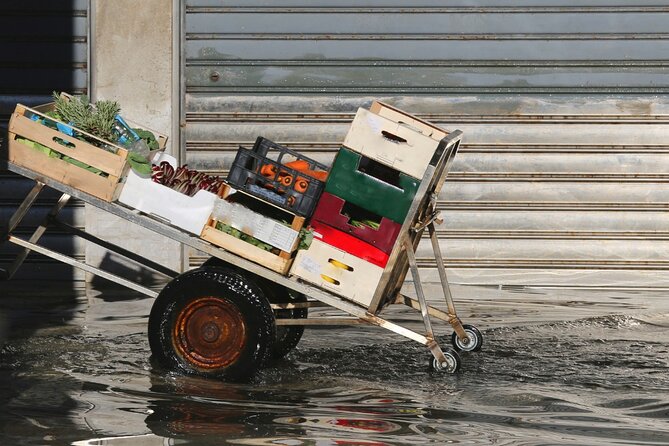
A central modern subject is MOSE, the system of floating flood barriers designed to protect Venice from severe high water. The name refers to movable barriers positioned at the lagoon’s three port inlets.
The idea is straightforward, but the challenge is enormous. The barriers can be raised when a dangerous tide is expected, closing the lagoon entrances for a period of time. When conditions improve, they can be lowered so normal water exchange can resume.
That balance is important. Venice cannot simply be sealed off from the Adriatic every time the tide rises. The lagoon needs its connection with the sea, and the system must account for shipping, water circulation, and the wider ecosystem.
The tour presents MOSE as a possible lifeline, not a magic solution. It may reduce the worst flooding, but Venice still faces the broader effects of climate change and pressure from heavy tourism. You get a clearer idea of why protecting the city requires both engineering and careful management.
If you are interested in how old cities handle modern problems, this is one of the tour’s strongest sections. The subject gives the lagoon story a current edge. You are not only learning what Venice survived in the past. You are considering what it needs to remain livable in the future.
Campo Santa Maria Formosa and the human side of flooding
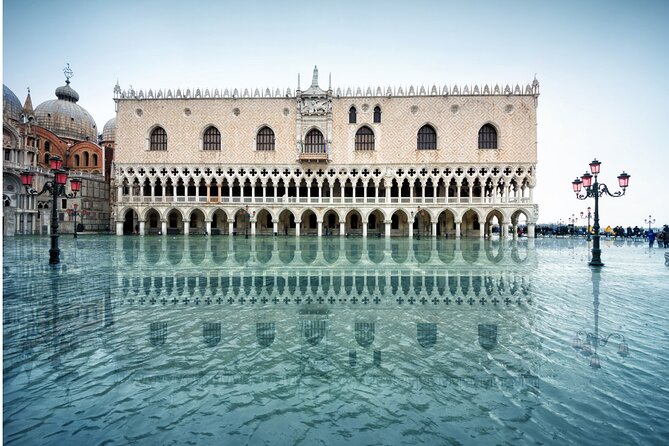
The itinerary includes Campo Santa Maria Formosa, an area connected with the serious flooding experienced in late 2019. This gives the discussion a more personal scale.
Rather than treating acqua alta as an abstract measurement, you can relate it to a real square and the buildings around it. Historic churches, shops, doorways, and paths are not just scenery when water rises. They are part of a working city with residents, businesses, and visitors trying to move around.
The tour also includes Lido di Venezia, an important part of the lagoon system and another place tied to the effects of the 2019 events. These stops help spread the story beyond the most photographed center of Venice.
A possible limitation is that the provided timing assigns about 15 minutes to each of seven stops. That creates a brisk pace, especially if you want long pauses for photographs or extended visits inside monuments. The experience is built around explanation and movement, not lingering at one site.
That pace can work well on your first day. You get several viewpoints quickly, and the small group makes it easier to ask for clarification. If you prefer a slow architectural tour with long interior visits, you may want to pair this with a separate church or palace visit.
A local guide who adds practical Venice advice
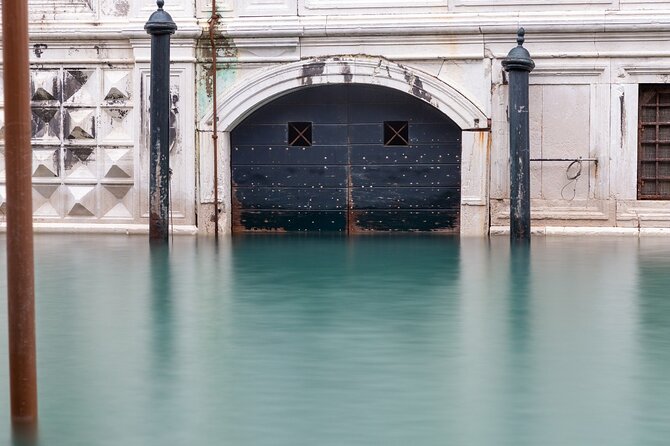
Guide Valerio Coppo is presented as a local Venetian who knows the city’s smaller streets and less crowded corners. That matters in Venice, where a short turn can take you from a packed route to a quiet lane.
The strongest practical benefit is the advice you can use after the tour. Valerio has offered recommendations for restaurants, cafés, chocolate shops, gelato, and places to see beyond the usual route. You should treat that as a useful starting point, then check current opening hours yourself.
The guide also has experience making the walk work for families. Children aged seven, eight, nine, ten, eleven, and twelve have been included successfully, with explanations adjusted to keep younger participants involved. That does not mean every child will enjoy every section, but the subject offers plenty of clear, memorable ideas, from floating barriers to tides and moon cycles.
English is the offered language. The tour is private, so only your group participates, and the maximum group size is eight. That combination gives you more control than a large group outing. You can ask why a particular part of Venice floods, request a food suggestion, or pause briefly to clarify something without competing with a crowd.
Pickup is offered, and the tour is near public transportation. The exact pickup arrangement should be confirmed when you book, since the supplied details do not specify the meeting point or whether pickup is included in every location.
Is $185.85 per person a fair price?
At $185.85 per person, this is not a budget walk. The value depends heavily on your group size and how much you care about personal guidance.
For one or two people, the price is a serious splurge for a two-hour experience. For a larger private group of up to eight, the cost may feel more reasonable because you are paying for a private guide rather than a seat on a large scheduled tour.
You are paying for several things beyond time on the street:
- A licensed guide
- A private experience for your own group
- A small maximum group size
- A focused explanation of tides, lagoon management, flooding, and MOSE
- Local suggestions for food and further sightseeing
- A first-day orientation to Venice
I would not choose this tour solely to see famous monuments. Many of Venice’s major sights can be visited independently, and two hours is too short for a full city tour.
I would consider it good value if you want context. Understanding the lagoon can make the rest of your visit more rewarding, especially if Venice is new to you. It can also save you from spending your first day with no idea how the city’s waterways and high-water warnings work.
The tour is booked, on average, well in advance, around 70 days. That suggests you should reserve early if your dates are fixed, especially if you want a particular time. Free cancellation is available until 24 hours before the start time, with a full refund. Changes or cancellations inside that window are not accepted for a refund.
Who should book this Venice introduction?
I would recommend this for first-time visitors who want a clear explanation of Venice rather than a checklist of monuments. It is particularly useful if you enjoy geography, engineering, weather, local history, or the practical problems of keeping an old city alive.
Families may also like it. The private format lets Valerio adjust the pace and invite questions from children, rather than forcing everyone to follow a fixed large-group script.
It is less suitable if your main goal is an interior tour of St. Mark’s Basilica, a gondola ride, or a detailed art-history lesson. None of those is the central focus here.
You should also know that the tour’s subject is more serious than a simple orientation walk. Climate change, historic flooding, and the future of Venice are part of the experience. That adds substance, but it may not match what you want if you are seeking only light sightseeing.
What to know before you go
Wear comfortable shoes and expect to walk through Venice, though the supplied details do not give a precise route or accessibility plan. Most people can participate, and service animals are allowed.
If you are visiting Venice for the day from outside the city, check the official access-fee rules before arriving. On certain dates, many day visitors must pay a €5 fee, while exemptions apply in some cases. The applicable dates and conditions can change, so use the official Venice access-fee website before your trip.
The tour is offered in English and includes a licensed guide. Confirmation arrives when you book. Since the experience requires a minimum number of participants, a cancellation for that reason results in an alternative date or experience, or a full refund.
Should you book it?
Book this tour if you want Venice to make sense before you start exploring on your own. The combination of lagoon geography, acqua alta, MOSE, 1966, 2019, and local food advice gives you more than a standard introductory walk.
I especially like it for a first morning or first afternoon, when you need a mental map and a better feel for the city’s unusual rhythms. The two-hour limit keeps it manageable, but also means you should not expect long monument visits.
Skip it if your priority is a low-cost sightseeing route or a major attraction ticket. Choose it if you value a local guide, a private group, useful advice, and the chance to understand why Venice is both beautiful and difficult to protect.
FAQ
Where does the tour take place?
The experience takes place in Venice and the Venetian Lagoon, with stops connected to Venice, Lido di Venezia, and Campo Santa Maria Formosa.
How long does the tour last?
The tour lasts approximately two hours.
How much does the tour cost?
The listed price is $185.85 per person.
Is this a private tour?
Yes. Only your group participates, and the group is limited to eight travelers.
Is the tour offered in English?
Yes. English is the offered language.
What does the tour explain about acqua alta?
It explains the difference between normal tides and high water, including the effects of lunar phases, astronomical tides, strong winds, and low air pressure. It also explains why rain is not the main cause.
Does the tour discuss the MOSE barriers?
Yes. You learn about the MOSE floating flood barriers and their possible role in protecting Venice.
What is the cancellation policy?
You can cancel up to 24 hours before the experience starts for a full refund. Cancellations or changes made less than 24 hours before the start time are not accepted for a refund.
Just added around Venice
- Exclusive Private Venice Jewish Ghetto Tour★ 5.0 · 41 reviews
- The Secret Corners of Burano★ 5.0 · 41 reviews
- Verona: Private 2-Hour Walking Tour★ 4.9 · 41 reviews
- St Mark’s Basilica & Doge’s Palace Skip the Line – Semi-Private★ 5.0 · 42 reviews
- Venice: 3-Course Dining Experience at Local Home★ 4.8 · 41 reviews
- Wine Tasting in Venice★ 4.6 · 42 reviews
- Venice Skip lines at Doge’s & St. Mark’s with Exclusive Sky Walk★ 4.5 · 42 reviews
- Venice Saint Mark’s Basilica afternoon guided tour★ 4.5 · 42 reviews
Private, compared.
Murano & Burano Islands Guided Small-Group Tour by Private Boat
Read our review →
Private 3 hrs Venice Tour: St Mark’s, Walking tour & Boat tour
Read our review →
Private Best of Venice Walking Tour with St Mark’s Basilica
Read our review →
Private tour on Murano Island: discover the art of Artisanal Glassblowing
Read our review →