
Reviewed · DOGE'S PALACE TOURS
Ducal Venice, Historical Walking Tour & Skip the line Doge’s Palace
The best part of this tour is the way it connects everyday Venice with its grandest stage. You begin in quiet lanes and church squares, pass Marco Polo’s former home and the Malibran Theatre, then arrive at Doge’s Palace with its great halls, prison cells, and Bridge of Sighs.
I like the small maximum of 20 people, which makes a guided walk easier to follow, and I like that admission is included. Guides Ilaria and Gina have been praised for lively, clear storytelling, especially when explaining Venice’s history and modern life. The main drawback is the pace: three hours and a moderate amount of walking may feel brisk if you want long, unhurried visits at each stop.
In This Review
- Key points to know before booking
- A three-hour introduction to Venice’s power and daily life
- Saint Mark’s Square sets the scene
- Marco Polo’s house and the Malibran Theatre
- Saints Giovanni and Paolo, a church square with weight
- Santa Maria Formosa and the value of a slower street walk
- Entering Doge’s Palace without the regular queue
- The prison cells and the Bridge of Sighs
- What your ticket lets you see afterward
- Is $112.82 a fair price?
- Who should book this morning tour?
- Booking, weather, and cancellation details
- Should you book Ducal Venice?
- FAQ
- What time does the tour start?
- Where does the tour begin?
- Where does the tour end?
- How long does the experience last?
- Is admission to Doge’s Palace included?
- Can I visit other museums with the ticket?
- Are the Hidden Itineraries included?
- Are children charged for the tour?
- Can I cancel for a full refund?
Key points to know before booking
- The morning start helps you reach Doge’s Palace before the day gets away from you.
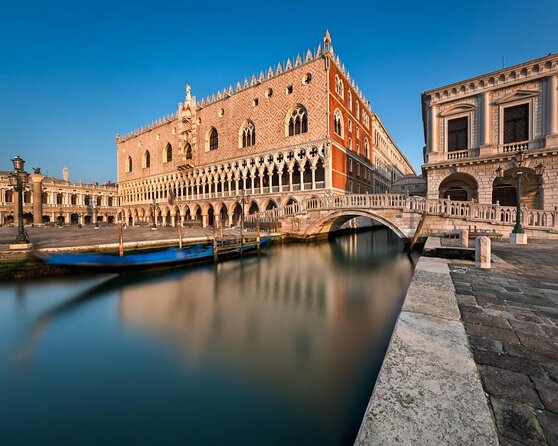
- The Castello walk adds local streets and church squares that a palace-only visit misses.
- Skip-the-line entry takes you past the regular palace queue.
- The tour includes headsets, useful in busy rooms and on narrow streets.
- Your palace ticket also covers Museo Correr, the Archaeological Museum, and the Marciana Library rooms for later self-guided visits.
- Large bags and backpacks are not allowed inside Doge’s Palace, so pack light.
A three-hour introduction to Venice’s power and daily life
This experience begins at 9am near Saint Mark’s Square and ends outside Doge’s Palace at the Carta Gate. That route matters. You are not simply taken from one famous building to another. You first get a sense of the lanes, churches, and public spaces around the center of Venice, then see how those quieter places connect to the political heart of the old republic.
I find this format useful on a first visit because Venice can feel confusing at street level. A guide gives you a thread to follow. You hear about religious life, military power, exploration, theater, and government without spending the whole morning studying a map.
The tour runs for about three hours. The first two hours are spent walking through the Saint Mark’s and Castello neighborhoods, followed by about an hour inside Doge’s Palace. You should expect a moderate amount of walking, standing, and moving through rooms at the guide’s pace.
The group is capped at 20 people. That is not a private tour, but it is more manageable than a large procession. Headsets are included, so you can hear the guide while standing behind the group or looking up at a building.
More History Tours in Venice
- Venice’s Best: Basilica, Doge’s Palace, Gondola & History Gallery
★ 4.5 · 2,478 reviews - Venice: City Center Historical Guided Walking Tour
★ 4.2 · 1,873 reviews - Venice: Bell Tower & St Mark’s Square History Gallery Ticket
★ 4.3 · 910 reviews
Saint Mark’s Square sets the scene
You meet at the TU.RI.VE. Meeting Point on Calle larga dell’Ascension, close to Saint Mark’s Square. Arrive 15 minutes early for check-in. The square is the obvious starting point for Venice’s political story, even though much of the walking portion moves away from its busiest sights.
Saint Mark’s Basilica is part of the visual setting, but it is not listed as an interior stop. If the basilica is closed, your guide can still explain its role from outside, as Gina did on one occasion. That is helpful context, but you should not book this tour expecting entry to the basilica.
The opening introduction also gives you a chance to understand the layout. Saint Mark’s Square, the palace, the waterfront, and the narrow eastern streets are close together on a map, yet Venice’s winding routes can make them feel far apart.
Marco Polo’s house and the Malibran Theatre
The first named stop is the exterior of Casa di Marco Polo, followed by the Malibran Theatre. You do not enter either building, and no admission fee is charged for this part.
Marco Polo’s name carries an outsized place in European ideas about travel and exploration. Seeing the house site gives the story a physical address instead of leaving it as a distant tale from a book. The guide can also place Polo within Venice’s trading culture and the city’s outward-looking character.
The Malibran Theatre adds another layer. It reminds you that Venice was not only a port and political power. It was also a place of performance and public entertainment. The stop takes about 30 minutes, so expect an explanation from the street rather than a theater visit.
I like this opening because it avoids making the morning all about marble palaces. The limitation is clear: if you want interiors at every stop, this section may feel brief. Its value comes from the setting and the guide’s interpretation.
Saints Giovanni and Paolo, a church square with weight
The walk continues to Saints Giovanni and Paolo Square, known locally as Campo San Giovanni e Paolo. Here you see the Basilica dei Santi Giovanni e Paolo, often called San Zanipolo.
The church is associated with the burial of several Venetian Doges. That detail helps explain why this square matters. The Doge was not simply a ruler in a modern royal sense. Venice had a complicated political system, and the tombs of its former leaders connect religious ceremony with the public memory of government.
The equestrian statue of Bartolomeo Colleoni is another major feature here. Colleoni was an Italian mercenary captain, and the statue reflects Venice’s habit of honoring military service in a public setting. It is a good place to pause and consider the practical side of the republic: trade needed protection, and political independence required force as well as ceremony.
This stop also gives you a change of scale. Saint Mark’s Square can feel ceremonial and grand. San Zanipolo’s campo offers a broader neighborhood setting where the church, statue, and surrounding buildings can be seen together.
More Walking Tours in Venice
- Venice Walking Tour and Gondola Ride
★ 3.5 · 3,630 reviews - Venice: Rialto Bridge & Offbeat Unusual Venice Walking Tour
★ 4.2 · 3,538 reviews - Private 3 hrs Venice Tour: St Mark’s, Walking tour & Boat tour
★ 4.0 · 3,372 reviews - Venice: Walking Guided Tour of the City Must-See Sites
★ 4.7 · 1,095 reviews
Santa Maria Formosa and the value of a slower street walk
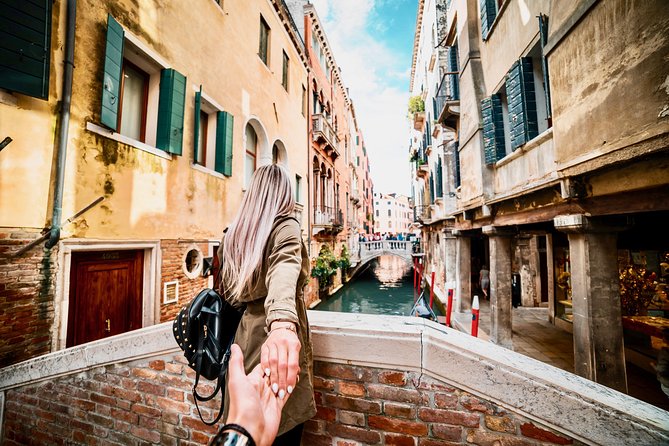
Campo Santa Maria Formosa is the next stop, with time to see the square and its church from outside. The church gives the campo its name and provides another example of how Venetian public spaces are organized around religious buildings.
For me, this part of the tour is important because it shows Venice between the headline sights. You walk through narrow lanes, cross small passages, and reach a square that feels different from the formal open space beside the palace. The guide can point out how Venice’s neighborhoods work as a chain of campos, churches, lanes, and canals.
The walking route is not a strenuous hike, but Venice’s paving and bridges can make moderate walking more tiring than the distance suggests. Wear comfortable shoes. The tour operates rain or shine, so bring suitable protection if the forecast looks wet.
Entering Doge’s Palace without the regular queue
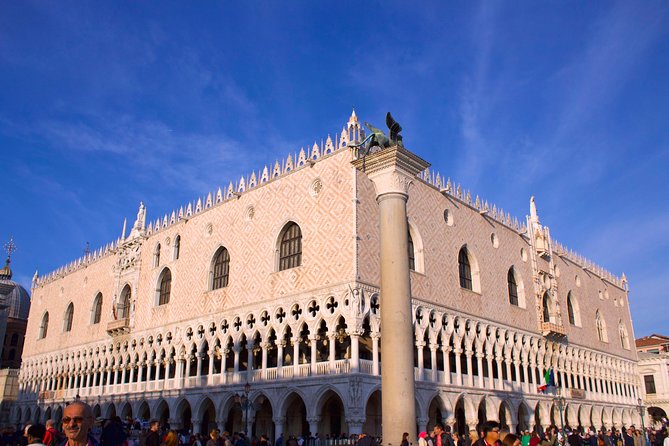
After the neighborhood walk, you return toward Saint Mark’s Square and head to Doge’s Palace. This is where the included skip-the-line ticket becomes especially useful. You pass the regular line and enter with the group, saving time that could otherwise be spent waiting outside.
Queue access does not mean the palace will be empty. You are still visiting one of Venice’s central attractions, and the grand rooms can be active. The advantage is that your limited morning time goes toward seeing the palace rather than standing in an entrance line.
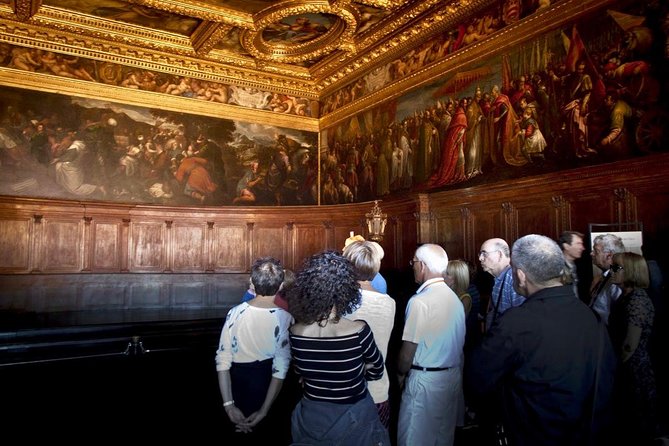
The guide stays with you for about an hour, explaining the palace as you move through its decorated interiors. Expect stuccoed halls, major paintings, and the visual language of Venetian authority. The palace was built to impress, but the guide’s job is to explain what that display meant: the republic wanted power to look permanent, organized, and almost overwhelming.
One highlight is the enormous oil painting described as the largest in the world. It is the sort of detail that can be easy to miss when you are looking at an entire wall of decoration. A guide helps direct your attention and gives the scale some meaning.
Gina’s palace presentation has been described as thorough, and Ilaria has also led a tour praised for being informative and captivating. Names and guides can vary by departure, so treat those examples as an indication of the style available, not a promise that one particular guide will lead your tour.
The prison cells and the Bridge of Sighs
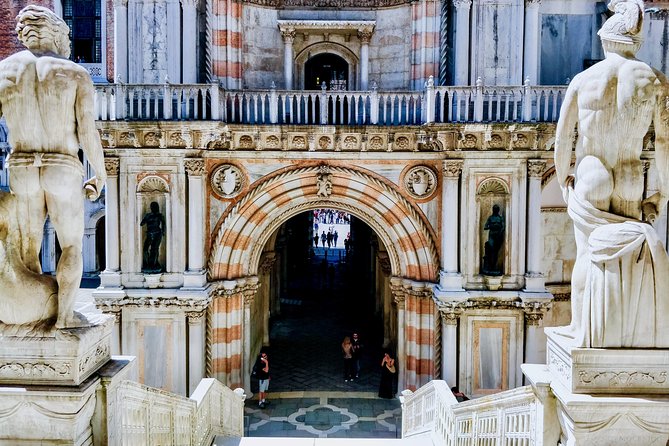
The palace visit continues downward into the basement prison. This shift is one of the tour’s strongest contrasts. You move from ceremonial rooms and painted ceilings to cells that held some of Venice’s most famous criminals.
The prison section adds human consequence to the palace’s grand political story. It shows that the government represented by the decorated rooms also arrested, judged, and confined people. The experience is still guided, so you receive context rather than simply walking through bare chambers.
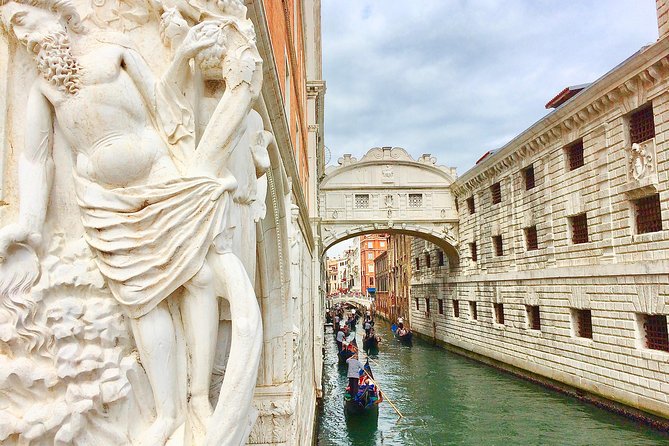
You then cross the enclosed Bridge of Sighs. From inside, you can look down toward the Rio di Palazzo. The bridge is famous, but its name is more meaningful when you understand its purpose as a passage between the palace and prison. The view is part of the experience, but the historical function is the real reason to pay attention.
This is also a practical point in the visit. You are not taking the palace’s Hidden Itineraries tour. Those special routes are specifically excluded, so do not expect access to secret passages or additional restricted rooms.
What your ticket lets you see afterward
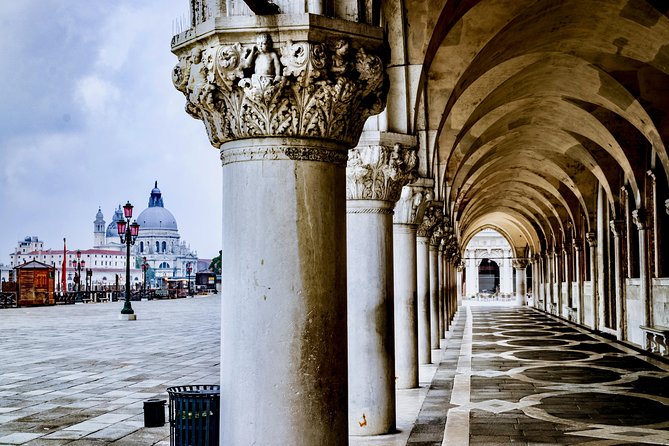
At the end of the guided portion, you leave outside Doge’s Palace at the Carta Gate. Keep your ticket. It also allows you to visit Museo Correr, the Museo Archeologico Nazionale, and the Monumental Rooms of the Biblioteca Nazionale Marciana in Saint Mark’s Square.
These museums are not part of the guided three-hour route. You visit them on your own, and the supplied schedule allows about another hour for that option. This can make the $112.82 price more useful if you have time to stay in the square after the tour.
I would not rush to fit every museum into the same morning. The guided walk and palace already provide a full block of sightseeing. If you are tired, use the ticket later, when you can look at the collections at your own speed.
The added museum access is most valuable for people who want more than a quick palace visit. If your schedule is tight and you plan to leave immediately, the extra admission has less practical value.
Is $112.82 a fair price?
At $112.82 per person, this is not a budget walking tour. You are paying for a three-hour guided experience, admission to Doge’s Palace, skip-the-line access, headsets, and the option to visit three nearby cultural sites afterward.
The value depends on how you normally travel. If you would otherwise buy a palace ticket, wait in line, and arrange a separate walking tour, the combination is convenient. You also get a route that links Castello’s streets with the palace instead of treating the palace as an isolated attraction.
The price is harder to justify if you prefer to wander alone, already have a palace reservation, or want a longer palace visit. The guided palace section lasts about one hour, and the neighborhood stops are mostly exterior. You are paying for explanation and structure, not for several hours inside the palace.
The 20-person limit and headsets improve the experience, but this remains a shared tour. I see it as a good-value choice for a first visit, especially if you want a clear introduction and do not want to manage the palace queue yourself.
Who should book this morning tour?
I would recommend it to first-time visitors who want Venice explained in plain terms. It suits you if you enjoy walking, want to see more than Saint Mark’s Square, and prefer a guide to connect buildings with people and events.
It also works well for history-minded families with older children. Children five and under are free, while children aged six and older pay the full ticket, with a document required. The amount of walking and the palace’s formal presentation may not suit every young child, so consider your group’s energy level.
This is less suitable if you need step-free sightseeing, since the experience involves a moderate amount of walking through Venice. The supplied details say most people can participate, but they do not promise a fully accessible route.
Plan to carry only what you need. Backpacks and large bags are not allowed inside Doge’s Palace. Hotel pickup and drop-off are not included, and food and drinks are your responsibility.
The tour is offered with a guide in English, French, German, or Spanish. The experience information also highlights English, so confirm your chosen language at booking if that matters to you.
Booking, weather, and cancellation details
The tour is booked an average of 19 days in advance, which suggests that early planning is sensible during popular periods. Confirmation is issued at booking, and the activity operates rain or shine.
Free cancellation is available if you cancel at least 24 hours before the local start time. Cancellations or changes made inside that window are not accepted for a refund.
If you are visiting Venice for the day from outside the city, check the official access-fee information before you go. On certain dates, a €5 fee may apply, with exemptions and applicable days listed at cda.ve.it. This fee is separate from the tour.
Should you book Ducal Venice?
Book this tour if you want a guided morning that combines neighborhood streets, historic church squares, Marco Polo’s former home, and the central rooms of Doge’s Palace. The strongest reasons are the skip-the-line entry, the manageable group size, and the guides’ lively approach, with Ilaria and Gina singled out for clear and engaging tours.
Skip it if you want extensive free time, interior visits at every stop, or the palace’s Hidden Itineraries. At $112.82, it asks you to value expert context and saved time. For a first Venice visit, that is a sensible trade, especially when you keep the ticket for the museums around Saint Mark’s Square.
FAQ
What time does the tour start?
The tour starts at 9:00am. You should check in 15 minutes before the booked start time.
Where does the tour begin?
It begins at the TU.RI.VE. Meeting Point on Calle larga dell’Ascension, 30124 Venezia VE, Italy.
Where does the tour end?
The guided tour ends outside Doge’s Palace at the Carta Gate, Piazza San Marco 1.
How long does the experience last?
The guided experience lasts approximately three hours. The neighborhood walking portion takes about two hours, followed by about one hour inside Doge’s Palace.
Is admission to Doge’s Palace included?
Yes. The Doge’s Palace admission fee and skip-the-line entrance are included.
Can I visit other museums with the ticket?
Yes. You can keep the ticket and visit Museo Correr, Museo Archeologico Nazionale, and the Monumental Rooms of the Biblioteca Nazionale Marciana in Saint Mark’s Square on your own.
Are the Hidden Itineraries included?
No. The Hidden Itineraries in Doge’s Palace are not included.
Are children charged for the tour?
Children aged five and under are free. Children aged six and older pay the full ticket, and a document is required.
Can I cancel for a full refund?
Yes, if you cancel at least 24 hours before the experience start time. Cancellations or changes made less than 24 hours before the start are not refunded or accepted.
More Historical Tours in Venice
- Verona: History and Hidden Gems Guided Walking Tour
★ 5.0 · 1,379 reviews - Basilica, Doge’s Palace, History Gallery & Bell Tower Option
★ 5.0 · 586 reviews - Venice: Natural History Museum Entry Ticket
★ 4.7 · 312 reviews - St. Mark’s Cathedral Priority Guided Tour & History Gallery
★ 3.5 · 148 reviews
More Doge's Palace Visits
- Venice: Doge’s Palace Reserved Entry Ticket
★ 4.6 · 42,716 reviews - Doge’s Palace & St. Mark’s Basilica with Terrace Access Tour
★ 4.7 · 10,697 reviews - Venice: Doge’s Palace, St Mark’s Basilica, and Pala d’Oro
★ 4.4 · 6,235 reviews - Legendary Venice: Doge’s Palace, St Mark’s & VIP Terrace Access
★ 4.5 · 5,033 reviews
Just added around Venice
- Padua City Sightseeing Walking Tour of Must-See-Sites with Local Guide★ 5.0 · 3 reviews
- Gondola Ride and St Mark’s Basilica★ 4.5 · 3 reviews
- Padua: Private Pasta-Making Class at a Local’s Home★ 5.0 · 3 reviews
- Venice: Market Tour and Meal at a Local’s Home★ 4.3 · 3 reviews
- VIRTUAL MUSEUM: Creature di Gomma – Venice Vintage Toys★ 4.7 · 3 reviews
- 3 Hour Shared Walking and Aperitivo Tour of Verona★ 5.0 · 3 reviews
- Venice: The Best of Dolomites 3Cime and Refuges with Drone★ 5.0 · 3 reviews
- Verona: Blindfolded Wine Tasting★ 5.0 · 3 reviews
Doge's Palace Tours, compared.
Doge’s Palace & St. Mark’s Basilica with Terrace Access Tour
Read our review →
Doge’s Palace, St Mark’s Basilica, and Pala d’Oro
Read our review →
Legendary Venice: Doge’s Palace, St Mark’s & VIP Terrace Access
Read our review →
St. Mark’s Basilica & Doge’s Palace Tour with Ticket
Read our review →
St Mark’s Basilica, Doge Palace, & Bell Tower Option
Read our review →
Doge’s Palace, Bridge of Sighs & Prisons Guided Tour
Read our review →Browse the lists this tour appears in