
Reviewed · AUDIO TOURS
The Heart of Venice: A Self-Guided Audio Tour
Venice tells its best stories in the spaces between its famous sights. This one-hour GPS audio walk begins in Piazza San Marco and leads you toward Rialto Bridge, linking grand landmarks with smaller corners, a revolt memorial, an opera house, and the city’s tide center. The audio starts as you reach each point, so you can look around instead of staring at a screen.
I like the freedom to set your own pace, and I like that the VoiceMap app includes offline audio, maps, and geodata. The main tradeoff is simple: there is no human guide to answer questions, and the tour is offered only in English.
In This Review
- Key things to know before you book
- Why this audio walk works well in Venice
- Starting in Piazza San Marco
- Campo San Salvador and the memory of revolt
- Carlo Goldoni and ordinary Venetian life
- La Fenice and Venice’s opera tradition
- Palazzo Cavalli and Venice’s daily tides
- Ending at the Rialto Bridge
- What the VoiceMap format is like
- Is $11.99 a fair price?
- Who should choose this tour?
- Should you book The Heart of Venice?
- FAQ
- How long does The Heart of Venice audio tour last?
- Where does the tour start?
- Where does the tour end?
- What language is the audio tour offered in?
- Does the tour include offline maps and audio?
- Is a smartphone included?
- Is transportation or food included?
- Can I cancel for a full refund?
Key things to know before you book
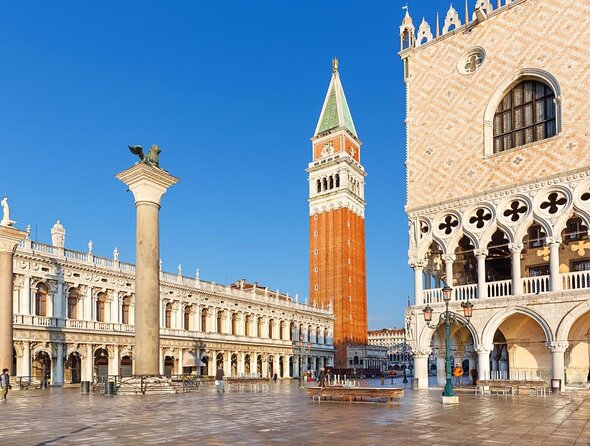
- Piazza San Marco is the opening scene: Hear about papal visits, emperors, public ceremonies, executions, processions, and Carnival in Venice’s grandest public square.
- The audio starts automatically: Location-triggered narration lets you keep walking without constantly checking directions.
- The route ends at Rialto Bridge: You finish beside one of Venice’s most important crossings over the Grand Canal.
- Offline access saves data: Downloaded audio, maps, and geodata are included through the VoiceMap application.
- The price is $11.99 per person: That is good value if you want historical context without paying for a private guide.
- You control the timing: The tour is available any time during the stated operating period, with no fixed group departure.
Why this audio walk works well in Venice
Venice can feel confusing even when you know where you are going. Narrow lanes turn sharply, canals interrupt direct routes, and a short walk on the map can feel much longer on foot. This tour gives you a simple structure: start at Piazza San Marco, follow the route, and finish at Rialto Bridge.
The best part is the way the narration is tied to place. When you reach a listed stop, the audio begins automatically. That keeps the experience more like a walking tour than a collection of recorded facts. You can listen while looking at the buildings around you.
I also like the balance between famous sights and useful local context. Piazza San Marco and La Fenice are major names, but Campo San Salvador and Palazzo Cavalli give the walk more texture. You get stories about public life, theater, politics, marriage services, tides, and the engineering problems that shaped Venice.
This is not a long, all-day tour. At about one hour, it works well as an introduction, a first walk after arriving, or a compact way to connect San Marco with Rialto. You should allow extra time if you want to pause, take photographs, enter a building, or deal with crowds in the square.
A few more Venice days to weigh up
- Venice: Grand Canal Gondola Ride with App Commentary
★ 4.1 · 18,908 reviews - Venice: La Fenice Opera House Entry Ticket with Audio Guide
★ 4.6 · 11,742 reviews - Trieste Bus Tour with Audio Guide
★ 4.5 · 1,648 reviews
Starting in Piazza San Marco
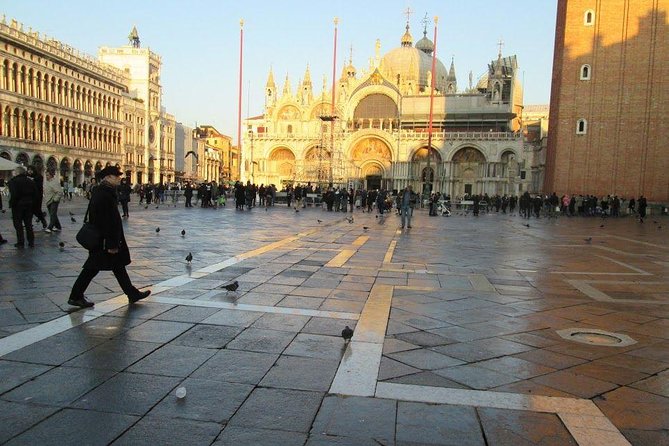
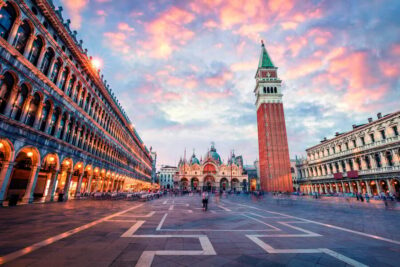
The tour begins at P.za San Marco, 328, in the heart of Venice. Piazza San Marco is not simply a pretty square to cross on the way to somewhere else. For roughly a thousand years, it has been the city’s main public stage.
The audio places the square in its proper role. Popes and emperors came here. Religious processions moved through it. Public executions took place here. Carnival brought elaborate celebration. The square could serve as a place of ceremony, spectacle, power, and entertainment, often within the same broad setting.
That context changes how you look at the space. Instead of seeing only cafés, arcades, and grand façades, you begin to notice how carefully the square was built for public display. Venice wanted visitors and citizens alike to feel the authority of the city as soon as they reached its central room.
Give yourself a few minutes here before following the route. The stated duration is approximate, and Piazza San Marco is the one stop where you may naturally want more time. The audio provides the story, but your own attention does the rest.
A practical point: the start is in one of Venice’s most central and heavily visited locations, so finding the exact starting point may take a moment. The app provides directions to the start, and the tour begins when you are in the correct place.
Campo San Salvador and the memory of revolt
The route continues to Campo San Salvador, a smaller square with a tall marble column at its center. The column was installed in 1898 to commemorate Venice’s 17-month revolt against Austrian occupation in 1848 and 1849.
This stop gives the walk a political edge. Venice is often presented through art, palaces, music, and canals, but the city also has a long record of conflict and changing rule. A single column can be easy to overlook when you are hurrying between major sights. The audio tells you why it is there.
I find this kind of stop especially useful on a self-guided walk. A human guide might point it out in passing, but when you are alone, a location-triggered explanation makes sure the memorial does not disappear into the background.
Do not expect an attraction with admission or a large interior visit here. The value is in understanding the square and its monument. You are looking at a piece of civic memory, not checking off another grand building.
Carlo Goldoni and ordinary Venetian life
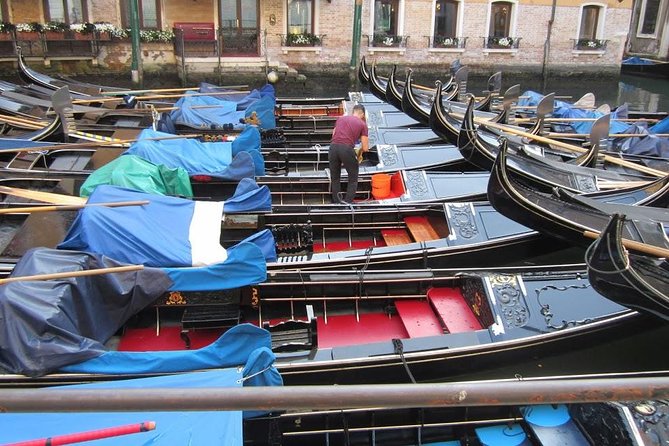
One stop brings you to the Teatro Comunale Carlo Goldoni, named for the Venetian playwright of the 1700s. Goldoni wrote comedies in the Venetian dialect and helped change theater by presenting characters as recognizable people rather than distant comic types.
His work highlighted the quirks of ordinary Venetians with affection. That detail matters because it brings the city down from its official monuments to its daily voices and personalities.
The theater stop also adds variety. You have just heard about a political memorial, and now the route turns to performance and language. Venice’s identity was shaped not only in government buildings and churches but also in comedy, speech, and public entertainment.
The tour does not include a theater performance or an admission ticket. It is an exterior and historical stop, so you should book it for the story rather than access to the building.
A different sort of day out around Venice:
- Venice: Doge’s Palace Reserved Entry Ticket
★ 4.6 · 42,716 reviews - Boat Trip: Glimpse of Murano, Torcello & Burano Islands
★ 4.3 · 15,699 reviews - Venice: Grand Canal by Gondola with Live Commentary
★ 4.1 · 13,681 reviews - Doge’s Palace & St. Mark’s Basilica with Terrace Access Tour
★ 4.7 · 10,697 reviews
La Fenice and Venice’s opera tradition
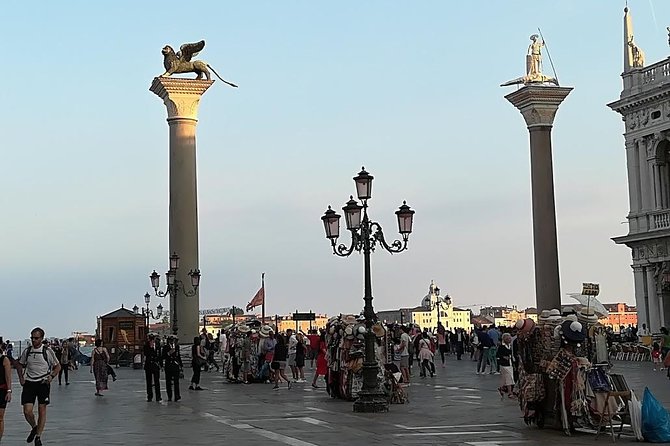
The next major cultural stop is La Fenice, one of Italy’s important opera houses. Several famous operas had their first performances here, including Rigoletto and La Traviata.
Even if opera is not high on your personal list, La Fenice gives the route a strong sense of place. The name is tied to Venice’s long role as a center for music and theater. The stop also shows why a walking tour can be more useful than a simple map. A map can tell you where the opera house is. The audio explains why it matters.
The tour does not include admission to La Fenice. That keeps the price low, but it also means you should not expect an interior visit as part of the one-hour route. If you plan to attend a performance or take a separate tour, this audio stop can serve as a compact introduction.
Because the walk is self-guided, you can pause outside the theater if the narration gives you a reason to look more closely. You are not holding up a group, and you do not need to keep pace with a guide.
Palazzo Cavalli and Venice’s daily tides
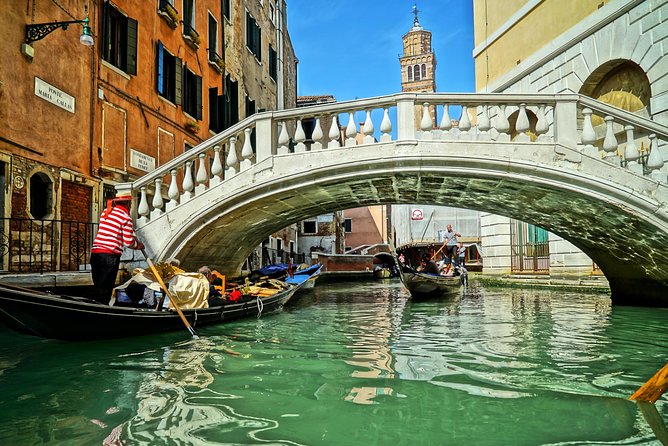
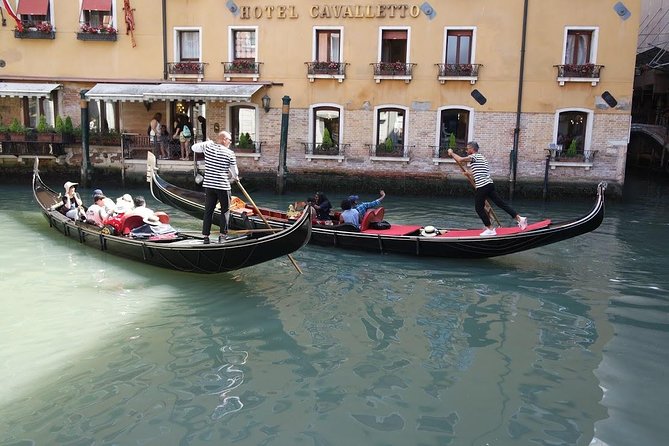
Palazzo Cavalli offers one of the most unusual stops on the route. It is where civil marriage services are conducted, and it also houses offices for the Centro Maree, or Tide Center.
The Tide Center monitors weather and tide data and prepares daily predictions, especially for acqua alta, or high water. This is a practical part of Venetian life that many short sightseeing walks skip.
The stop helps explain why water is not just a scenic feature in Venice. Tides affect how the city functions, how people move through it, and how officials prepare for high water. You may look at a canal and see beauty. The Tide Center reminds you that Venetians also see schedules, measurements, warnings, and daily planning.
Palazzo Cavalli also ties public administration to personal life. The same stop connects wedding services with tide forecasts, two very different duties carried out in the same historic building. That contrast makes it one of the more memorable points on the route.
There is no admission to the building included. You are hearing the explanation from outside or from the route location, so plan accordingly.
Ending at the Rialto Bridge
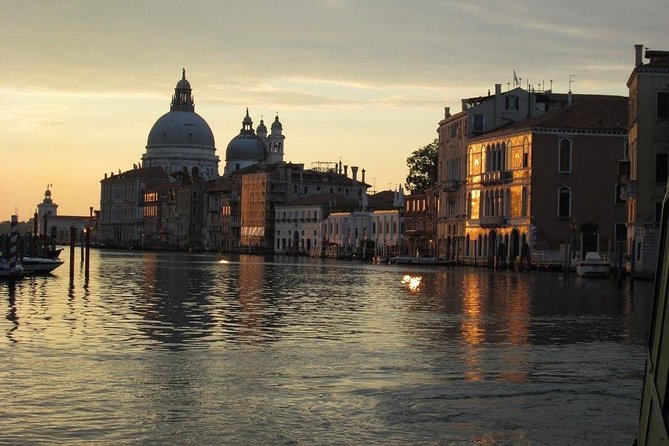
The final stop is Rialto Bridge, Ponte de Rialto. It is the third bridge of its kind at this crossing. Earlier Rialto bridges were made of wood and included bascule sections, meaning the center could be raised to let ships with masts pass through.
That detail turns the bridge into more than a famous photo stop. It shows how Venice had to adapt its crossings to shipping, trade, and the practical demands of a city built around canals.
Ending here makes good sense. You begin in the ceremonial center at Piazza San Marco and finish at one of Venice’s best-known transport and commercial crossings. The route creates a clear line through the city, even though Venice itself rarely feels linear.
Rialto Bridge is also a useful place to continue your day. The tour itself ends there, but the location gives you a central point for further independent exploration. The experience does not include transportation, meals, or personal expenses, so you are free to decide what comes next.
What the VoiceMap format is like
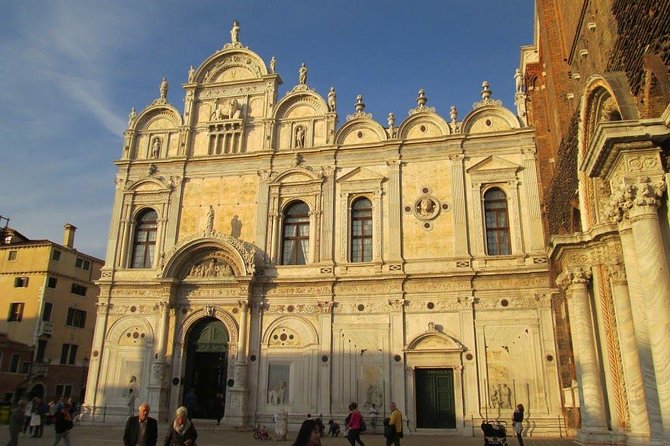
The VoiceMap application is the heart of this experience. You download the audio, maps, and geodata for offline use, then follow the route with your phone. That matters in Venice, where relying on a constant mobile connection can be inconvenient or costly.
The automatic playback is the feature I value most. You do not need to stop at every corner to find the next paragraph or press play at each landmark. The app uses your position to deliver the relevant section when you reach the right place.
The format also makes the tour private by default. Only your group participates, and there is no fixed departure time or group meeting beyond getting to the starting point. You can pause, walk slowly, or stop for photographs without affecting anyone else.
The limitation is that the experience depends on your smartphone. A phone is not provided, and the tour is offered only in English. You also need to be comfortable following app directions and listening while walking.
The audio is described as easy to understand, and the strongest praise for the format centers on its simple interface and the ability to explore independently. That makes it a good fit if you want guidance without a guide beside you.
Is $11.99 a fair price?
At $11.99 per person, this is a modest-cost way to add structure and context to a walk between two major Venetian sights. You are not paying for a vehicle, a meal, a live guide, or building admissions. You are paying for the route, narration, app access, and location-based information.
For me, the value depends on how you like to sightsee. If you want a personal conversation with a local guide, the format will feel limited. If you mainly want clear directions and stories at the right places, the price is easy to justify.
Lifetime access is another useful part of the deal. You can use the tour during your visit and retain access afterward, rather than treating it as a one-time recording that disappears at the end of the day.
The one-hour length also keeps the commitment small. You can fit it into a morning or afternoon without giving up an entire day. Just remember that the listed time is approximate, and the route can take longer if you linger.
Who should choose this tour?
I would recommend it most strongly to independent visitors who want historical context but do not want a fixed group schedule. It also suits couples, families, and small private groups that prefer to stop when they wish.
It is a practical choice for a first visit because it connects several types of Venetian story: public ceremony, foreign occupation, theater, opera, civil administration, tides, and bridge design. It gives you a framework without trying to explain all of Venice in one sitting.
You may want something else if you need a live guide, detailed answers to spontaneous questions, or access to interiors. The tour is also less suitable if you do not want to use a smartphone or if you need narration in a language other than English.
Service animals are allowed, and the activity is near public transportation. Most people can participate, according to the supplied participation information. On certain dates, day visitors staying outside Venice may also need to pay a €5 access fee to enter the city. Check the official cda.ve.it site for applicable dates and exemptions.
You can cancel for a full refund up to 24 hours before the local start time. Cancellations or changes made within 24 hours are not accepted for a refund.
Should you book The Heart of Venice?
Book it if you want a low-cost, private walking introduction that lets you explore at your own speed. The route is strongest when you use the audio as a prompt to look more closely at places you might otherwise pass without noticing.
The automatic playback, offline maps, and simple route from Piazza San Marco to Rialto Bridge make the experience easy to manage. I especially like the range of subjects, from Carnival and imperial visits to Venetian theater and acqua alta.
Skip it if your ideal sightseeing experience requires a live person, a longer route, or included admissions. For everyone else, $11.99 is a sensible price for a self-guided hour in central Venice, with enough practical flexibility to fit around the rest of your day.
FAQ
How long does The Heart of Venice audio tour last?
The tour lasts approximately one hour.
Where does the tour start?
It starts at P.za San Marco, 328, 30124 Venezia VE, Italy, in Piazza San Marco.
Where does the tour end?
The tour ends at Rialto Bridge, Ponte de Rialto, 30100 Venice, Italy.
What language is the audio tour offered in?
The tour is offered in English.
Does the tour include offline maps and audio?
Yes. The VoiceMap application includes offline access to the audio, maps, and geodata, so you do not need to use mobile data during the walk.
Is a smartphone included?
No. You must provide your own smartphone.
Is transportation or food included?
No. Transportation, food, drinks, and personal expenses are not included. Admission fees are also not included when applicable.
Can I cancel for a full refund?
Yes. You can cancel at least 24 hours before the local start time for a full refund. Cancellations and changes made less than 24 hours before the start time are not accepted for a refund.
Just added around Venice
- Padua: Private Pasta-Making Class at a Local’s Home★ 5.0 · 3 reviews
- Padua City Sightseeing Walking Tour of Must-See-Sites with Local Guide★ 5.0 · 3 reviews
- Gondola Ride and St Mark’s Basilica★ 4.5 · 3 reviews
- Venice: Market Tour and Meal at a Local’s Home★ 4.3 · 3 reviews
- VIRTUAL MUSEUM: Creature di Gomma – Venice Vintage Toys★ 4.7 · 3 reviews
- 3 Hour Shared Walking and Aperitivo Tour of Verona★ 5.0 · 3 reviews
- Venice: The Best of Dolomites 3Cime and Refuges with Drone★ 5.0 · 3 reviews
- Verona: Blindfolded Wine Tasting★ 5.0 · 3 reviews
Audio Tours, compared.

La Fenice Opera House Entry Ticket with Audio Guide
Read our review →
Juliet’s House Fast-Track Entry Ticket & Audio Guide
Read our review →
Gondola Tour under the Bridge of Sighs & Audio Guide
Read our review →
St. Mark’s Basilica Priority Ticket and Audio Guide
Read our review →
Miramare Castle & Museum Entry Ticket & Audio App
Read our review →Browse the lists this tour appears in